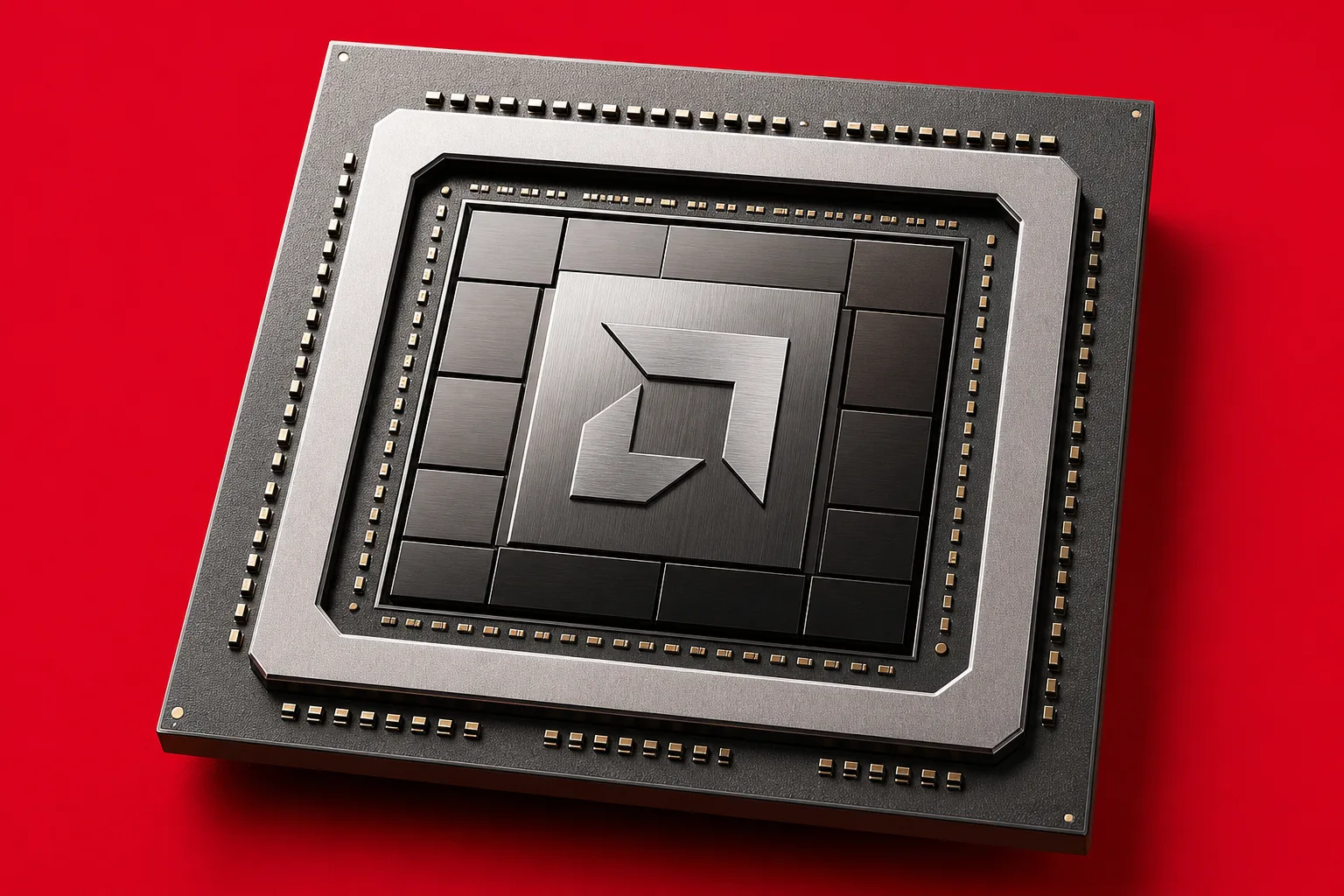
AMD stock fell sharply to $577.31 on October 15, sliding 4.66% by late morning and briefly dropping as low as $576.01. The move erased the prior session’s gain and pushed the company’s market value back below the $1 trillion threshold that had recently become a key psychological marker for investors.
The selloff came as the 10-year U.S. Treasury yield climbed to 5.278%, increasing pressure on high-multiple growth stocks. For AMD, the decline highlighted a central tension in the name: operating momentum remains strong, but the valuation leaves little room for macro disappointment.
Even after the pullback, AMD remains one of the market’s biggest AI winners, with shares up 182.8% year to date and 175% over the past 12 months. The question now is whether accelerating data center revenue, large AI infrastructure commitments and the Helios rack rollout can continue to justify that premium.
Key Facts
- AMD traded at $577.31, down $28.22 or 4.66%, after opening at $589.57 and touching an intraday low of $576.01.
- The company reported second-quarter revenue of $11.5 billion, up 50% year over year, while Data Center revenue rose 107% to $6.718 billion.
- AMD guided third-quarter revenue to $13.0 billion, plus or minus $300 million, implying about 41% annual growth at the midpoint.
- At $577.31 and 1.63 billion shares outstanding, AMD’s market capitalization stood near $943.62 billion, below the $613.50 share price needed to support a $1 trillion valuation.
- The 10-year Treasury yield rose to 5.278%, a key headwind for AMD, which trades near 50 times forward earnings and carries a beta of 2.45.
AMD stock and the AI data center trade
The immediate trigger for the drop was macro pressure. Higher Treasury yields tend to hit long-duration growth stocks hardest, especially companies whose valuations depend on earnings years into the future. AMD fits that profile more than most large semiconductor peers. Its premium multiple reflects confidence that AI-related revenue, particularly in Data Center, will keep expanding at a rapid pace through 2027.
That confidence is not without support. AMD’s latest quarterly results showed a business that is increasingly centered on AI infrastructure rather than its older identity as a PC and gaming chip designer. Data Center revenue reached $6.718 billion in the second quarter, accounting for 58% of total sales, up from 42% a year earlier. The segment is being driven by EPYC server processors and Instinct accelerators, two product families that are now central to the company’s growth narrative.
The market is also looking ahead to the next phase of that strategy: rack-scale systems. Helios, AMD’s full AI rack platform, is meant to deepen its challenge to Nvidia by selling more of the system stack rather than individual chips alone. If Helios shipments ramp on schedule and major customers convert commitments into deployments, AMD could sustain a much larger revenue base by 2027. If timing slips, the stock’s valuation could come under renewed pressure.
AMD’s business is accelerating, but its valuation remains highly exposed to higher rates, delivery timing and the market’s rising expectations for AI infrastructure.
Why Helios and 2027 matter so much
Helios has become the centerpiece of AMD’s forward story because it ties product execution to unusually large customer commitments. Each rack links 72 Instinct MI455X GPUs, 18 sixth-generation EPYC CPUs and networking components into a rack-scale AI system designed for hyperscale workloads. Management has framed the platform as a major step toward competing at the systems level in training and inference.
AMD has also outlined an aggressive medium-term target: Data Center revenue is expected to more than double in 2027. That forecast is supported by large commitments from OpenAI, Meta and Anthropic, as well as cloud exposure through Oracle and Microsoft. The scale is striking, but so is the concentration risk. A small number of customers account for much of the forward AI revenue that investors are pricing into the shares.
Implications for Investors
For investors, AMD presents a classic high-conviction growth setup with little margin for error. On one side of the ledger, the company is delivering strong top-line growth, expanding margins and significant share gains in servers. It also has a visible roadmap in AI accelerators, rack systems and CPUs, supported by a healthy balance sheet that included $13.1 billion in cash and investments and $1.6 billion in free cash flow in the latest quarter.
On the other side, valuation risk is impossible to ignore. AMD was trading near 148 times trailing earnings and roughly 50 times forward earnings at the levels cited in the selloff. Those multiples can remain elevated when revenue growth is accelerating, but they can compress quickly when bond yields rise or quarterly guidance lands only in line with expectations. The stock’s beta of 2.45 means those moves can be amplified during broader semiconductor or market weakness.
Key watch points now center on execution and timing. Investors will be focused on the November 3 earnings report for evidence that third-quarter revenue tracks toward the top end of guidance, that Helios shipments are appearing in results, and that the 2027 Data Center doubling target remains intact. They will also be listening for commentary on advanced packaging capacity, supply constraints and customer deployment schedules, especially among the largest AI buyers.
Another factor is mix. AMD’s GPU business gets most of the headlines, but the EPYC server CPU franchise may provide an important stabilizer. The company said server CPU revenue should grow more than 80% year over year in the second half of 2026 and more than 70% in 2027. If that momentum continues, it could help cushion volatility if AI accelerator ramps become uneven quarter to quarter.
In the near term, technical levels may matter almost as much as fundamentals. The stock’s recent decline put attention on the $560 area as a possible support zone, while reclaiming $605.53 and then $613.50 would be important signs that momentum is recovering. Until then, AMD is likely to remain highly sensitive to bond yields, semiconductor sentiment and any signals from major foundry and cloud partners.
AMD still has one of the strongest growth stories in large-cap semiconductors, but the next leg higher will likely require flawless execution rather than enthusiasm alone. Investors should expect continued volatility as the market tests whether AI demand can outrun valuation pressure.