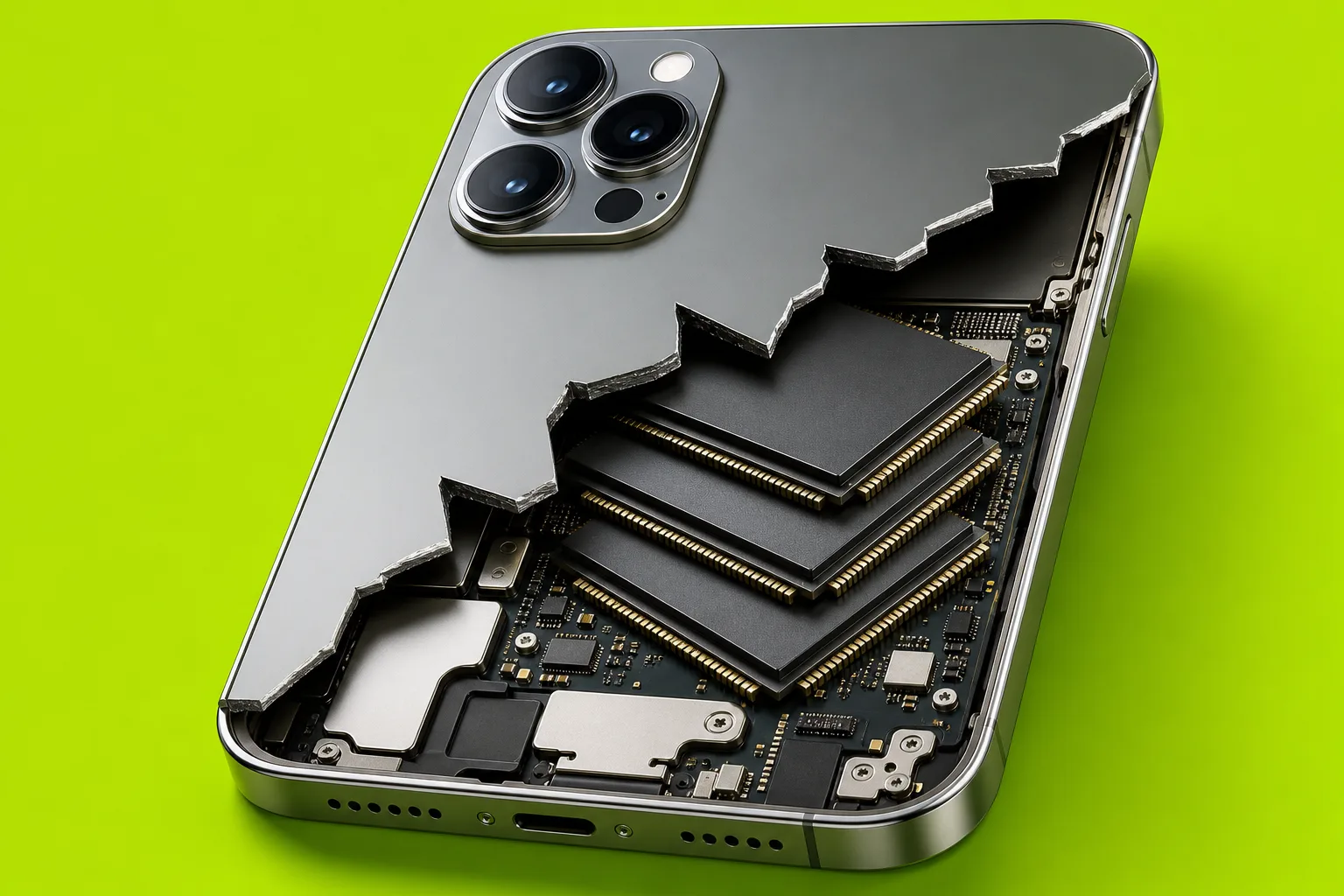
Apple shares fell 2.07% to $333.38 in late Friday morning trading, wiping roughly $103 billion from the company’s market value and jolting investors who had been pricing in another strong iPhone cycle.
The selloff followed a report that Apple cut October component orders for the iPhone 18 Pro and iPhone 18 Pro Max by at least 15%, with some parts reduced as much as 20%. For a stock trading near record highs and at a premium valuation, even a narrow supply-chain signal was enough to trigger a repricing.
The key issue is not just production. It is whether Apple can preserve demand after lifting Pro model prices by $100 while memory-chip inflation pressures gross margin guidance into the 47% to 48% range.
Key Facts
- Apple stock traded at $333.38, down $7.05 or 2.07%, after closing at $340.42 the prior session.
- The decline cut about $103 billion from Apple’s market capitalization, leaving the company valued near $4.865 trillion.
- October component orders for the iPhone 18 Pro and Pro Max were reportedly reduced by 15% to 20% from original plans.
- Apple’s fiscal June-quarter revenue was $109.4 billion, with iPhone sales contributing $54.25 billion, or 49.6% of total revenue.
- Apple guided September-quarter gross margin to 47% to 48%, after an underlying 48.1% margin in the June quarter.
Apple stock and iPhone 18 Pro demand
The market reaction reflects how tightly Apple’s valuation is tied to confidence in the iPhone franchise. At roughly 38.6 times trailing earnings, the shares trade well above a five-year median multiple of 30.98. That premium leaves little room for uncertainty around the company’s most important product, particularly when the Pro lineup carries the strongest profitability.
The immediate concern is that higher prices may be meeting softer consumer demand. The iPhone 18 Pro starts at $1,199 and the Pro Max at $1,299, both $100 above prior comparable models. Apple raised prices as soaring memory-chip costs squeezed margins, but investors now have an early signal that the trade-off between pricing and volume may be getting harder to manage.
There is, however, another interpretation. Apple changed the shape of this product cycle by launching premium devices first and delaying lower-priced models until early 2027. That means October order patterns may look weaker than in prior years simply because the standard iPhone volume has shifted out of the holiday window. The question for investors is whether this is a timing adjustment or the first sign of a weaker cycle.
For Apple, the market is no longer asking whether margins are under pressure; it is asking whether the company can raise prices without denting demand for its most profitable iPhones.
Why memory costs matter so much
Apple’s own financial guidance already showed the pressure building. In the June quarter, gross margin reached 50.1%, but that figure included a two-point benefit from tariff refunds. Excluding that one-time item, underlying gross margin was 48.1%. For the September quarter, Apple guided to 47% to 48%, including one point of refund benefit, implying a real step down in profitability.
Management had previously indicated that rising memory pricing was responsible for more than 100% of the margin compression at the midpoint of guidance. In effect, other cost factors were moving favorably, but DRAM and related memory inputs more than offset those gains. That puts unusual weight on the iPhone 18 pricing strategy, because Apple either passes through higher costs, absorbs them, or adjusts device specifications.
The order cuts also arrived unusually early in the launch cycle. In stronger iPhone cycles, October often brings upward revisions as demand outruns initial supply. A reduction in the first full month after launch suggests demand and supply may be converging faster than Apple initially expected, though one month of supplier data is still far from conclusive evidence of a failed cycle.
Implications for Investors
For shareholders, the most important near-term catalyst is holiday-quarter guidance. The September-quarter results due at the end of October may offer limited clarity because the reported order changes affect October production and therefore the December quarter. Investors should focus on three variables: revenue growth for the holiday period, gross margin outlook, and any management commentary on how the staggered launch is affecting demand patterns.
If Apple can guide to holiday-quarter growth near the high single digits while holding margin near the current range, the market may conclude the October order cuts were largely a calendar and mix issue. If guidance points to only mid-single-digit growth or margin pressure below 47%, the current valuation could come under more sustained pressure. At this multiple, even modest disappointment can have an outsized effect on the share price.
There are still offsets that matter for long-term investors. Services generated $30.74 billion in the June quarter and carry a gross margin of 75.6%, providing a stabilizing earnings base even if hardware demand softens. Apple also repurchased $25.8 billion of stock in the quarter, and that steady capital return helps cushion downside in weaker product periods. But buybacks and services strength do not eliminate valuation risk when the market begins to question iPhone pricing power.
The supplier read-through is also worth monitoring. Skyworks Solutions fell 5.89% to $75.99, while Qualcomm slipped 1.14% to $174.01, suggesting investors see more immediate volume risk for companies tied closely to handset builds. Carrier conditions are another secondary factor, since weaker promotional support from wireless operators could make premium phones harder to move at elevated prices.
Apple remains one of the market’s most profitable and resilient large-cap technology companies, but this episode shows how quickly sentiment can shift when a premium multiple meets early signs of uncertainty. The next earnings call will be critical in determining whether the iPhone 18 Pro order cuts are a brief adjustment or the start of a broader reset in expectations.