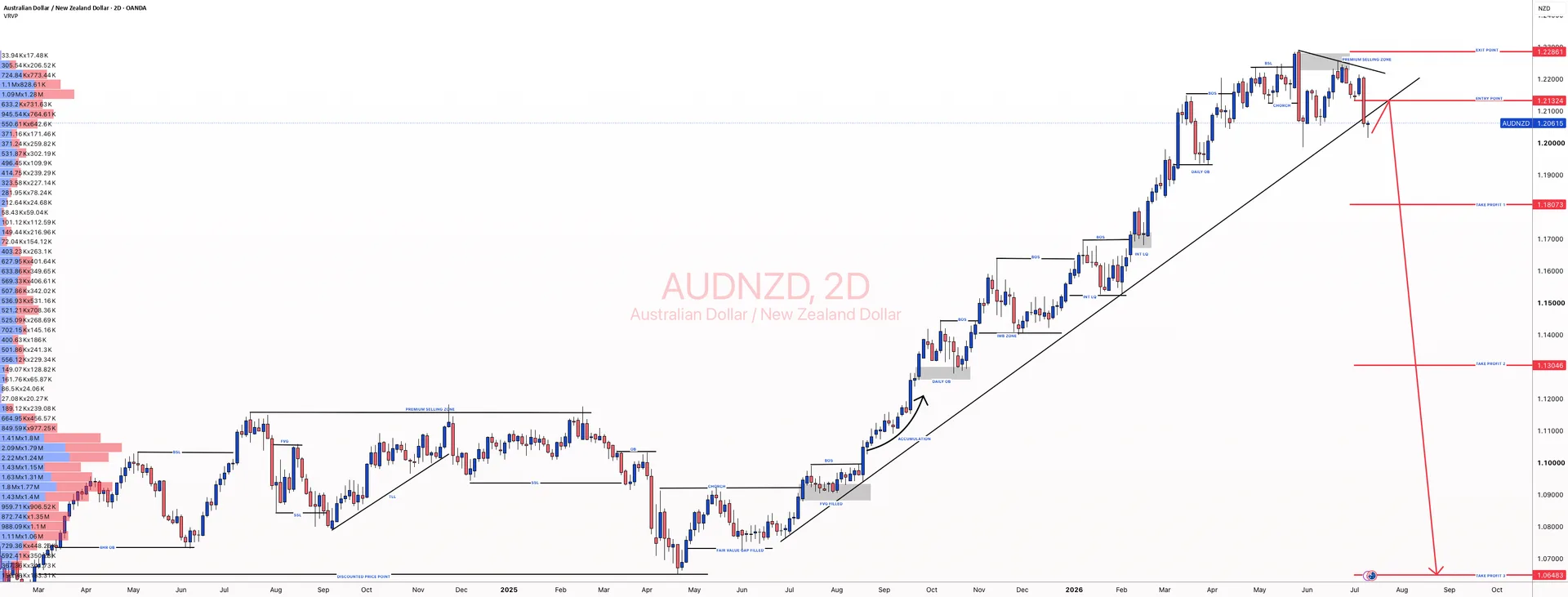
AUDNZD is holding a bearish bias, with market attention centered on whether the cross can sustain another leg lower. The key theme is renewed downside pressure driven by the possibility of relative New Zealand dollar strength against the Australian dollar.
For AUDNZD, the most important factor is not a single chart pattern but the broader directional structure: rebounds may remain vulnerable unless buyers can reclaim nearby resistance and shift short-term momentum.
Market Snapshot
AUDNZD is a forex cross being assessed through a swing-trading lens, with the focus on the coming days to weeks rather than very short-term intraday moves. The current structure points to a market that may be struggling to build durable upside follow-through, leaving the broader tone tilted to the downside.
In plain English, the prevailing bias is bearish. If the New Zealand dollar begins to outperform again while the Australian dollar loses traction, AUDNZD could extend lower and continue a broader corrective phase.
Key Levels
- Support: Recent swing lows and the next lower reaction zone should be watched as the first area where bearish momentum may pause or accelerate.
- Resistance: The latest rebound highs and the near-term supply zone above current price action remain the main barrier that bulls would need to recover.
These levels matter because they frame the current battle between trend continuation and attempted recovery. Prior reaction areas often attract liquidity, and any repeat rejection from resistance or clean break of support could help define the next directional move.
Bullish Scenario
A bullish scenario would require AUDNZD to stabilize and reclaim near-term resistance with enough conviction to invalidate the immediate bearish structure. If buyers can push the pair above the latest rebound zone, that could open the door to a recovery toward the next visible supply area and force a reassessment of the current downside bias.
Even in that case, any upside would likely need confirmation from stronger Australian dollar performance or fading New Zealand dollar strength. Without that trigger, rallies may continue to look corrective rather than the start of a lasting trend reversal.
Bearish Scenario
The bearish path remains the primary scenario. If AUDNZD fails to overcome resistance and sellers regain control, the pair could roll over and target a retest of recent lows, with scope for extension into the next lower support zone over the coming sessions or weeks.
The practical invalidation point for this bearish view is a sustained break above near-term resistance that disrupts the sequence of lower highs or weak rebounds. Until that happens, the broader expectation remains for downside continuation, especially if the cross starts to accelerate lower on renewed NZD outperformance.
What to Watch
Macro catalysts will matter for AUDNZD because this cross is highly sensitive to relative rate expectations and regional economic signals. Traders will be watching Australia- and New Zealand-related data releases, central bank commentary, and any changes in expectations around growth, inflation, or monetary policy.
Session timing is also important. AUDNZD often becomes more active during the Asia-Pacific trading window, when local news flow and regional liquidity can produce clearer directional moves. A sharp move during those hours may carry more weight than a drift seen in quieter market conditions.
Correlated assets and broader sentiment should remain on the radar as well. Commodity-linked currency behavior, risk appetite across global markets, and the relative performance of AUD and NZD against the US dollar can all provide context for whether bearish momentum in AUDNZD is building or fading.
AUDNZD remains tilted to the downside, but confirmation around support and resistance will be critical in defining the next move. Price action in the coming sessions should clarify whether the pair is preparing for a deeper decline or simply consolidating before a broader reassessment.