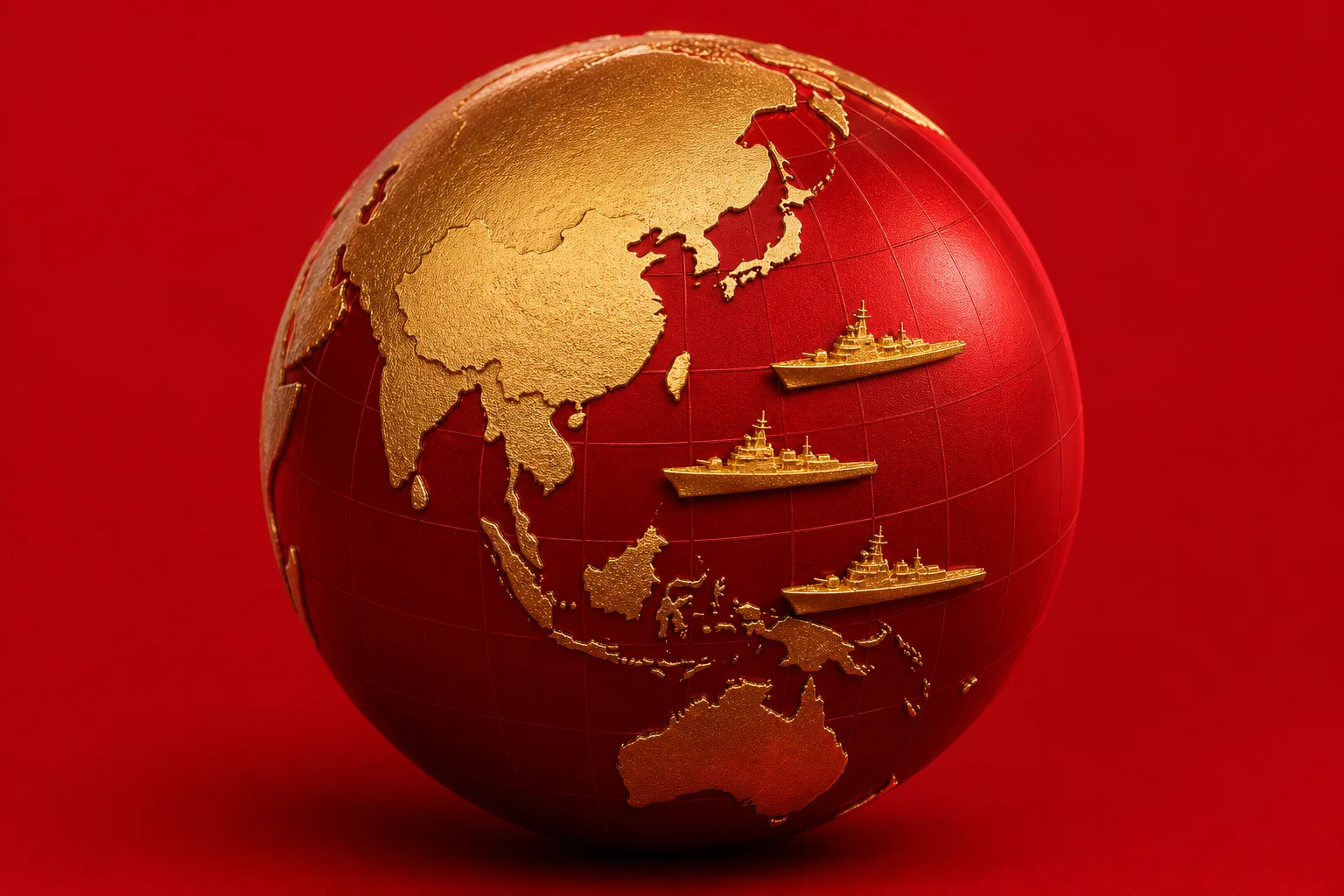
China military pressure on Taiwan is rising at a moment when Beijing’s armed forces are also navigating an unusually deep leadership shake-up. The tension is not centered on an immediate amphibious invasion, but on sustained coercion: near-daily operations, maritime patrols, and pressure tactics designed to strain Taiwan without crossing into open war.
The most striking data point is the hollowing out of the top command. The seven-member Central Military Commission, the body that formally oversees China’s military, is reported to be down to just two members after a series of expulsions and investigations.
That combination—a thinner chain of command and more aggressive activity near Taiwan—matters far beyond regional security. It raises the risk of miscalculation in one of the world’s most important trade corridors and sharpens investor focus on semiconductors, shipping, defense spending, and geopolitical hedging across Asia.
Key Facts
- The seven-member Central Military Commission is reported to have been reduced to just two members after purges and investigations.
- In October 2025, nine senior military officers, including Vice Chairman He Weidong, were expelled from the Communist Party and the military.
- In January 2026, investigations were announced into Zhang Youxia and Liu Zhenli, the chief of the Joint Staff Department.
- Taiwan’s defense budget for 2027 is set to exceed NT$1 trillion, or about $32 billion, for the first time.
- Taiwan’s security officials identified July through September as a typical period of elevated Chinese military exercise activity, with four Chinese naval formations detected in the western Pacific in July 2026.
China Military Pressure on Taiwan
The core issue is not simply that Beijing is increasing military activity around Taiwan. It is that this pressure appears to be unfolding while the People’s Liberation Army faces a broad leadership vacuum. Analysts cited in the underlying reporting argue that political loyalty is taking priority over battlefield competence, creating a command environment that may be less flexible and potentially less disciplined in a crisis.
For Taiwan, the practical effect is a more persistent gray-zone campaign. Beijing has increasingly blended military drills, combat-readiness patrols, and coast guard operations, producing a form of pressure that remains below the threshold of outright war. Such tactics can test Taiwan’s response times, wear down readiness, and normalize a larger Chinese presence around the island.
For markets, this matters because gray-zone operations can still disrupt trade expectations and risk pricing even without a formal conflict. The Taiwan Strait is central to global supply chains, and any increase in military unpredictability can affect shipping insurance, freight routes, electronics manufacturing sentiment, and demand for regional defense spending. The concern is not only a deliberate order to attack, but the possibility that a weaker command structure could mishandle an incident at sea or in the air.
Beijing may have fewer options than its rhetoric suggests, but sustained pressure on Taiwan can become more dangerous when military coercion outpaces command stability.
Why a Blockade Scenario Is Drawing Attention
Taiwan’s defense establishment has assessed that China still lacks some of the capabilities needed for a full-scale amphibious invasion. That does not remove the threat. A maritime isolation campaign, partial blockade, missile strikes, cyber operations, or information warfare could all be used to raise the cost of resistance while stopping short of a landing operation.
A blockade-style approach is especially relevant for investors because it could be framed as an extension of exercises or law-enforcement activity rather than the opening phase of declared war. That ambiguity complicates responses by Taiwan and its partners. If Taipei reacts too weakly, Beijing could gradually expand operational control. If it reacts too forcefully, China could attempt to cast Taiwan as the escalatory actor.
Implications for Investors
The first implication is that markets may need to price a longer period of elevated Taiwan Strait risk rather than a single binary invasion scenario. That distinction matters. Repeated military harassment, coast guard deployments, and exercises can weigh on sentiment in shipping, logistics, airlines, and trade-sensitive manufacturers even when no open conflict occurs.
The second implication is sector-specific. Semiconductor supply chains remain the most obvious exposure, given Taiwan’s central role in advanced chip production. Any reduction in warning time around the island, or any pattern of operations that complicates maritime access, could intensify customer diversification efforts, inventory buffering, and capital spending outside Taiwan. Defense names, drone technologies, cyber resilience providers, and companies tied to unmanned systems may also draw greater attention as Taiwan boosts domestic security investment.
The third implication is policy and currency risk across the region. Taiwan’s planned defense budget above NT$1 trillion signals a sustained increase in spending on unmanned systems, artificial intelligence, and domestic defense capabilities. Investors should watch whether neighboring economies respond with their own procurement increases, export-control adjustments, or contingency planning for shipping lanes. Any sign that military signaling is becoming less predictable could feed volatility in Asian equities, regional currencies, and transport costs.
Key watch points include the pace of further PLA personnel changes, the frequency and geography of Chinese naval formations in the western Pacific, the mix of coast guard and military activity, and any evidence of logistical mobilization that would suggest movement beyond gray-zone coercion. A command system under stress does not automatically point to war, but it can narrow the margin for error.
For now, the balance of evidence suggests continued military intimidation rather than an imminent invasion. Even so, a prolonged campaign of pressure around Taiwan is enough to keep geopolitical risk elevated and force investors to reassess exposure to one of the most strategically important chokepoints in the global economy.