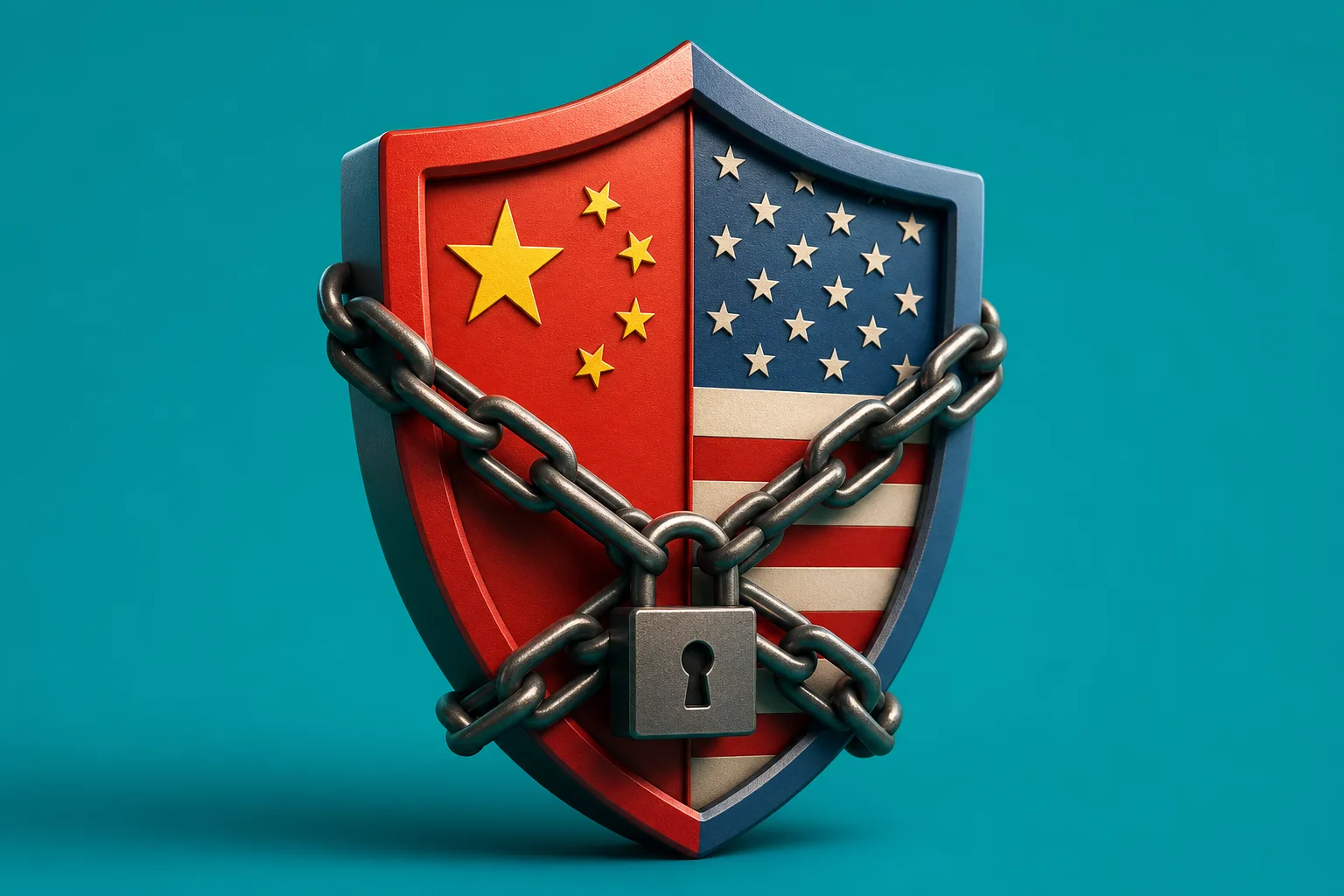
China sanctions 10 U.S. firms and restricts 46 others from government procurement, marking a sharper turn in the latest phase of U.S.-China commercial retaliation. The move is notable not only for its scale, but for the inclusion of rare earth companies MP Materials and USA Rare Earth.
The measures took effect immediately on June 22, 2026, and arrive just weeks after the Pentagon expanded its list of Chinese military-linked companies on June 9. While the two governments have tried to stabilize ties, the latest actions show strategic sectors remain firmly in the firing line.
For investors, the central issue is not just diplomacy. It is whether export controls on dual-use items and procurement restrictions begin to disrupt capital spending, defense supply chains, and the long-running effort by U.S. producers to reduce dependence on China in rare earths and magnets.
Key Facts
- China added 10 American companies to its export control list on June 22, 2026, including MP Materials and USA Rare Earth.
- China also restricted 46 U.S. firms from government procurement, with the curbs taking effect immediately.
- The U.S. expanded its Chinese military-linked company list on June 9, 2026, adding groups including Alibaba, Baidu, BYD and Nio.
- The 46-company procurement list includes Lockheed Martin, Raytheon Missiles & Defence, General Atomics Aeronautical Systems, Boeing Defence, Space & Security and General Dynamics Land Systems.
- China’s export control order prohibits shipments of dual-use items to the 10 named firms and requires any covered in-progress exports to stop.
China sanctions 10 U.S. firms
Beijing framed the action as a legal response under its export control regime for dual-use goods, citing national security and non-proliferation obligations. In practical terms, exporters are barred from supplying covered items to the 10 listed entities, and third parties are also prohibited from transferring China-origin dual-use items to them. That broad language matters because it reaches beyond direct China-to-U.S. trade and could complicate procurement through intermediaries or overseas partners.
The named entities span defense, aerospace, robotics, drones, maritime systems and critical minerals. The list includes AVEOX, Red Cat Holdings and Teal Drones, IMSAR, Jaia Robotics, Ball Aerospace & Technologies, Oshkosh Defense, L3Harris Maritime Services, MP Materials and USA Rare Earth. Several defense-linked companies had already faced prior Chinese curbs tied to U.S. arms sales to Taiwan, but adding rare earth players introduces a different signal: China is willing to apply pressure where the U.S. has been investing to build strategic industrial independence.
That is why the inclusion of MP Materials and USA Rare Earth stands out. MP Materials is one of the most important U.S. rare earth miners and processors and has backing linked to Pentagon efforts to strengthen domestic supply. USA Rare Earth is earlier in its development cycle, but it is also part of the broader U.S. push to build non-Chinese capacity in magnets and critical materials. Even if near-term commercial effects are limited, the symbolism is powerful because rare earths sit at the crossroads of defense, electric vehicles, electronics and energy transition manufacturing.
By targeting rare earth companies alongside defense contractors, Beijing is signaling that supply-chain leverage remains one of its strongest strategic tools.
Why rare earths are the pressure point
Rare earths are a small part of the global mining economy by volume, but they are disproportionately important for high-performance magnets used in missile systems, aircraft, robotics, wind turbines and electric vehicles. China’s dominance in mining, separation and magnet production has long been viewed in Washington as a national-security vulnerability. Over the past several years, U.S. industrial policy has aimed to close that gap through domestic mining, refining and allied-country sourcing.
The latest restrictions do not erase those efforts, but they underscore how difficult and expensive diversification can be. Investors should watch whether these controls slow equipment purchases, technology transfers, feedstock access or downstream processing plans for U.S. rare earth projects. Even incremental delays can affect project timelines, contract awards and valuation assumptions in a sector where scale-up risk is already high.
Implications for Investors
The most immediate market takeaway is that geopolitical risk remains concentrated in sectors tied to national security, advanced manufacturing and strategic commodities. Defense primes named in China’s procurement restrictions may see limited direct financial impact if their China government exposure is already small. However, additional compliance burdens, reputational effects and the possibility of future sanctions escalation can still affect sentiment and supply-chain planning.
For rare earth and critical minerals investors, the announcement reinforces a two-sided thesis. On one hand, it supports long-term demand for non-Chinese supply chains, which could benefit U.S. and allied producers as governments and manufacturers seek redundancy. On the other hand, it highlights execution risk. Companies attempting to scale mining, separation or magnet production outside China may face greater volatility in sourcing, permitting, equipment access and customer contracting if trade controls broaden further.
Investors should also monitor the broader diplomatic calendar. Analysts cited the June 9 Pentagon blacklist expansion as a catalyst for Beijing’s response, and further measures from either side could be used as leverage ahead of a possible September meeting involving President Xi Jinping in the U.S. If both governments continue adding entities, the result may be less a full commercial break than a more fragmented global market in which compliance, localization and political alignment become increasingly important to earnings quality.
The next key watch-point is whether Washington responds with tougher trade or entity-list actions, especially in sectors such as artificial intelligence, semiconductors, defense technology and critical materials. For now, the latest move suggests that even when headline relations appear steadier, the competition over industrial capacity and supply-chain control is still intensifying.