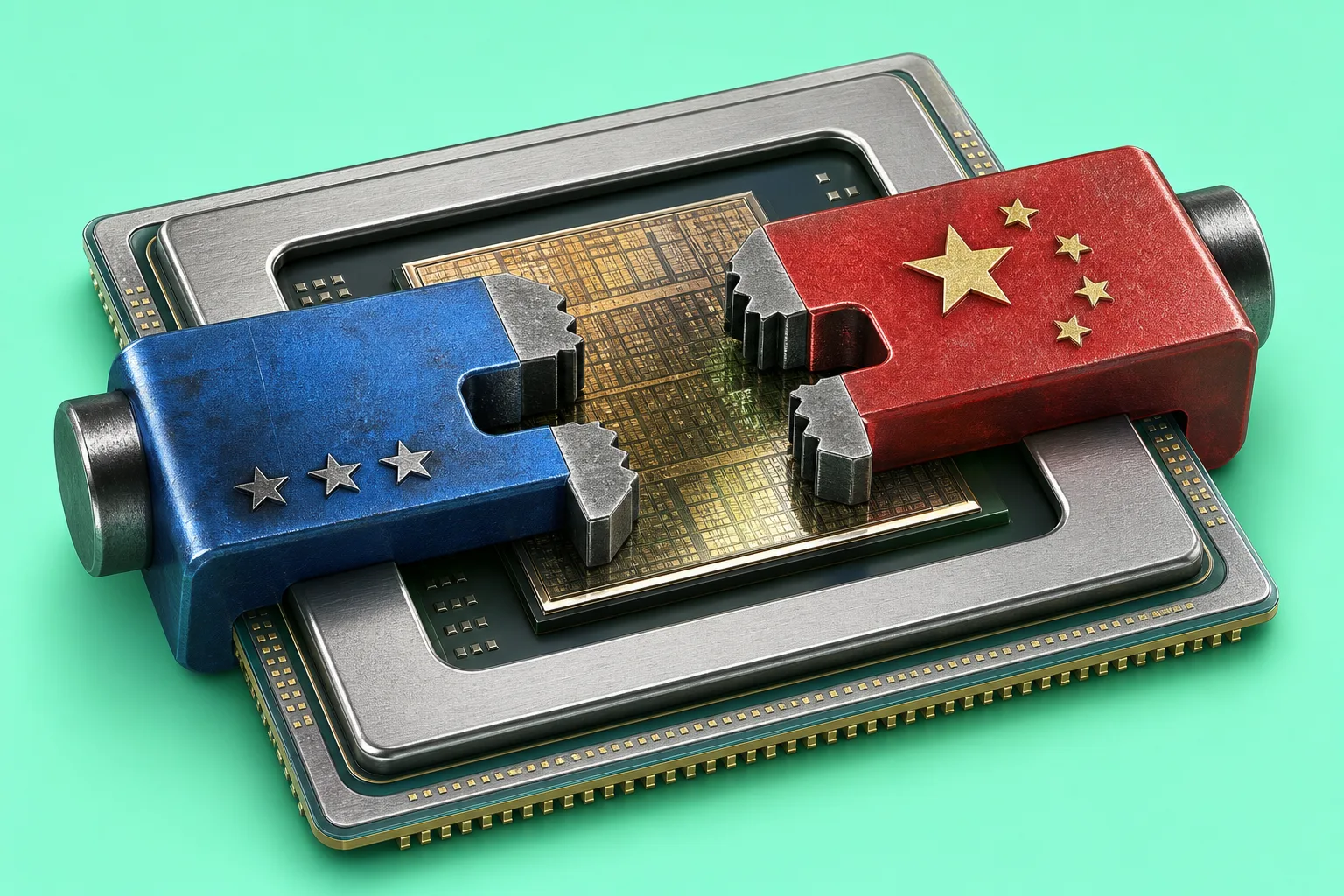
The U.S. AI data center build-out is facing pressure on two fronts: a tighter supply of indium phosphide, a critical optical-chip material, and a wave of online influence activity aimed at amplifying opposition to new facilities. The immediate market impact is most visible in materials, where prices and delivery timelines have surged.
China produces about 70% of global indium supply, giving it meaningful leverage over a component that helps AI servers move data at the speeds modern workloads require. That matters because the industry’s shift from copper to fiber-based interconnects has made optical materials more central to the economics of hyperscale computing.
The result is a new chokepoint for companies building AI infrastructure, from chip and photonics suppliers to utilities, construction contractors, and cloud operators. While the restrictions are not expected to derail U.S. AI leadership, they could make expansion slower, more expensive, and more politically contested.
Key Facts
- China accounts for roughly 70% of global indium supply, making it a major force in the indium phosphide market used for optical data transmission.
- China began restricting indium phosphide exports in February 2025, and a six-inch wafer was priced near $5,000 by June 2026, up about 250%.
- One major supplier, Lumentum, is sold out through 2028, highlighting the depth of demand and supply tightness in optical components.
- At least 75 U.S. data center projects worth about $130 billion faced blocks or delays in the first quarter of 2026 due largely to local opposition.
- Trade easing in November 2025 covered gallium, germanium, and antimony, but indium phosphide remained restricted into June 2026.
China AI supply squeeze
The central issue is that AI infrastructure depends on more than advanced graphics processors. As training clusters grow larger, chips must exchange information at extreme speed and low latency. Copper interconnects increasingly struggle to keep up, pushing data center designers toward optical links that convert electrical signals into laser light. Indium phosphide is a standard material in those tiny lasers, which makes it a strategic input rather than a niche commodity.
That raises the importance of export controls. If a material bottleneck slows delivery of optical components, data center projects can face higher capital costs, longer commissioning periods, and weaker returns on invested capital. The strain extends beyond photonics firms. Hyperscalers, semiconductor equipment vendors, power developers, and industrial real estate operators all depend on predictable build schedules.
The second front is political and social. OpenAI disclosed in June that it had removed two China-linked account clusters, including one dubbed the “Data Center Bandwagon,” which pushed content claiming data centers raise household electricity bills. The direct reach appeared limited, but the episode underscores a broader risk: real local concerns over power use, water consumption, and noise can be amplified into a more disruptive permitting environment.
AI leadership is not decided by chips alone; it also depends on who controls the materials, infrastructure, and public consent needed to scale.
Why indium phosphide matters to AI infrastructure
Indium phosphide sits at the intersection of semiconductors and communications. Its role is especially important in optical transceivers and lasers that move data within and between AI servers. As model sizes and inference workloads expand, networking throughput becomes a limiting factor, making these components increasingly valuable.
The pricing spike illustrates how quickly scarcity can ripple through the stack. A 250% increase in wafer prices does not automatically translate into a similar increase in total data center costs, but it can squeeze margins for suppliers and push operators to reorder spending priorities. In an industry already constrained by power availability and long lead times for transformers, cooling systems, and high-end chips, another bottleneck is significant.
Implications for Investors
For investors, the immediate takeaway is that AI infrastructure remains a multi-layer supply-chain story, not just a GPU story. Companies exposed to optical networking, specialty materials, and domestic mineral development may attract more attention as the market reassesses where bottlenecks are forming. Firms with concentrated manufacturing footprints in China or heavy dependence on restricted materials face higher execution risk.
There is also a policy angle. U.S. efforts to localize strategic supply chains could support capital spending in mining, refining, advanced materials, and photonics manufacturing. That may create opportunities for industrial and small-cap names tied to domestic sourcing, though those projects often carry long development timelines, permitting risk, and uncertain economics before scale is reached.
Investors should also watch the political environment around data centers. Local opposition is not merely a headline risk; delayed or blocked projects can affect utility demand forecasts, land valuations, construction schedules, and the revenue outlook for power equipment and engineering firms. The fact that 75 projects worth about $130 billion were delayed or blocked in the first quarter of 2026 shows the build-out is increasingly vulnerable to community pushback even without foreign amplification.
Longer term, the broader balance still favors the U.S. in advanced chips and software, but the path to monetizing that lead may be less smooth than the market assumed. The AI trade is becoming more dependent on power access, network hardware, and critical minerals, which means valuations may increasingly reward companies that can secure supply and execute around infrastructure constraints.
The next phase of the AI race will be shaped as much by materials and permitting as by model performance. Investors should track export controls, domestic supply responses, and project delays closely, because those factors may decide which parts of the AI value chain compound fastest through 2026 and beyond.