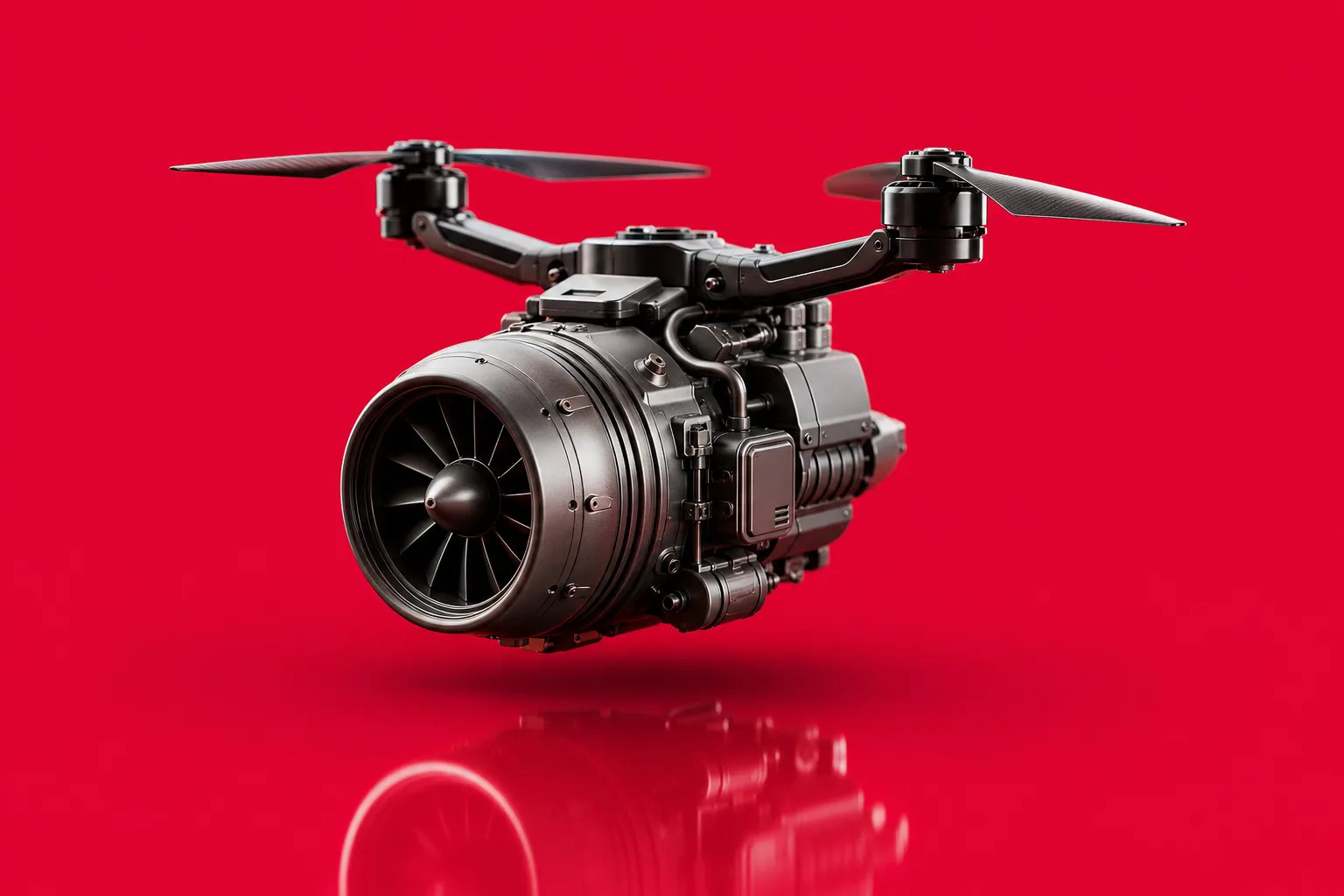
China’s dual-use drone engines are emerging as a critical concern in the global race to produce low-cost autonomous weapons. The central issue is not simply manufacturing capacity, but the growing commercial availability of MD550-type engines that can power Shahed-style one-way attack drones.
Listings for these engines on major Chinese e-commerce platforms point to a wider structural problem: parts with legitimate civilian uses can also be integrated into long-range strike systems with limited visibility into the final customer. That blurring of commercial and military supply chains is becoming harder for regulators to contain.
For investors, the development matters because it highlights a fast-expanding market in low-cost drone technology, while also increasing geopolitical risk for aerospace, defense, logistics, and industrial supply chains.
Key Facts
- MD550-type UAV engines linked to the Shahed drone family are being advertised by Chinese vendors in large quantities on commercial marketplaces.
- The United Nations has identified the Iranian MADO-550 as the engine used in the Shahed drone family.
- The U.S. Treasury has previously sanctioned Oje Parvaz Mado Nafar Company, commonly known as the Mado company.
- China casts more metal products than the next nine countries combined and more than five times the output of the United States, based on figures cited in the source material.
- China’s shipbuilding capacity is estimated at roughly 200 times that of the United States on a total-capacity basis.
China’s Dual-Use Drone Engines
The immediate concern centers on the MD550-type engine, a small aviation powerplant associated with the Iranian Shahed-136 family and Russia’s Geran-2 variant. Engines of this class are not inherently illicit; they can be sold as components for unmanned aerial vehicles and other aerospace applications. The problem arises when a commercially available engine can be adapted into a low-cost attack drone with relative ease.
That dynamic exposes a deeper shift in modern warfare economics. Instead of relying only on tightly controlled military production lines, drone programs can increasingly draw from civilian manufacturing networks. In practical terms, this lowers barriers to entry for states seeking cheap mass-strike capabilities and raises the possibility that non-state actors could gain access to similar systems over time.
There is no public evidence in the raw material provided that commercial listings alone prove a deliberate state-directed weapons supply program. But the listings do suggest that traditional export-control regimes were built for a different era, one in which military hardware was easier to distinguish from civilian goods. In the age of dual-use components, that distinction is eroding quickly.
The strategic risk is no longer limited to who can build a drone, but who can source the parts cheaply and at scale through civilian channels.
Why manufacturing scale matters
China’s industrial base gives it a structural advantage in any market that depends on high-volume, low-cost production. The figures cited in the source material on metal output and shipbuilding capacity illustrate the same broader point: when commercial industry is deep enough, scaling adjacent defense-related production becomes easier, faster, and potentially cheaper.
For Shahed-style systems and similar loitering munitions, scale may prove more decisive than technical sophistication. A mass-produced drone built from commercially available engines, electronics, and airframes can still impose serious costs on conventional air defenses, particularly if deployed in swarms or stockpiled in very large numbers.
Implications for Investors
For defense investors, the rise of dual-use drone engines reinforces a long-term demand case for counter-drone systems, electronic warfare, air defense interceptors, radar, and sensor networks. Companies tied to autonomous systems, expendable munitions, and battlefield networking may also benefit as militaries adapt procurement plans to a world where cheap drones are abundant.
At the same time, the trend raises risks for industrial and technology companies exposed to cross-border trade restrictions. If governments tighten controls on small aerospace engines, navigation modules, composite materials, or related electronics, compliance costs could rise and some supply chains may face disruption. Investors should watch for new sanctions, licensing rules, and end-use verification requirements that could affect manufacturers and distributors.
The issue also matters beyond listed defense contractors. Logistics providers, insurers, and infrastructure operators may need to account for a wider threat envelope as long-range, low-cost drones spread across more regions. The potential proliferation of such systems to proxies, criminal networks, or other hostile actors would increase pressure on both public-sector security spending and private-sector resilience investments.
Markets will be watching whether regulators move from entity-specific sanctions toward broader controls on dual-use drone components. Any policy shift could reshape parts of the aerospace supply chain while accelerating demand for counter-UAV technologies over the next several years.