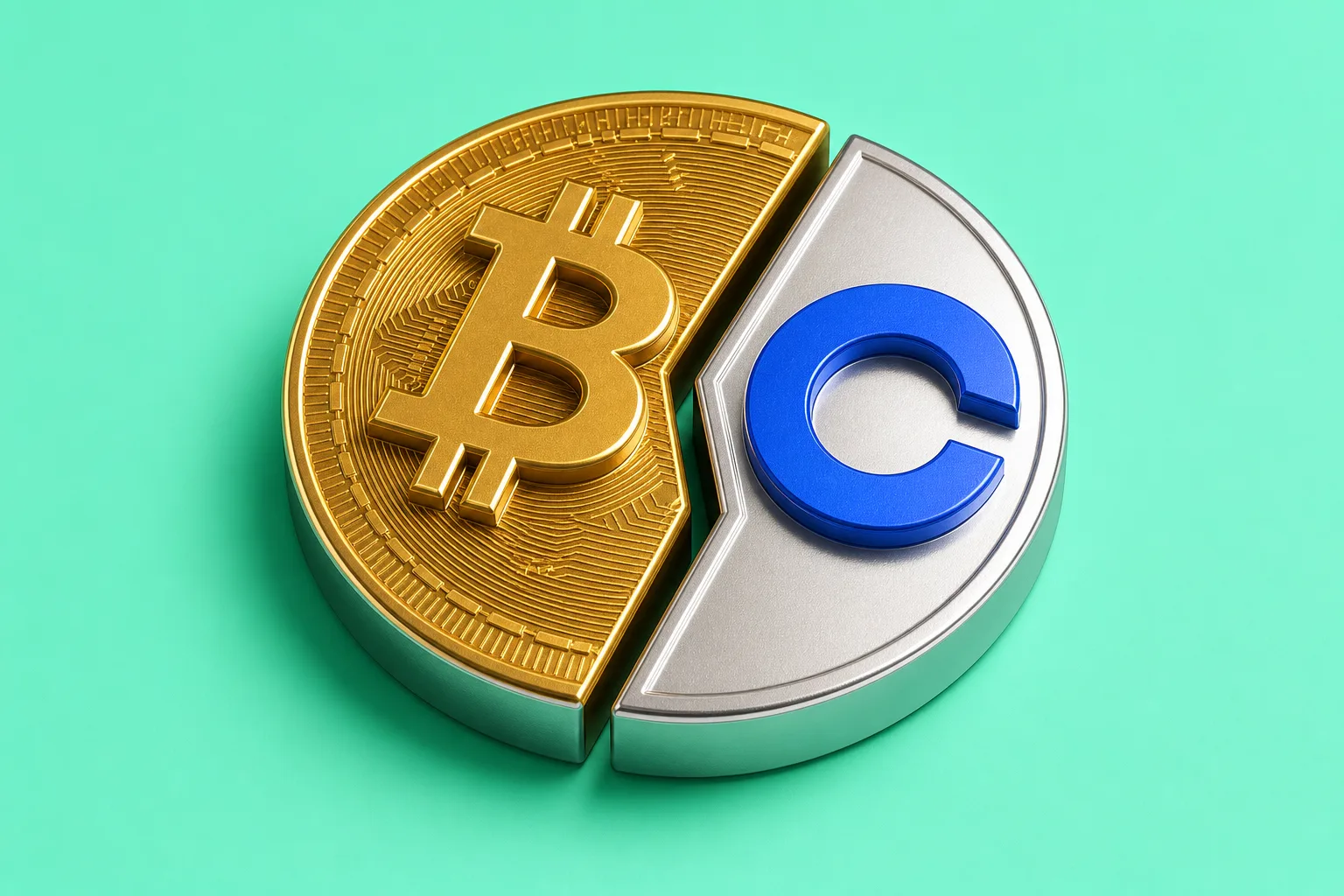
Coinbase stock gained 6.69% to $170.92, but the move still trailed Bitcoin’s 8.72% rally to $71,639.28 and Ethereum’s 15.63% jump. For investors, that performance gap says more about Coinbase’s changing business model than about a missed reaction to higher crypto prices.
Coinbase is no longer primarily a Bitcoin-linked trading proxy. In the second quarter, Bitcoin-related transactions accounted for just 12% of total revenue, while 88% of net revenue came from other lines of business, including subscriptions, services, stablecoin income and emerging infrastructure products.
That shift matters because the market continues to treat Coinbase Global Inc. (NASDAQ: COIN) as a high-beta crypto equity, even as its revenue base becomes more diversified and potentially more resilient than in earlier cycles.
Key Facts
- Coinbase shares closed at $170.92, up $10.72 or 6.69%, giving the company a market capitalization of $45.095 billion.
- Bitcoin rose 8.72% to $71,639.28 in the same session, while Ethereum advanced 15.63%.
- Bitcoin-related transactions represented 12% of Coinbase’s total revenue in the second quarter, down from more than 50% historically.
- Coinbase reported a record 10.3% global crypto trading volume market share for the third consecutive quarter of gains.
- Average USDC held in Coinbase products reached an all-time high of $20 billion during the quarter.
Coinbase Stock
The immediate takeaway from the latest move in Coinbase stock is that the company is increasingly trading on structural business developments rather than simply mirroring coin prices. Even with Bitcoin surging, Coinbase’s smaller gain reflected a company whose earnings drivers are now spread across subscriptions, custody, stablecoins, Layer 2 infrastructure, derivatives and tokenization initiatives.
Several catalysts helped support the stock. Regulators advanced a tailored framework for crypto contracts and a digital securities innovation exemption that could eventually allow broader tokenized securities offerings in the United States. Coinbase also secured regulatory approval in Abu Dhabi Global Market to build an international tokenization hub capable of issuing fully backed tokenized securities with shareholder rights. In Washington, momentum around the CLARITY Act added another policy catalyst ahead of a Senate cloture vote scheduled for September 15.
For shareholders, the significance is clear: Coinbase is trying to reposition itself as financial infrastructure for digital assets, not just as a venue for retail crypto trading. That transition could expand its addressable market well beyond volatile spot trading volumes, but it also means investors must evaluate the stock using a more complex set of operating metrics.
Coinbase’s valuation debate increasingly hinges on whether investors see it as a Bitcoin proxy or as a diversified digital financial infrastructure company.
Why the Revenue Shift Matters
The second quarter highlighted both the opportunity and the tension in the investment case. Coinbase missed reduced earnings expectations and reported weaker revenue as softer crypto prices and lower spot volumes pressured transaction activity from April 1 through June 30. Shares fell 8.6% after that report, dropping to $155.10 from $163.58.
Yet under the surface, some strategic indicators improved. The company posted its fourteenth consecutive quarter of positive adjusted EBITDA, gained market share in a shrinking industry, and continued to grow recurring revenue streams. Nearly half of net revenue now comes from subscriptions and services, giving Coinbase a partial buffer when trading volumes contract.
That diversification is central to the long-term thesis. If recurring and infrastructure-based revenue lines continue to expand, Coinbase could eventually be valued more like an exchange-and-fintech platform than a cyclical crypto trading stock. The challenge is that market sentiment has not fully caught up to that shift, especially with the shares still down 46.65% over 12 months and 59.3% below the all-time closing high of $419.78.
Implications for Investors
For investors, Coinbase offers a mix of growth potential and unusually high volatility. On one hand, the business is building exposure to secular themes including tokenized equities, stablecoin payments, digital asset custody, derivatives and subscription products. Those areas could reduce dependence on Bitcoin spot trading over time and create steadier revenue streams. Base, the company’s Layer 2 network, and the growing Coinbase One subscription product also point to broader ecosystem monetization.
Stablecoin economics deserve especially close attention. With average USDC balances at $20 billion, interest income remains a meaningful contributor. At roughly a 3.6% gross yield, that balance implies an annualized interest pool of about $720 million before revenue-sharing arrangements. That creates a rate-sensitive but non-transactional earnings stream. If balances continue rising, stablecoin revenue could become even more important, although lower short-term interest rates would reduce that benefit.
At the same time, risk remains elevated. Coinbase’s beta was cited at 3.35, underscoring how sharply the shares can move with broader crypto sentiment regardless of the company’s evolving revenue mix. Competition from Robinhood and specialized derivatives platforms could pressure fees, while leadership turnover adds execution risk. Regulatory progress is a potential tailwind, but any delays around tokenization rules, stablecoin oversight or market structure legislation could weigh on the stock.
Investors should also watch technical levels and trading volume. The stock has been consolidating between resistance near $172 to $181 and support around $152 to $155. A decisive break above resistance on stronger-than-average volume would likely strengthen the bullish case, while a retreat below the post-earnings support zone could revive concerns about earnings pressure and weak trading activity.
Coinbase’s next phase will likely be judged less by whether Bitcoin rises on a given day and more by whether newer businesses can scale fast enough to justify a higher valuation multiple. Progress in tokenized securities, derivatives integration and recurring subscription revenue will be key signals into late 2026 and 2027.