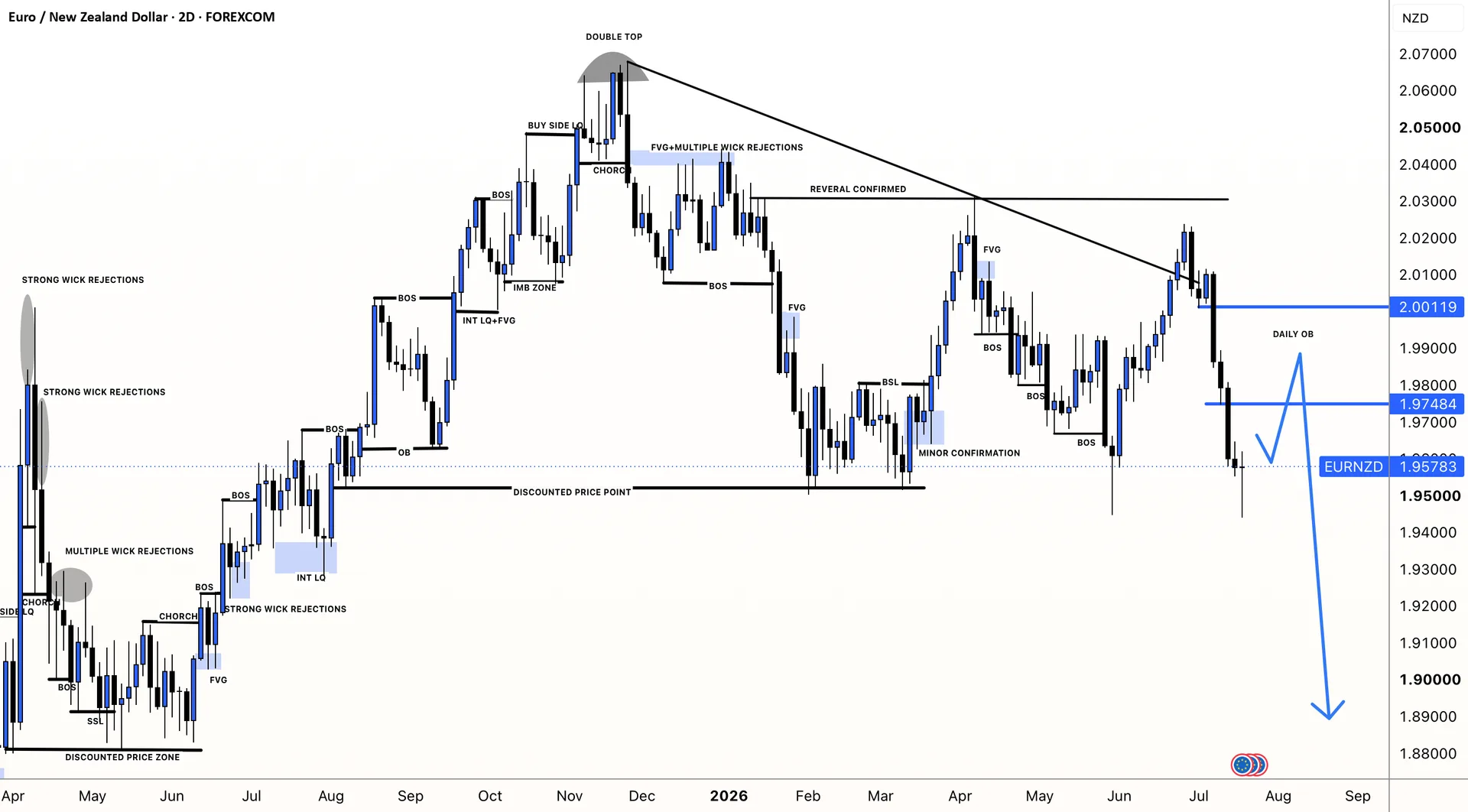
EURNZD is showing a bearish bias despite trading inside a range, with the 50% equilibrium area emerging as the most important reference point on the chart. Rather than a clean trend continuation, the pair appears to be setting up for a corrective bounce before the next directional move is decided.
For traders tracking EURNZD, the focus is on whether price can revisit the middle of the range and attract renewed selling pressure. If that zone continues to act as a ceiling, the broader downside structure may remain intact.
Market Snapshot
EURNZD is a forex pair currently defined by a range-based structure, but the prevailing bias remains bearish. In plain terms, price is not moving in a straight line lower; instead, it is oscillating within boundaries while sellers appear to retain the broader edge.
The key feature in this setup is the range equilibrium, commonly viewed as the 50% midpoint between the established high and low of the current structure. This area often acts as a decision zone, especially when a market is correcting against the dominant bias before potentially resuming the prior move.
Key Levels
- Support: The lower boundary of the current range, which serves as the main downside reference and the first area where price may attempt to stabilize.
- Resistance: The 50% equilibrium zone and the upper half of the range, where corrective rallies may face renewed selling pressure.
These levels matter because range midpoints often attract two-way flow, while the lower boundary reflects the area where sellers previously managed to press the pair down. If price reacts sharply near equilibrium, it would reinforce that the midpoint is acting as a confluence zone between structure and momentum.
Bullish Scenario
The bullish case is not the dominant view, but it would begin to develop if EURNZD can sustain a corrective bounce and reclaim the equilibrium zone with improving momentum. In that scenario, the pair could extend higher into the upper portion of the range, where price would test whether sellers are still in control.
A realistic upside path would involve a break above the midpoint followed by acceptance in the upper half of the structure. If that happens, the next target zone would likely sit near the range highs, though such a move would still look corrective unless the pair starts building higher lows and holds above resistance-turned-support.
Bearish Scenario
The bearish setup remains the primary focus as long as EURNZD fails to decisively break and hold above the equilibrium area. A bounce into that zone could attract fresh selling interest, especially if volume and momentum fade as price approaches resistance.
If that rejection takes shape, the pair could rotate back toward the lower boundary of the range and potentially challenge it. A clear loss of that support zone would strengthen the bearish case and open the door to a deeper extension below the current structure. In this framework, sustained trade above the equilibrium area would weaken the immediate bearish thesis and act as the near-term invalidation signal.
What to Watch
The next move in EURNZD may depend heavily on macroeconomic releases tied to the euro and New Zealand dollar. Traders should monitor inflation data, central bank commentary, and growth-related indicators that can alter rate expectations for both currencies. Shifts in monetary policy outlook often have a direct impact on cross pairs like EURNZD.
Session timing also matters. Volatility can increase notably during the European session and again when broader risk sentiment shifts in Asia-Pacific trading. Because the New Zealand dollar is often sensitive to risk appetite and commodity-linked sentiment, moves in related markets can influence how EURNZD behaves around key technical zones.
It is also worth watching momentum confirmation. If a corrective rally into equilibrium is accompanied by weak follow-through, that would fit the existing bearish structure. On the other hand, a strong reclaim of the midpoint with broad currency support behind the euro could suggest the range is evolving into a more balanced or even constructive pattern.
EURNZD remains at an important technical juncture, with the range midpoint acting as the main decision level. Whether price rejects that area or builds above it should offer a clearer signal on the pair’s next directional phase.