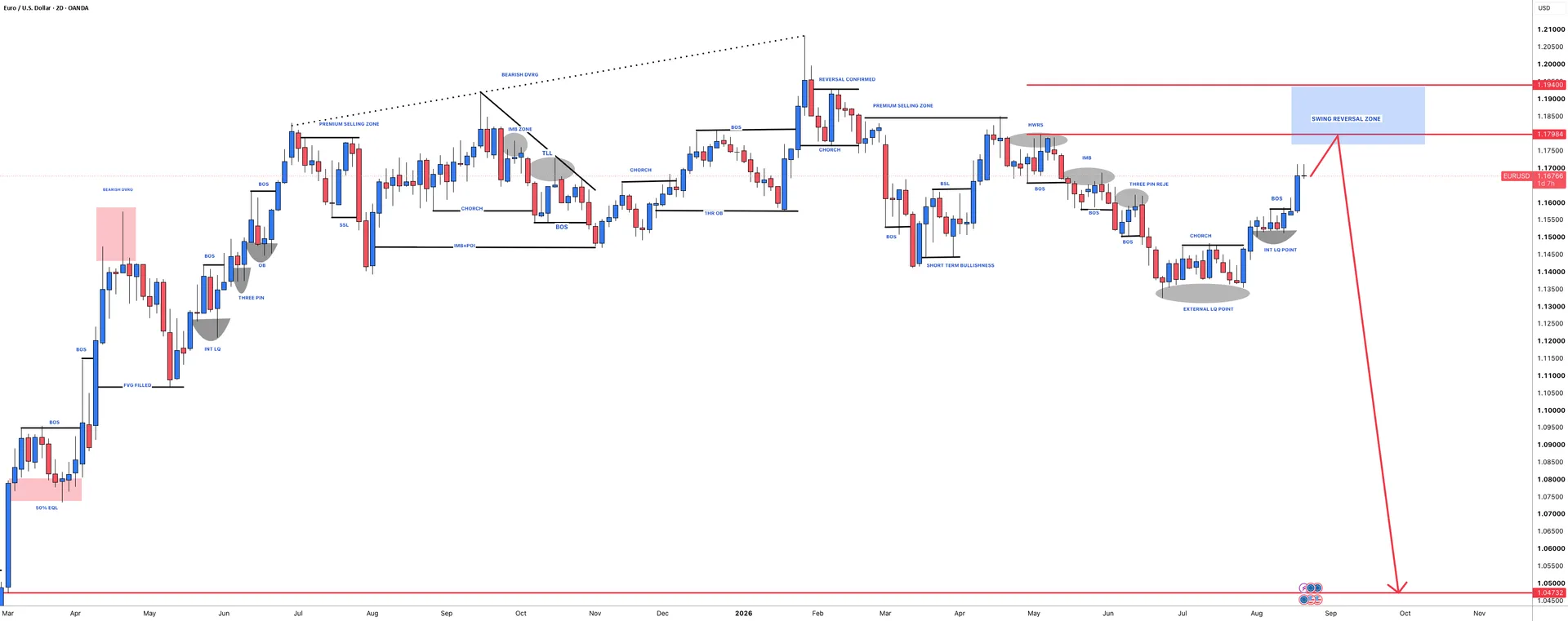
EURUSD is showing a bearish broader bias, with the 1.133 support zone emerging as the most important technical reference on the chart. While recent price action points to short-term strength, the larger structure still suggests the rebound may be vulnerable.
The key pattern in focus is a liquidity sweep, which often appears near turning points when price briefly pushes beyond a level before reversing. If that dynamic holds, EURUSD could be setting up for a renewed downside move after its current recovery phase.
Market Snapshot
EURUSD, in the forex market, is currently trading within a mixed structure where short-term bullish signals are developing inside a wider bearish framework. The analysis points to a change of character and a bullish break of structure on the lower horizon, but those signals have not yet overturned the broader directional pressure.
In plain English, the pair may still have room to rise in the near term, yet that strength appears corrective rather than decisive unless buyers can reclaim and sustain higher levels. The prevailing bias therefore remains bearish, with traders watching whether the current bounce transitions into a larger reversal lower.
Key Levels
- Support: 1.133
- Resistance: —
The 1.133 area matters because it acts as the clearest nearby technical reference in the current setup. It may serve as a reaction zone where liquidity, prior price interest, and structural decision-making converge. A clean hold above it could keep the recovery intact for longer, while a breakdown below it would reinforce the bearish outlook.
Bullish Scenario
The constructive case for EURUSD begins with follow-through after the recent change of character and bullish break of structure. If buyers continue to defend price above 1.133 and maintain upward momentum, the pair could extend its corrective recovery into a higher retracement zone.
In that scenario, the bullish trigger remains the market’s ability to stay above support and preserve a sequence of higher lows on the short-term chart. A realistic upside path would involve a push into the next reaction area formed by the latest swing highs, where the recovery would be tested against broader bearish pressure. Even then, strength would likely need to be sustained over multiple sessions to challenge the dominant negative structure.
Bearish Scenario
The bearish case remains the primary one because the larger market structure still points to the possibility that the current rebound is only temporary. If EURUSD fails to build on its short-term bullish signals and begins to reject higher prices, the setup could evolve into a deeper downside continuation.
The invalidation level for the near-term recovery is 1.133. A decisive move back below that support would suggest the liquidity sweep and recovery phase have run their course, shifting focus toward lower support zones and a broader retracement of the recent bounce. Under that outcome, sellers would be looking for a return toward the next visible demand region beneath 1.133, with the downside move gaining credibility if momentum accelerates on a break of structure to the downside.
What to Watch
Macro catalysts remain important for EURUSD because the pair is highly sensitive to shifts in interest-rate expectations and broad U.S. dollar sentiment. Market participants should monitor key eurozone and U.S. economic releases, especially inflation data, labor-market figures, and central-bank communication that could alter the rate outlook.
Session timing also matters. EURUSD often sees its clearest directional moves during the London session and in the overlap between London and New York, when liquidity is deepest and institutional participation is strongest. If the pair approaches 1.133 during those periods, the quality of the reaction may offer a stronger signal than price action during quieter hours.
Correlated assets and broader sentiment can provide additional context. The U.S. Dollar Index, European bond yields, and general risk appetite across global markets may help confirm whether EURUSD is likely to continue its corrective climb or roll back into its broader bearish trend. If dollar strength re-emerges alongside weaker risk sentiment, that combination could weigh on the pair.
For now, EURUSD remains at an important technical junction where short-term recovery and broader bearish structure are in conflict. The next decisive move around 1.133 should help clarify whether the bounce has further room to run or is setting up for reversal.