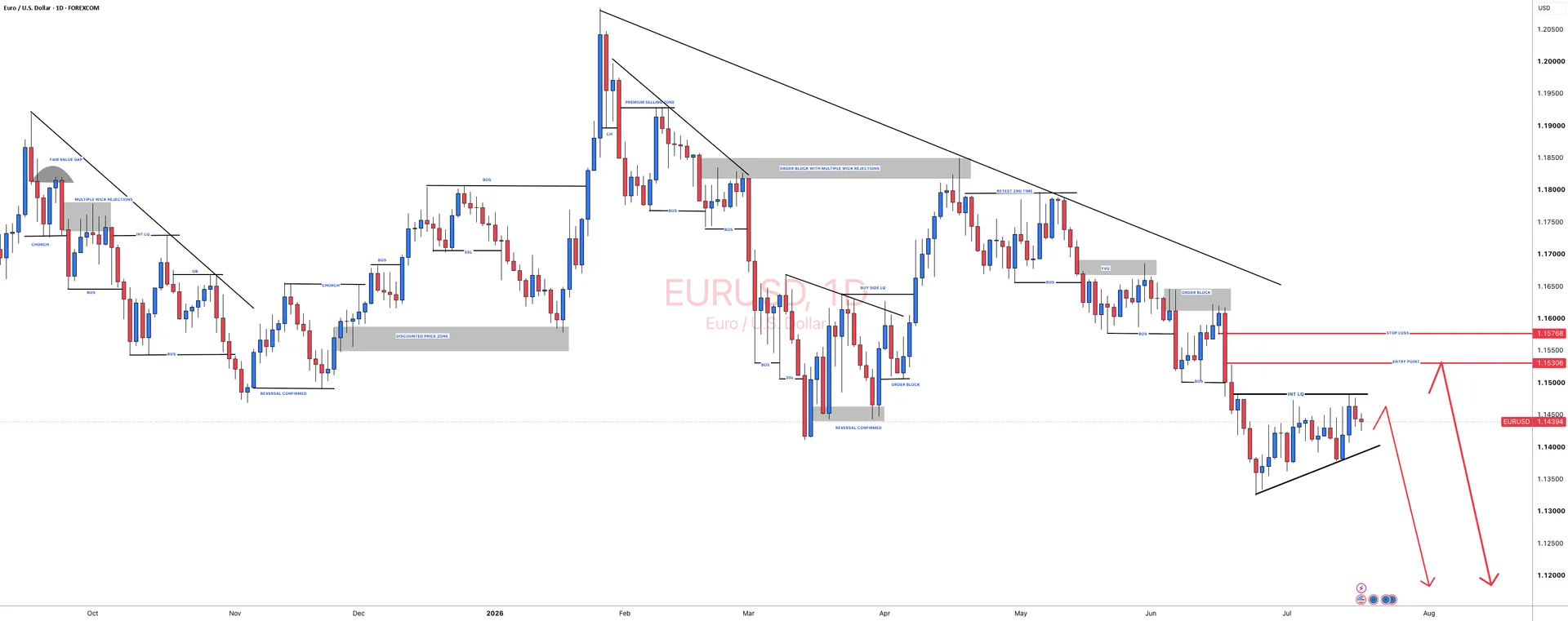
EURUSD is trading with a bearish bias as the pair continues to rotate inside a defined range. The most important level on the chart is 1.11, a support area that could become the focal point if sellers regain control.
While range conditions can delay trend continuation, they often set up the next impulsive move. For EURUSD, the question is whether a brief push higher to fill an imbalance can occur before the broader downside structure resumes.
Market Snapshot
EURUSD is a major forex pair, and the current technical picture points to a market consolidating within a range after prior directional movement. The structure suggests hesitation in the short term, but the prevailing bias remains tilted to the downside unless buyers can force a cleaner break above the upper portion of the range.
In plain English, EURUSD is moving sideways, yet the balance of risk still favors sellers. The pair may continue to fluctuate between local support and near-term supply before choosing its next sustained direction.
Key Levels
- Support: 1.11
- Resistance: Upper boundary of the current range
These levels matter because range extremes often attract both liquidity and strong reactions. The 1.11 zone stands out as a likely downside magnet if bearish momentum returns, while the top of the range may act as a rejection area if price first moves higher to fill a fair value gap.
Bullish Scenario
The constructive scenario for EURUSD begins with price extending toward the upper section of the current range. A move into that area could allow the pair to fill an existing fair value gap, which would represent a short-term recovery rather than a confirmed trend reversal.
For the bullish path to gain credibility, buyers would need to sustain trade above the recent range ceiling and hold that breakout on follow-through. If that happens, EURUSD could probe a modest target zone just above the current consolidation band, although any rally may still face pressure if broader bearish structure remains intact.
Bearish Scenario
The bearish scenario remains the primary technical view. If EURUSD forms a confirmed selling reversal from within or near the top half of the range, the pair could rotate lower and retest the 1.11 support area. That would align with the existing downside bias and reinforce the idea that consolidation is acting as a pause within a weaker structure.
From a technical standpoint, invalidation of the bearish setup would come from a decisive breakout above the range that is accepted by the market, rather than immediately rejected. Without that upside acceptance, rallies may continue to look corrective, leaving 1.11 as the realistic downside target zone.
What to Watch
Macro catalysts remain especially important for EURUSD because the pair is highly sensitive to rate expectations on both sides of the Atlantic. Traders will likely monitor major U.S. economic releases, euro area inflation data, central bank communication, and bond yield moves for clues on whether the dollar or the euro gains the upper hand.
Session timing can also matter. EURUSD often sees its most meaningful intraday moves during the London session and the London-New York overlap, when liquidity deepens and breakouts or reversals from range conditions are more likely to gain traction. If price approaches the edge of the range during those windows, the reaction may offer a clearer signal than a move in thinner trading hours.
Correlated markets could provide additional context. The U.S. Dollar Index, European sovereign yields, and overall risk sentiment across equities can all influence EURUSD direction. If the dollar firms alongside rising yields, that combination may reinforce the bearish case; if the dollar softens broadly, the pair may have room for a temporary squeeze higher before the next directional test.
For now, EURUSD remains in a waiting phase inside its range, with 1.11 serving as the pivotal downside reference point. The next sustained move will likely depend on whether price is rejected after a short-term recovery or can build enough strength to invalidate the bearish structure.