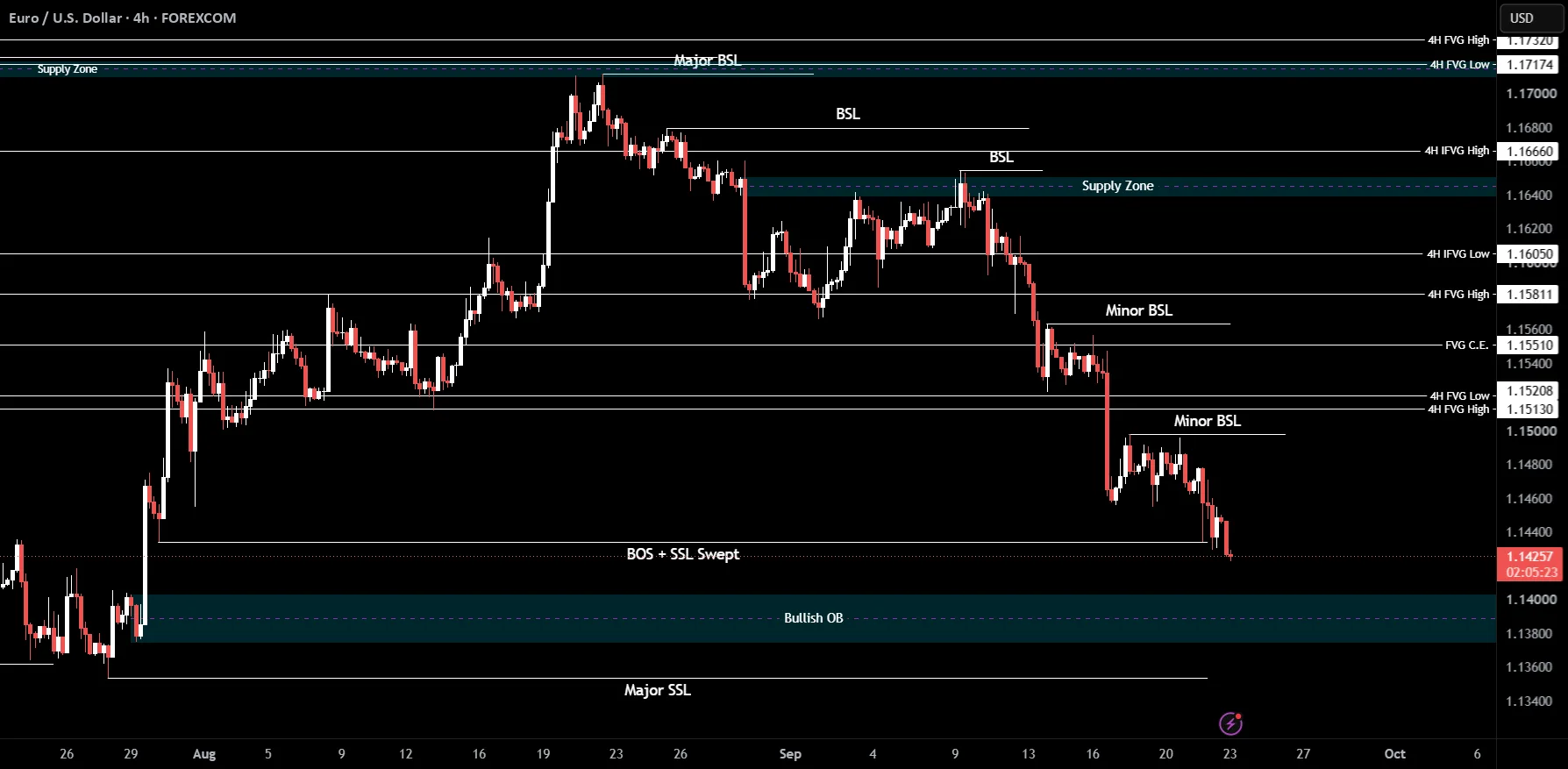
EURUSD is holding a bullish bias, with price action centered on the 1.14 support zone. The key feature of the current setup is a potential liquidity sweep before any stronger upside recovery takes shape.
The market structure suggests EURUSD could still drift lower in the near term, probing 1.1434 or even 1.14 before attracting renewed demand. That makes the 1.14 area the most important level to watch in the current configuration.
Market Snapshot
EURUSD is being assessed within a short-term technical framework where price remains vulnerable to an initial decline, even as the broader bias stays constructive. The pair is testing a zone where recent weakness could transition into a reversal if support is reclaimed decisively.
The prevailing structure points to a bullish view developing from lower levels rather than from immediate strength. In plain terms, the market may need to flush out liquidity below nearby support before a more stable upward move can begin.
Key Levels
- Support: 1.1434, 1.14
- Resistance: —
These support levels matter because they align with the expected reaction zone highlighted by the current liquidity-sweep pattern. The 1.1434 area serves as the first reference point, while 1.14 stands out as the deeper support area where buying interest may become more meaningful if price reaches it.
Bullish Scenario
The bullish path remains intact if EURUSD dips into the 1.1434 to 1.14 region and then shows signs of stabilization. In this scenario, the market would complete a sweep of nearby liquidity, reclaim support, and begin rotating higher from the order-block area around 1.14.
The main trigger for a more constructive rebound would be a clear defense of 1.14 followed by a move back above 1.1427. If that sequence develops, the pair could target a return toward the recent swing zone above current levels, with an initial objective in the 1.1450 to 1.1480 region, depending on momentum and follow-through.
Bearish Scenario
The bearish path would likely begin with EURUSD slipping from around 1.1427 and extending lower into the 1.14 support zone. That move alone would not necessarily break the broader bullish idea, since the setup already allows for a final downward leg before any reversal attempt.
However, the bullish structure would be undermined if price fails to hold 1.14 and starts trading convincingly below that area. In that case, the expected reversal would be invalidated in the near term, opening the door to a deeper retracement toward lower support not yet defined by the current framework.
What to Watch
The next catalyst for EURUSD is likely to come from macroeconomic releases tied to interest-rate expectations on both sides of the Atlantic. Inflation prints, labor-market data, and central-bank commentary can all influence whether the pair respects support or extends lower before finding balance.
Session timing also matters. Moves into the London and New York trading windows often provide the liquidity needed for a sweep of support, especially when price is hovering near a widely watched zone like 1.1434 or 1.14. If volatility rises during those periods, traders will likely focus on whether the decline is rejected quickly or accepted below support.
Beyond headline data, broader sentiment in the US dollar remains an important cross-current. A softer dollar backdrop would support the bullish recovery case for EURUSD, while renewed dollar strength could delay the rebound and increase pressure on the 1.14 area.
For now, EURUSD remains in a technically sensitive position with a bullish bias that depends on how price behaves around 1.1434 and 1.14. The next directional clue will likely come from whether that support zone attracts buyers or gives way under renewed selling pressure.