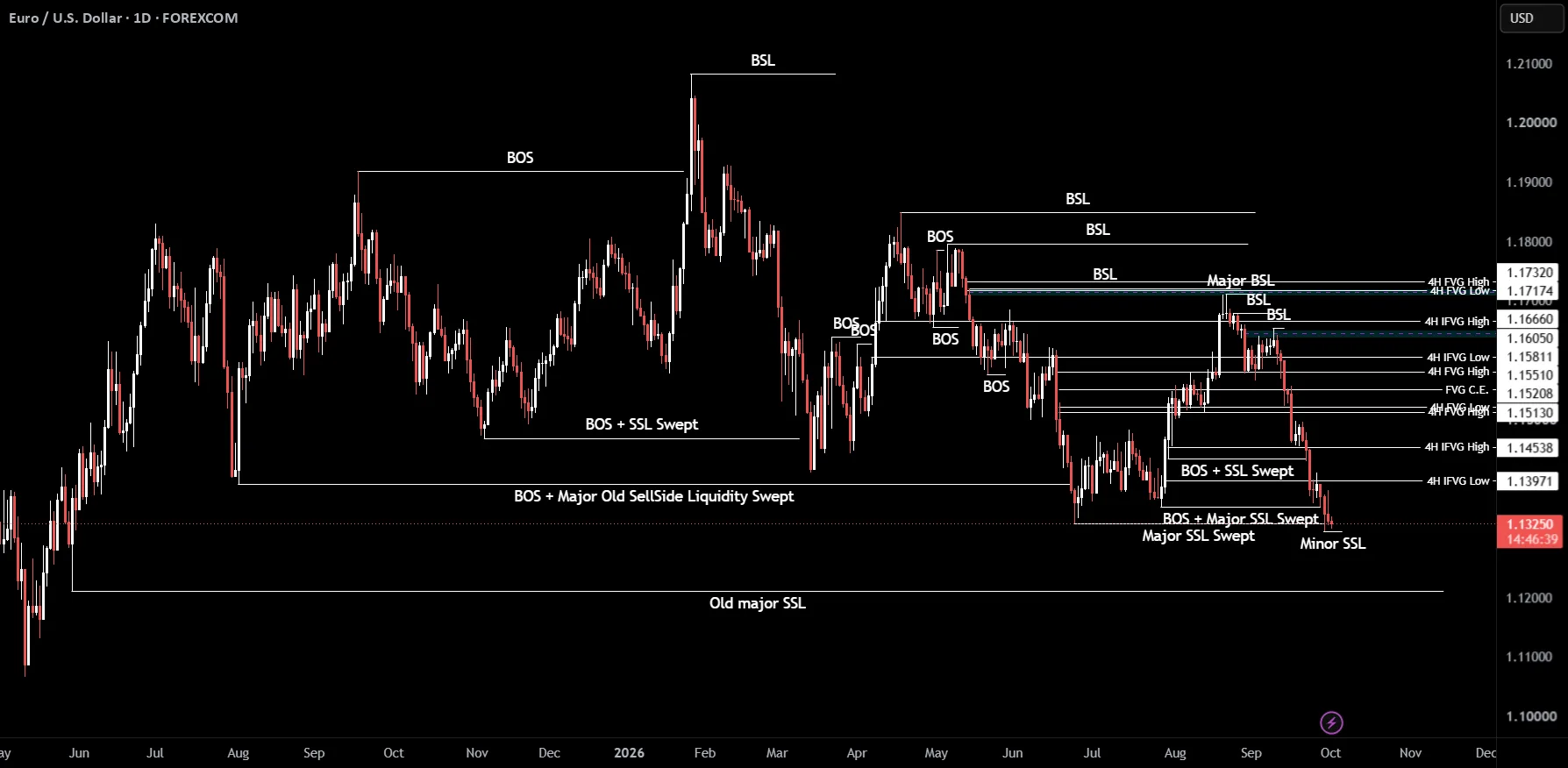
EURUSD is holding a neutral technical bias, with price action closely tied to the 1.1300-1.1320 support zone. That demand area stands out as the key near-term reference point after the pair printed a fresh low and paused into support.
For now, the main question is whether buyers can stabilize the pair above this cluster and drive a recovery toward resistance, or whether a weak reaction opens the door to another leg lower. The next directional clue is likely to come from how EURUSD behaves around 1.1320 and below.
Market Snapshot
EURUSD is being assessed as a forex setup on a short-term technical basis, with current structure showing price pressing into an important support band after recent downside pressure. The market is not yet showing a decisive reversal pattern, which keeps the broader near-term stance neutral rather than firmly bullish or bearish.
In plain English, EURUSD is sitting at a decision area. A firm hold above support could produce a rebound into the upper edge of the recent range, while failure to attract demand may confirm that sellers still control momentum. Until one side forces a clear break, the pair remains balanced between recovery and continuation risk.
Key Levels
- Support: 1.13, 1.1315, 1.132
- Resistance: 1.138, 1.14
These levels matter because they define the current battlefield between buyers and sellers. The 1.1300-1.1320 area represents a compact demand zone where price may attract renewed interest after the recent slide, while 1.1380 and 1.1400 mark nearby overhead barriers where prior selling pressure or profit-taking could re-emerge. In range-driven conditions, repeated reactions around these zones often shape the next swing.
Bullish Scenario
The constructive path for EURUSD begins with a stable reaction from the 1.1300-1.1320 support region. If price finds buyers there and starts building higher intraday lows, that would suggest the recent decline is losing momentum rather than accelerating into a full breakdown. In that case, the first meaningful upside trigger would be a move back through 1.1380, which could indicate improving short-term control from the bulls.
Should that recovery develop, the most realistic target zone sits near 1.1380 to 1.1400, where resistance is already defined. A push into 1.1400 would not automatically imply a larger trend reversal, but it would confirm that support held and that EURUSD managed at least a tradable rebound from demand.
Bearish Scenario
The bearish path remains active if EURUSD fails to bounce convincingly from the 1.1300-1.1320 area. A weak or short-lived reaction would signal that buyers are not defending the zone with enough force, leaving the pair vulnerable to renewed downside continuation. In that setting, a loss of 1.1300 would be a notable sign that support has been invalidated.
Once below that floor, the pair could extend lower as stops under the range are exposed and short-term sentiment deteriorates. Because the available structure identifies support as the main anchor, the downside target zone would be defined by continuation beneath 1.1300 rather than a precise lower resistance-to-support flip. The key takeaway is that failure at demand would shift the balance away from consolidation and toward fresh weakness.
What to Watch
Macro catalysts remain important for EURUSD because the pair is highly sensitive to interest-rate expectations and relative growth signals between the euro area and the United States. Traders will likely focus on major economic releases such as inflation data, central bank communication, labor market figures, and purchasing managers’ surveys, all of which can quickly alter the tone around the euro and the US dollar.
Session timing also matters. EURUSD often sees its most meaningful moves during the overlap between European and US trading hours, when liquidity and institutional participation are strongest. If price is sitting near 1.1320 or 1.1380 during that window, reactions around those levels may carry more technical significance than moves made in thinner conditions.
It is also useful to monitor correlated assets and broader sentiment. US Treasury yields, the US Dollar Index, and general risk appetite can influence whether EURUSD respects support or extends lower. If the dollar strengthens broadly while yields rise, pressure on EURUSD may intensify; if the dollar softens and risk sentiment improves, the support zone may prove more durable.
EURUSD remains in a technically sensitive position, with support at 1.1300-1.1320 likely to shape the next short-term move. Whether the pair rebounds toward 1.1400 or slips into a deeper decline will depend on how price reacts at this decision zone.