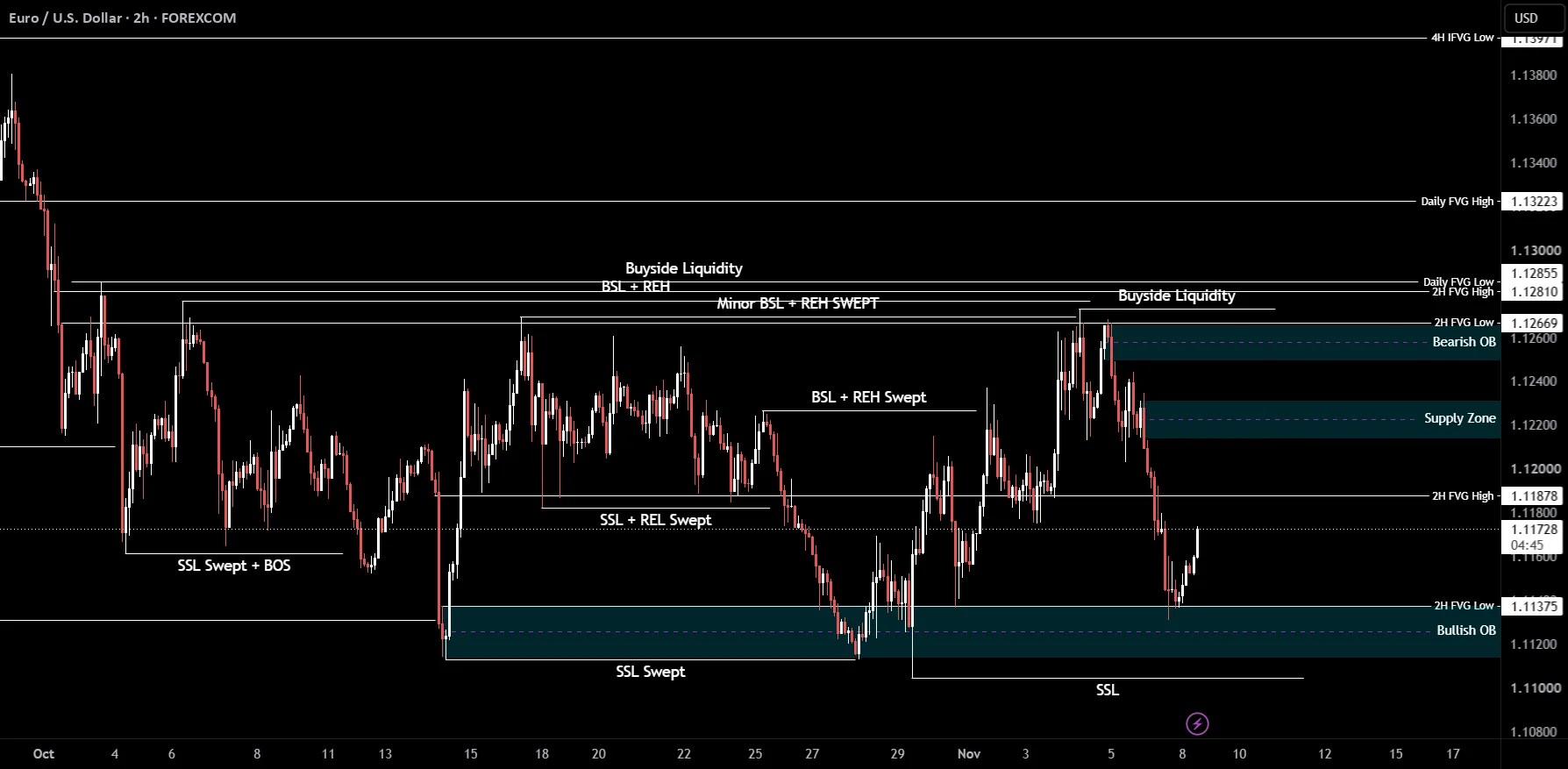
EURUSD is holding a neutral bias as the pair retests resistance near 1.119, a level that now stands out as the key decision point for near-term direction. The broader setup suggests a market in balance rather than a clean trend, with buyers and sellers both defending important short-term levels.
The most important feature on the chart is the ongoing retest structure around 1.119 after a bounce from lower levels. Whether EURUSD can establish acceptance above that zone, or slip back below the mid-range support area, is likely to shape the next move.
Market Snapshot
EURUSD is being assessed on a 2-hour timeframe, where price action shows a retest pattern developing after a rebound from recent lows. The pair has recovered enough to challenge overhead supply, but it has not yet delivered a decisive breakout that would clearly shift the structure back in favor of bulls.
For now, the prevailing bias remains neutral. In plain English, that means EURUSD is trading between well-defined support and resistance, and the next directional signal may depend on whether price can hold above 1.119 or rotates back toward the lower boundary of the current range.
Key Levels
- Support: 1.1131, 1.117
- Resistance: 1.119, 1.1273
These levels matter because they mark recent reaction points and areas where short-term order flow appears concentrated. The 1.119 zone is especially important as it aligns with the current retest area, while 1.1131 represents the recent low that could come back into focus if bullish momentum fades.
Bullish Scenario
The constructive path for EURUSD would require a clean move above the nearby resistance cluster and, more importantly, evidence that price can hold above 1.119 rather than briefly spike through it. A stable break over that level would suggest that buyers are absorbing supply in the retest zone and attempting to build a higher short-term base.
If that happens, the next realistic upside target is the 1.1273 area, which stands as the next notable resistance zone on the chart. Reaching that region would likely require follow-through momentum during active trading sessions, especially if the pair sees support from broader euro strength or a softer tone in the U.S. dollar complex.
Bearish Scenario
The bearish path becomes more relevant if EURUSD fails to sustain trade above the retest area and slips back under the mid-range support zone after the bounce. That kind of rejection would signal that the recent recovery was not strong enough to alter the broader short-term balance, leaving price vulnerable to renewed selling pressure.
In that case, 1.117 would be an early area to monitor, but the larger downside focus would shift back to 1.1131, the recent low. A return to that zone would not necessarily confirm a broader breakdown on its own, but it would reinforce the neutral-to-soft tone and show that sellers still control rallies into resistance. From a structure standpoint, failure to hold above 1.119 would weaken the bullish case and keep the pair trapped in a reactive range.
What to Watch
Macro catalysts remain critical for EURUSD because foreign exchange markets often need a fundamental spark to break out of consolidation. Traders will be watching major eurozone and U.S. economic releases, especially inflation figures, labor data, and central bank commentary, all of which can quickly reshape rate expectations and drive repricing in the pair.
Session timing also matters. EURUSD often shows its clearest intraday moves during the London session and the London-New York overlap, when liquidity is deepest and institutional participation is strongest. If a move above 1.119 or below 1.117 occurs outside those active windows, market participants may look for confirmation before treating it as a durable directional signal.
It is also worth monitoring correlated assets and broader sentiment indicators. U.S. Dollar Index performance, euro crosses, and government bond yield differentials can all offer context for whether EURUSD has enough backing to break from its current retest pattern. If dollar strength broadens across the board, upside progress in the pair may remain limited; if the dollar softens, the bullish scenario toward 1.1273 may gain traction.
EURUSD remains in a balanced short-term structure, with 1.119 acting as the key pivot and 1.1131 as the downside reference. The next sustained move will likely depend on whether price confirms the retest to the upside or rolls back into the lower end of the range.