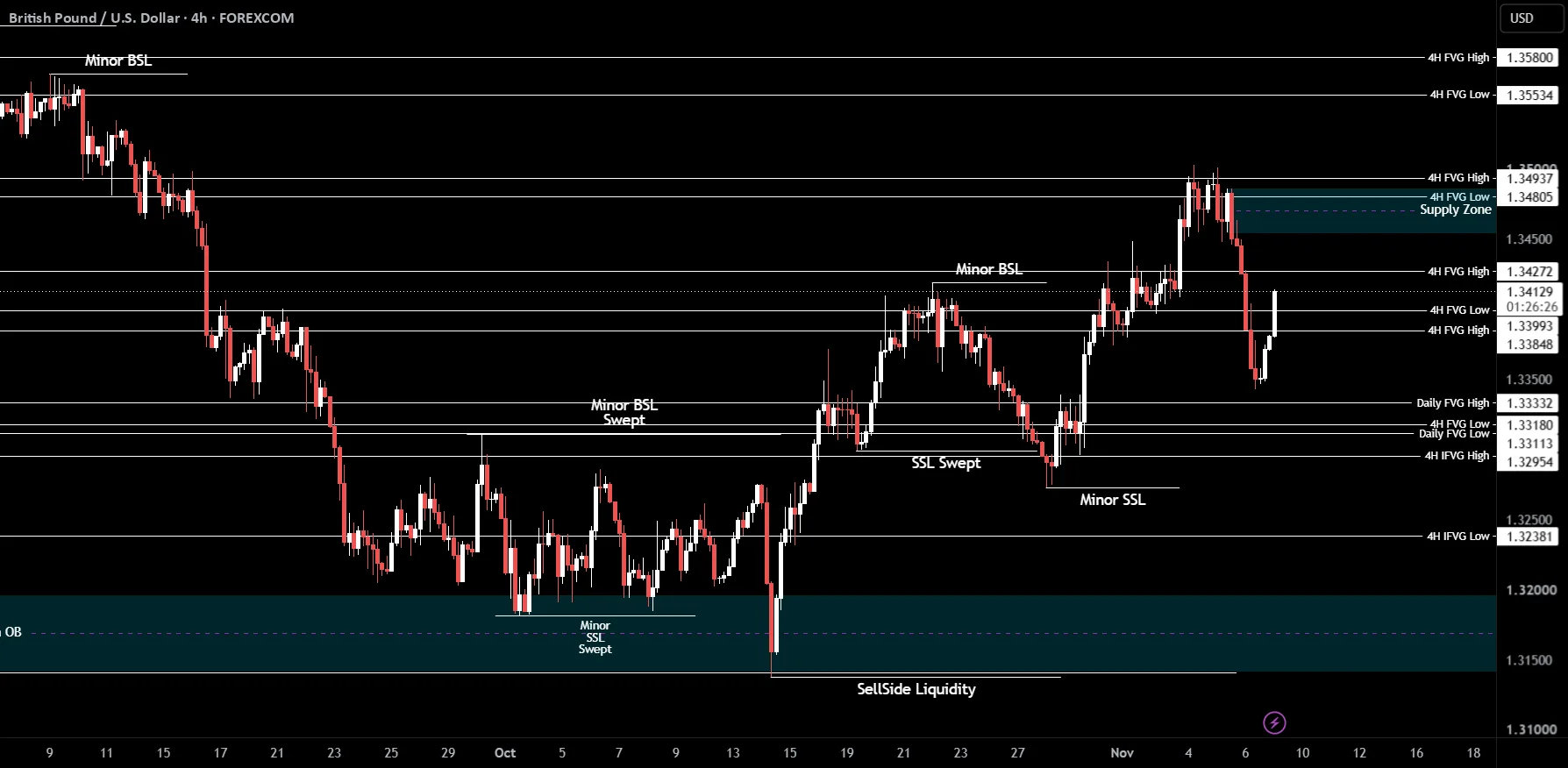
GBPUSD is holding a constructive tone, with bullish attention centered on a breakout above 1.3427. That level stands out as the key technical threshold that could define whether momentum extends or stalls.
As long as price action stays firm around nearby support, the pair remains positioned for a possible push toward 1.35. The setup is relatively straightforward: confirmation above resistance would strengthen the bullish case, while failure to hold the recent structure would shift focus back to lower support levels.
Market Snapshot
GBPUSD is being assessed on a short-term technical basis, where the pair is trading within a rising structure and testing an important breakout area. The current market picture suggests buyers still have an edge, but follow-through above resistance is needed to confirm continuation.
In plain English, sterling is trying to build enough momentum to clear a ceiling that has capped advances. If that ceiling gives way decisively, the broader bias remains bullish; if not, the market may fall back into consolidation near support.
Key Levels
- Support: 1.3413, 1.3342
- Resistance: 1.34, 1.3427, 1.35
These levels matter because they cluster around recent reaction points and likely represent areas where short-term order flow could intensify. The 1.3427 zone is especially important because it aligns with the breakout trigger, while 1.35 acts as the next clear upside reference if momentum expands.
Bullish Scenario
The bullish path depends on a clean move above 1.3427 followed by price stabilization over that level. If GBPUSD can break through resistance and hold it as support, that would suggest buyers have absorbed supply and are ready to target the next major zone higher.
Under that scenario, the most realistic upside objective sits around 1.35. A measured advance toward that area would fit the current structure, especially if momentum improves during active London or U.S. trading hours and the pair avoids slipping back below the breakout point.
Bearish Scenario
Even with a bullish bias, the setup is vulnerable if GBPUSD fails to sustain pressure near resistance. Rejection from 1.3427 or a move back below 1.3413 would weaken the immediate breakout thesis and suggest that upside momentum is not yet strong enough for continuation.
In that case, the invalidation of the bullish structure would shift attention toward 1.3342 as the next realistic downside target zone. A deeper retreat into that area would imply the market has returned to a broader consolidation phase rather than beginning a fresh leg higher.
What to Watch
For forex traders tracking GBPUSD, macroeconomic catalysts remain central to whether the breakout develops. Sterling and the U.S. dollar are both highly sensitive to interest-rate expectations, so inflation data, labor-market releases, and central bank commentary can all influence whether price is able to push through 1.3427 or gets rejected.
Session timing also matters. Breakouts that occur during more liquid periods, especially the London session overlap with New York, tend to carry more technical significance than moves that develop in thinner conditions. Strong volume and sustained trading above resistance would improve confidence in the bullish structure, while a brief spike with no follow-through would be less convincing.
Market participants may also want to monitor broader U.S. dollar sentiment and bond yield direction, as both can shape near-term flows in major currency pairs. If the dollar softens across the board, GBPUSD may find support for a continuation move. If risk sentiment deteriorates or the dollar strengthens sharply, resistance near the current highs could prove harder to overcome.
For now, GBPUSD remains focused on whether resistance can turn into support. The next move will likely depend on how price behaves around 1.3427 and whether the pair can sustain momentum toward 1.35 without losing its underlying structure.