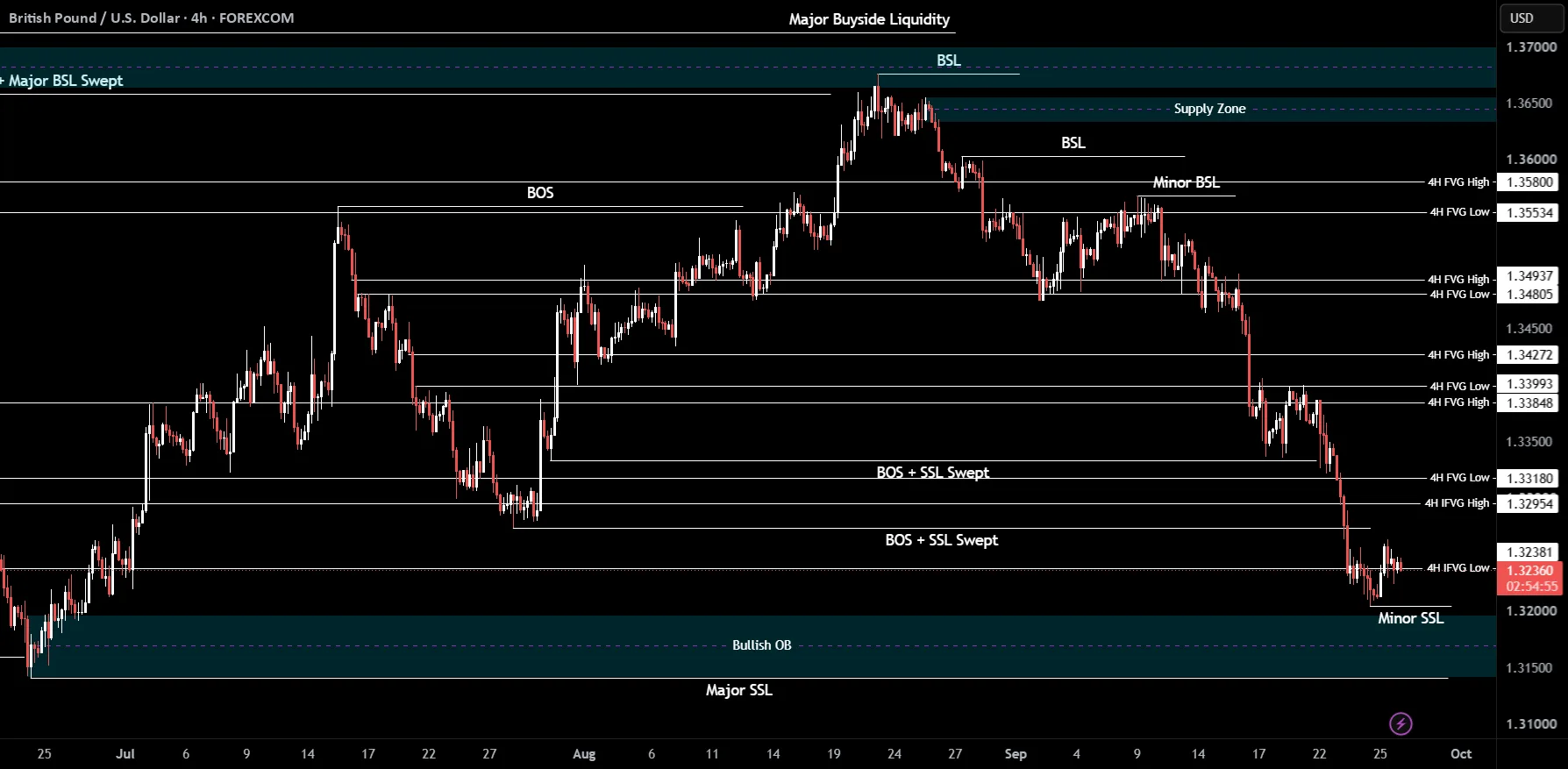
GBPUSD is holding a bullish near-term bias as traders focus on a retest around 1.3238, the key level shaping the current setup. That area stands out as the main line between a continuation higher and a deeper pullback.
The pair has pulled back into a support region tied to a bullish order block, creating a classic retest structure. If buyers can defend the zone and reclaim momentum, 1.3266 becomes the next level to watch.
Market Snapshot
GBPUSD is being assessed through a short-term technical lens, where the current structure reflects a pullback within a broader constructive move. The recent decline has brought price back into a demand area, but the overall pattern still favors a bullish interpretation as long as support remains intact.
In plain English, this is a market testing whether buyers are still willing to step in after a temporary dip. The prevailing bias remains positive while price holds around the retest zone, with traders watching for stabilization above support and a move back toward resistance.
Key Levels
- Support: 1.3238
- Resistance: 1.3266
These levels matter because they frame the immediate range and define the current decision point. Support at 1.3238 is important not only because of recent price interaction, but also because it aligns with the retest concept and nearby bullish order flow. Resistance at 1.3266 marks the first meaningful upside checkpoint where prior selling pressure could reappear.
Bullish Scenario
The bullish case depends on GBPUSD respecting the pullback and regaining traction above 1.3238. A firm defense of that area would suggest the retest is functioning as a continuation pattern rather than the start of a larger reversal. In that scenario, buyers would be looking for price to rebuild structure through higher intraday lows and push back toward the recent ceiling.
If upward momentum returns, 1.3266 is the immediate target zone. A clean approach into that level would confirm that demand remains active after the retracement, and it could keep the broader short-term bullish structure intact. The quality of the rebound matters here: a sharp rejection from support would be more constructive than a slow, hesitant grind.
Bearish Scenario
The bearish path develops if GBPUSD fails to hold above 1.3238 on a sustained basis. That would weaken the retest thesis and suggest that buying interest is not strong enough to maintain the current structure. Instead of acting as support, the level could become a point of rejection and shift near-term control back to sellers.
Under that outcome, the likely move would be a deeper slide into the bullish order block beneath the current range. That area would become the next realistic target zone for downside exploration, as traders reassess whether lower support can attract fresh demand. A break below 1.3238 would not necessarily erase the broader constructive backdrop, but it would invalidate the immediate bullish trigger and delay any move toward 1.3266.
What to Watch
The next catalyst for GBPUSD may come from macroeconomic releases affecting either the British pound or the US dollar. Data tied to inflation, labor markets, growth expectations, or central-bank policy can quickly alter short-term momentum, especially when price is sitting at a technically sensitive retest level.
Session timing also matters. Volatility often increases during the London session and again when London and New York overlap, making those windows especially relevant for whether support at 1.3238 holds or fails. A breakout attempt during liquid hours typically carries more weight than a move that develops in thinner trading conditions.
Traders may also monitor correlated markets for confirmation. Broad US dollar direction, moves in UK rate expectations, and overall risk sentiment can influence whether GBPUSD follows through on a bullish bounce or slips into a deeper retracement. If the dollar firms broadly while GBPUSD remains pinned under resistance, that could complicate the upside case.
For now, GBPUSD remains centered on the battle around 1.3238, with 1.3266 acting as the first upside reference point. The next move will likely depend on whether the current retest attracts enough demand to preserve the pair’s constructive short-term structure.