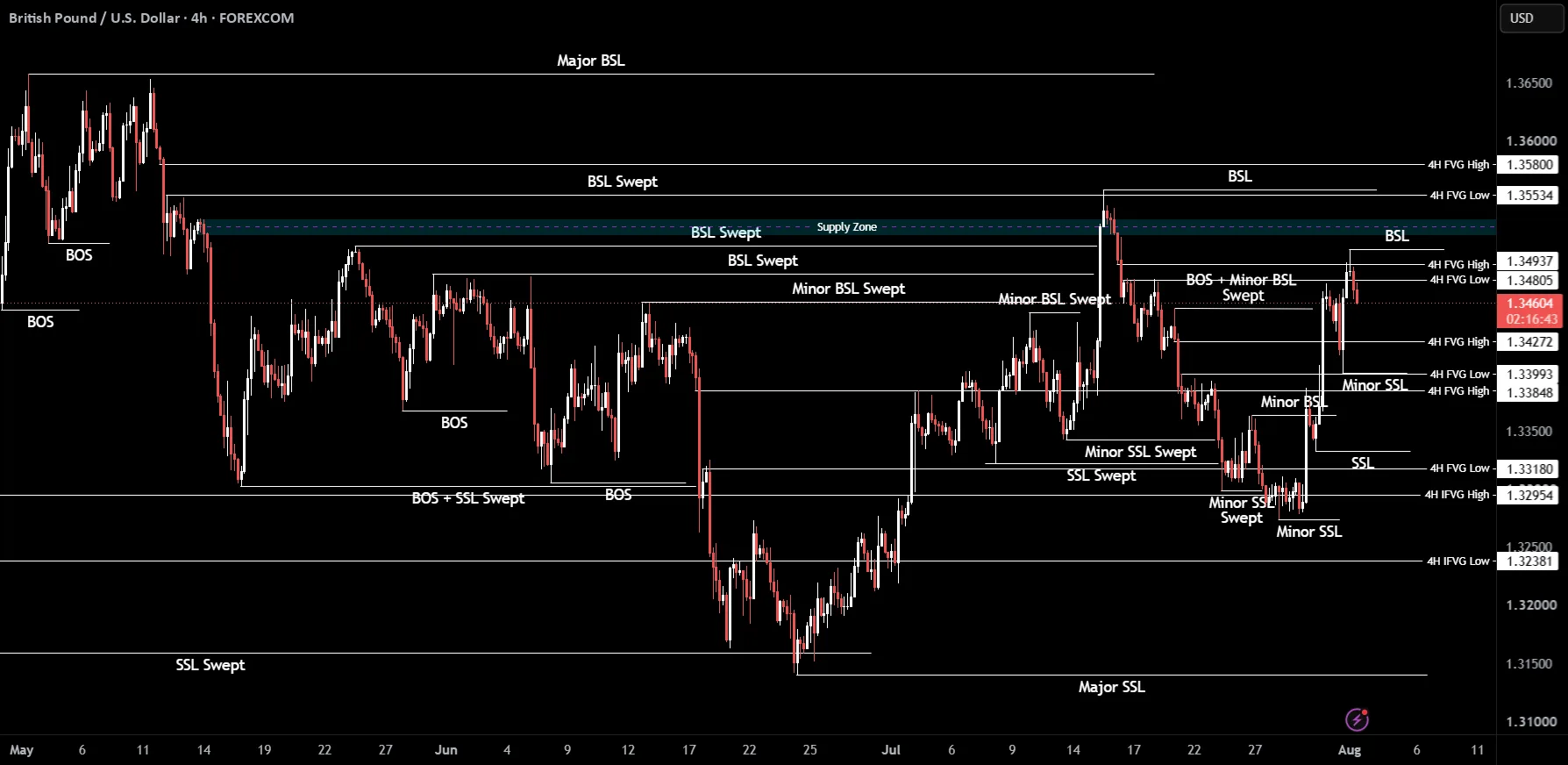
GBPUSD is holding a bullish short-term bias, even as price action suggests the pair may extend lower briefly before attempting a recovery. The central technical feature is a potential liquidity sweep, with support near 1.347 in focus.
If that sweep develops and buyers reclaim momentum, the pair could resume its upward path. For now, 1.3506 stands out as the most important near-term resistance, making it the level that may confirm whether bullish continuation is gaining traction.
Market Snapshot
GBPUSD is being assessed on a short-term forex chart, where price structure remains constructive despite the risk of an initial dip. The broader setup points to a market that may be clearing nearby liquidity below support before attempting to push higher.
In plain terms, the prevailing bias is moderately bullish, but not without volatility. The pair appears to be balancing between a near-term shakeout and a possible continuation move, which makes reaction around support especially important for the next directional clue.
Key Levels
- Support: 1.347, 1.3287
- Resistance: 1.3506
These levels matter because they define the current short-term battle zone. The 1.347 area is the first line of support and may act as the trigger point for a liquidity sweep. Meanwhile, 1.3506 marks the immediate upside barrier that bulls would likely need to clear to reinforce the recovery structure. The deeper 1.3287 support remains a more significant fallback zone if selling pressure intensifies.
Bullish Scenario
The bullish case assumes GBPUSD dips into or just below 1.347, collects resting liquidity, and then stabilizes with renewed buying interest. Such a move would fit the classic liquidity sweep pattern, where an initial downside push is followed by a reversal as weak hands are forced out and fresh demand emerges.
A sustained move back above 1.3506 would strengthen the case for continuation higher. If that level is reclaimed decisively, the pair could rotate into a short-term target zone above the recent local range, with momentum traders likely watching for follow-through rather than a one-candle breakout. In that scenario, the market would be signaling that the dip served as a reset rather than the start of a broader reversal.
Bearish Scenario
The bearish path begins with the near-term drop already implied by the setup. If GBPUSD fails to hold around 1.347 and does not show a credible rebound after the sweep attempt, the bullish structure would start to weaken. That would suggest sellers remain in control for longer than expected, delaying or even canceling the rebound thesis.
A deeper move toward 1.3287 becomes more realistic if the pair loses 1.347 and struggles to recover 1.3506 afterward. In that context, 1.3506 effectively acts as a practical invalidation level for immediate bearish continuation: if price climbs back above it, downside pressure may fade. But if rallies remain capped below that resistance, the path toward lower support stays open.
What to Watch
Macro catalysts remain important for GBPUSD because the pair is highly sensitive to both UK and US economic expectations. Traders will likely monitor upcoming inflation data, labor market releases, central bank commentary, and any shifts in interest-rate pricing that could affect relative strength between sterling and the US dollar.
Session timing also matters. GBPUSD often sees its clearest directional moves during the London session and again when London and New York overlap. If a liquidity sweep occurs during a high-volume window, the reaction may carry more technical significance than a similar move during quieter trading hours.
Correlated assets and broader sentiment should also stay on the radar. The US Dollar Index can help frame whether dollar strength is driving the move, while UK gilt yields and US Treasury yields may offer clues about rate-sensitive positioning. Risk sentiment across broader markets can further influence whether GBPUSD finds support quickly or remains under pressure for longer.
For now, GBPUSD remains in a technically constructive position, but confirmation still depends on how price behaves around support and resistance. The next move is likely to be shaped by whether the market treats the dip as a liquidity event or the start of a deeper retracement.