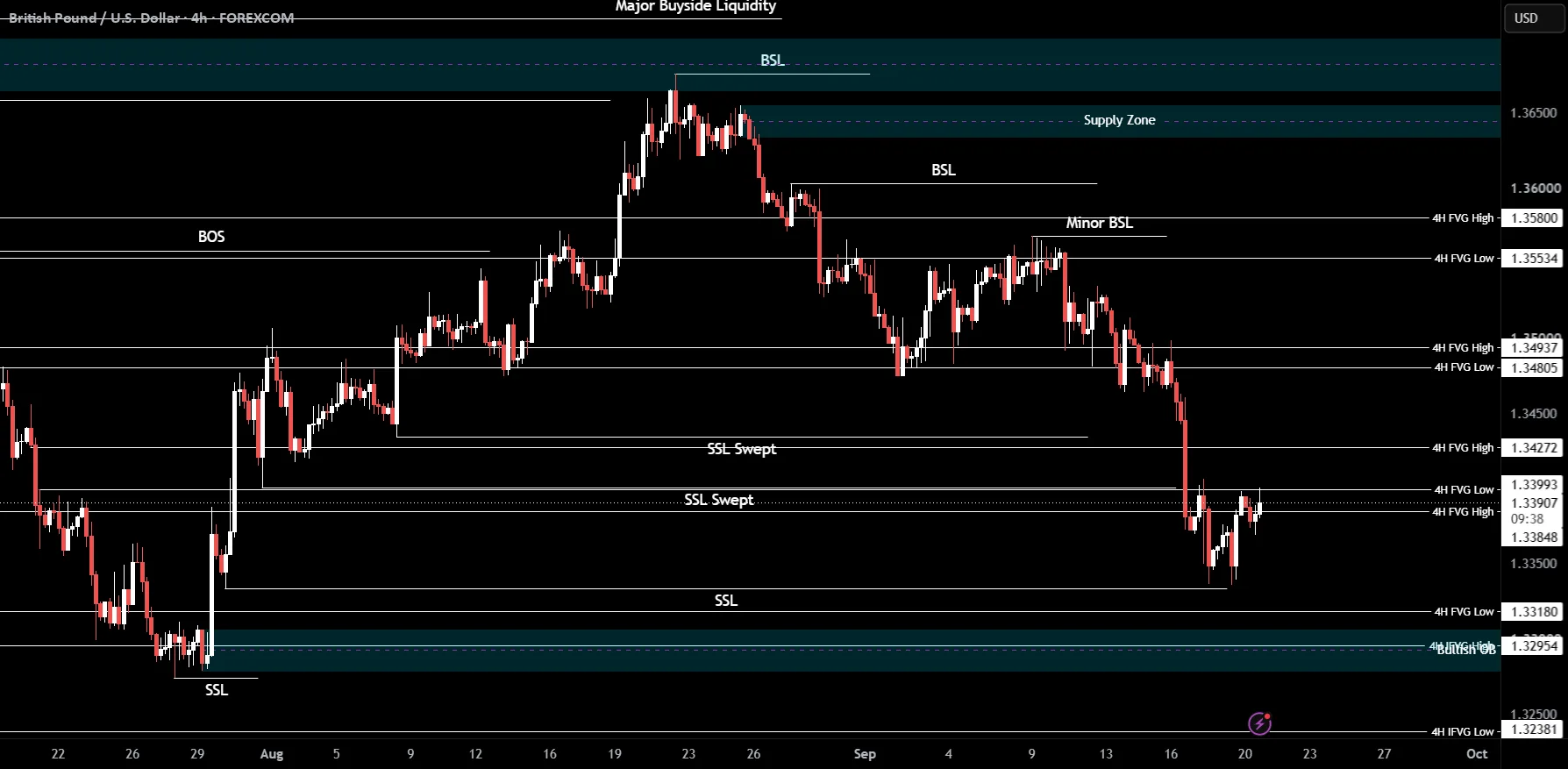
GBPUSD is trading with a neutral bias as price consolidates beneath the 1.34 resistance zone. The most important feature on the chart is the ongoing range structure, with the market compressing between nearby support at 1.3335-1.3333 and a clear psychological ceiling overhead.
For now, the pair appears to be in wait-and-see mode. That makes 1.34 the key level to watch, as a clean break could shift momentum higher, while a move back under 1.3333 would expose lower liquidity and reopen downside pressure.
Market Snapshot
GBPUSD is a major forex pair currently trading in a short-term consolidation phase. On the referenced setup, price action is moving sideways rather than trending cleanly, suggesting a market that is balancing bullish and bearish flows near an important resistance area.
In plain English, the structure remains neutral until one side forces a breakout. Buyers have kept the pair supported above 1.3333, but sellers are still defending the 1.34 zone. Until one of those boundaries gives way, the prevailing bias remains balanced rather than directional.
Key Levels
- Support: 1.3335, 1.3333
- Resistance: 1.34
These levels matter because they define the current consolidation band. The 1.34 area stands out as a psychological barrier and a likely trigger for momentum if broken, while 1.3335 and 1.3333 mark a support pocket where price has found footing. A decisive move outside this range would likely provide the clearest signal on short-term direction.
Bullish Scenario
The constructive scenario for GBPUSD starts with a confirmed move above 1.34. If buyers can push the pair through that resistance and sustain trade above it, the breakout would suggest bullish continuation from the current compression pattern rather than another failed test of the upper boundary.
In that case, the market could begin working toward a higher target zone above the round-number barrier, with follow-through dependent on whether momentum expands after the breakout. A strong hold above 1.34 would be the key trigger, as it would show that the market is no longer trapped inside the recent range.
Bearish Scenario
The weaker path comes into focus if GBPUSD loses support at 1.3333. A move back below that level would indicate that the lower edge of the consolidation has failed, increasing the probability of a sweep into sell-side liquidity resting under the recent base.
That downside development would invalidate the idea of immediate bullish continuation through 1.34 and shift attention toward a lower target zone beneath the current range. The main bearish signal is not simply a dip within the structure, but a more decisive break under 1.3333 that shows sellers are regaining short-term control.
What to Watch
Macro catalysts remain important for GBPUSD because the pair is highly sensitive to both UK and US economic data. Traders will likely monitor releases tied to inflation, labor-market conditions, central bank expectations, and broader growth sentiment, as any surprise in those areas can quickly break a consolidation structure.
Session timing also matters. GBPUSD often becomes more active during the London session and again when London and New York overlap, which is when breakouts from narrow intraday ranges are more likely to gain traction. If price approaches 1.34 or 1.3333 during those higher-liquidity windows, the reaction may carry more significance.
Beyond scheduled data, the pair can also respond to shifts in the US dollar broadly, as well as moves in UK rate expectations and overall risk sentiment. Watching the dollar index and the tone of global markets may help explain whether pressure is building for a topside break or a downside liquidity run.
GBPUSD remains compressed between well-defined levels, and the next move may depend on whether resistance at 1.34 breaks or support at 1.3333 gives way. Until that happens, the pair appears to be consolidating within a neutral short-term structure.