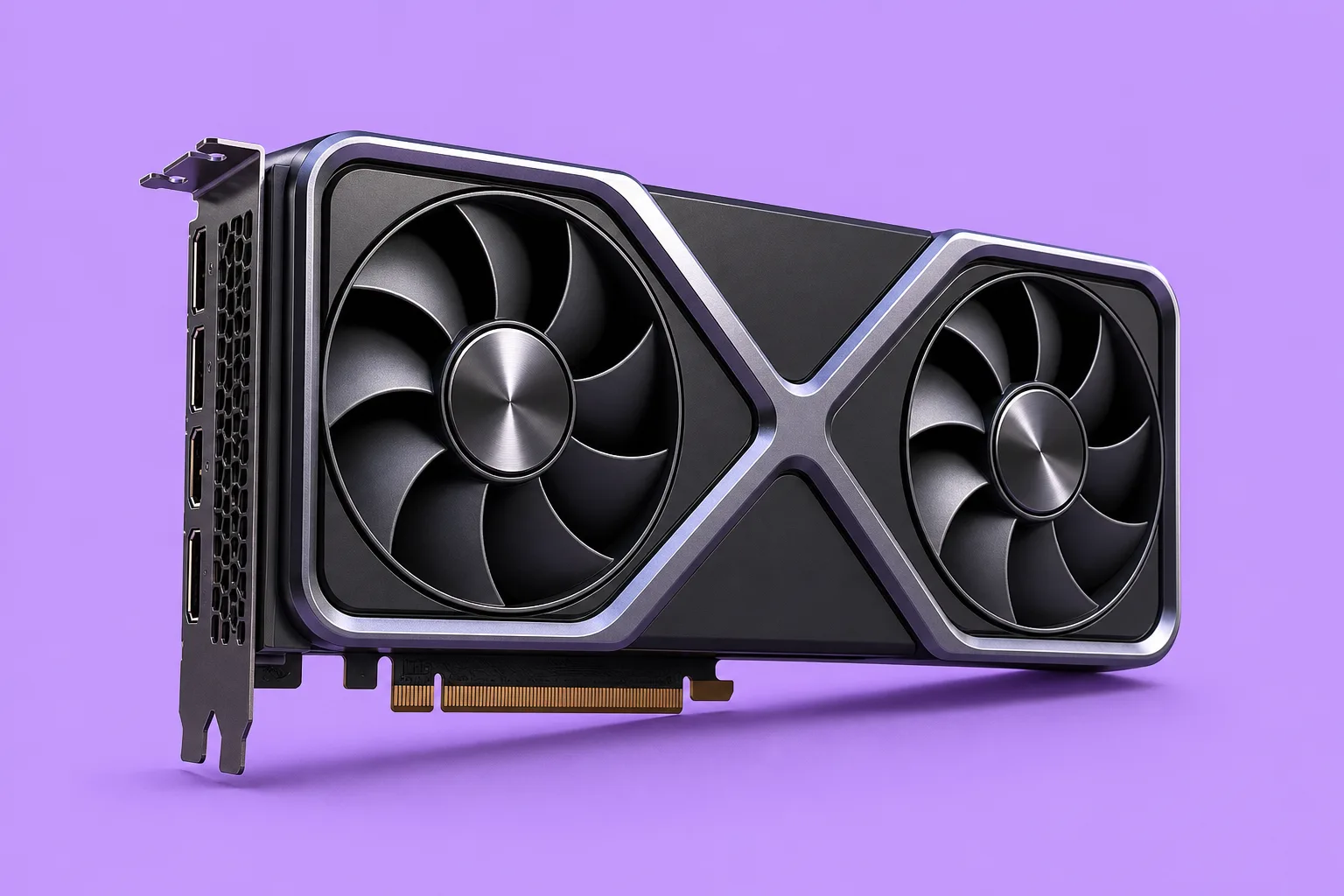
Meta has released Muse Glimmer, a 30-billion-parameter AI model built to run on a single consumer-grade GPU, marking a notable push into the fast-growing market for downloadable AI systems.
The company said the model can fit within roughly 20GB of memory after compression, making it usable on 24GB and 32GB graphics cards as well as high-end laptops. That changes the economics of deploying advanced AI by shifting more workloads away from rented cloud infrastructure.
The release is also significant because Meta published Muse Glimmer under an Apache 2.0 license, a permissive framework that gives developers and businesses broad freedom to use, modify, and distribute the model.
Key Facts
- Meta released Muse Glimmer on August 10, 2026 as a 30-billion-parameter model aimed at agent-style AI tasks.
- The company said compression reduced the model’s memory footprint from more than 55GB at full precision to under 20GB.
- Meta reported speed gains of 3.1x on an RTX 5090, 1.8x on an M5 Max, and 1.5x on an M4 Max using speculative decoding.
- Muse Glimmer was published on Hugging Face under an Apache 2.0 license rather than a more restrictive custom license.
- Meta also announced a $1 billion fund for communities that host its data center infrastructure.
Muse Glimmer
Muse Glimmer is designed for so-called agent work, where a model does more than generate text and instead carries out multi-step tasks such as fixing code, calling external tools, and adjusting when a process fails. That category has become one of the most commercially relevant segments of generative AI because enterprises increasingly want systems that can automate portions of software development, research, support, and internal workflows.
Technically, the model was distilled from Meta’s larger Muse Spark system. Distillation lets a smaller model learn from the outputs of a larger one, preserving much of the larger model’s capability while dramatically lowering hardware demands. Meta paired that with aggressive compression, reducing the precision of the model’s weights to make deployment on consumer hardware feasible without requiring data center-class memory.
The timing matters. Rival open-model ecosystems have expanded quickly, with Google, Alibaba, Mistral, DeepSeek, and others offering compact models for local use. Meta helped popularize open-weight AI but had increasingly faced criticism that its more recent releases imposed restrictions that limited commercial flexibility. By using Apache 2.0 for Muse Glimmer, the company is signaling a more developer-friendly posture at a time when open, portable AI is becoming strategically important.
Meta is betting that powerful AI running on local hardware will be cheaper, easier to customize, and strategically harder to lock into cloud platforms.
Why the hardware efficiency matters
A 30B model at full precision would normally require more than 55GB of memory, far beyond the reach of most mainstream graphics cards. By shrinking that footprint to under 20GB, Meta has made a model of this size practical for advanced desktops and laptops used by developers, startups, and enterprise teams experimenting with private AI deployments.
The second performance lever is speculative decoding. Instead of generating every token sequentially at full cost, the system uses a smaller assistant model to predict chunks of text and lets the main model verify them in batches. That approach can materially improve throughput, which is critical for coding assistants and task-oriented agents where responsiveness shapes user adoption.
Implications for Investors
For investors, Muse Glimmer highlights a structural shift in AI monetization. If more capable models can run locally on a single GPU, some value may migrate away from centralized inference providers and toward edge hardware, developer tooling, and software layers that help companies customize, secure, and manage on-device AI. Graphics hardware makers, workstation vendors, and providers of AI deployment software could benefit if local inference adoption accelerates.
The release also sharpens competitive pressure across the open-model landscape. Permissive licensing can increase adoption by reducing legal uncertainty for startups and enterprises, especially compared with models that carry usage restrictions. If Muse Glimmer gains traction, it could strengthen Meta’s influence over the software stack even if direct monetization is limited, reinforcing its broader ecosystem strategy in AI.
There are still important caveats. Meta’s performance comparisons against Gemma4-31B and Qwen3.6-27B come from internal testing, so third-party benchmarks will be closely watched. Investors should also monitor whether downloadable models begin to erode demand for cloud-based inference in some workloads, or whether they instead expand the total addressable market by making AI deployment cheaper and more accessible.
Looking ahead, Meta has indicated that a version of Muse Spark will follow in the coming weeks, with larger models after that. The next phase will show whether the company can pair open distribution with competitive performance strongly enough to regain leadership in the rapidly evolving open AI market.