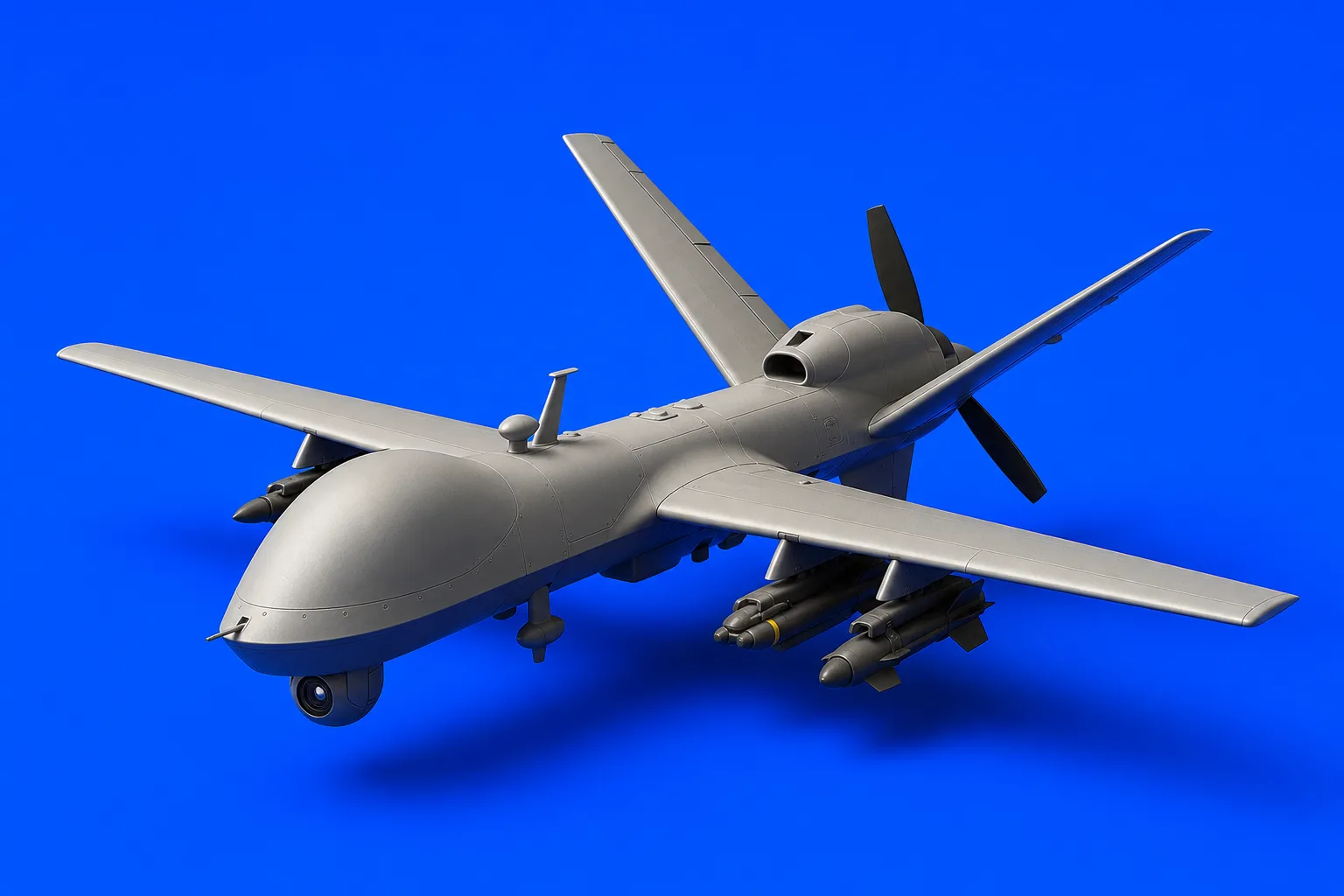
Military drone imports have become heavily concentrated in a single conflict. From 2022 through 2025, Ukraine received 8,664 foreign-supplied military drones and Russia took in 6,720, combining for 91.4% of the global total of 16,822 recorded transfers.
That concentration underscores how rapidly warfare is redirecting defense procurement, industrial capacity, and geopolitical supply chains. For investors tracking aerospace, defense electronics, munitions, and dual-use manufacturing, the numbers offer a clear signal: demand for unmanned systems is no longer a niche trend but a central feature of modern defense spending.
The figures cover only a narrow slice of the market, but the direction is unmistakable. Even with major exclusions such as small first-person-view systems and most domestically built drones, military drone imports are now closely tied to urgent battlefield requirements and broader national rearmament plans.
Key Facts
- Ukraine imported 8,664 military drones from 2022 to 2025, equal to 51.5% of the global recorded total.
- Russia imported 6,720 military drones over the same period, representing 39.9% of worldwide recorded transfers.
- The global total reached 16,822 military drone imports between 2022 and 2025.
- Taiwan ranked third with 291 imported drones, or 1.7% of the global total.
- Long-range one-way attack drones and loitering munitions made up 97% of the transfers captured in the dataset.
Military Drone Imports
The ranking shows an unusually steep drop after the top two buyers. Ukraine and Russia dominate recorded cross-border military drone flows by a wide margin, while no other country reached 300 imported systems during the four-year period. Taiwan placed a distant third at 291, followed by South Korea at 190, Azerbaijan at 154, India at 119, and Georgia at 100.
Ukraine’s recorded imports were heavily concentrated in U.S. systems, which accounted for 83% of its total. Russia’s imports were largely linked to Iranian Shahed-136 drones, a platform that has become central to Moscow’s long-range strike strategy. Over time, the Russian program has shifted from direct imports toward local production of related versions such as the Geran-2, highlighting how foreign supply can evolve into domestic manufacturing capability.
For markets, the bigger takeaway is not only who is buying but what is being counted. The dataset focuses on major weapons: larger drone aircraft with a loaded weight of at least 150 kilograms, plus one-way attack drones and loitering munitions. That means the headline figures capture a strategically important but incomplete segment of the unmanned systems economy. Investors should read them as evidence of high-value procurement intensity rather than a full census of drone warfare.
The recorded trade in military drones now revolves around one conflict, but the broader unmanned arms race is already much larger than the official import totals suggest.
Why the Real Market Is Much Bigger
The most important caveat is that small FPV drones and many commercial-derived systems are mostly outside the scope of the data, even though they now play a major role on the battlefield. The scale gap is striking. The United Kingdom alone delivered more than 85,000 smaller military drones to Ukraine in the first six months of 2025, roughly five times the recorded global total of major drone transfers over the full 2022-2025 period.
Domestic production also changes the picture. Ukraine’s defense industry has capacity to produce more than 8 million FPV drones annually, while Ukrainian intelligence estimates Russia produces about 2,800 Geran-2 drones per month. Those volumes dwarf the import counts and suggest that future value creation may increasingly sit with manufacturers of components, software, propulsion systems, sensors, communications links, and counter-drone technology rather than with cross-border airframe deliveries alone.
Implications for Investors
For defense investors, the data reinforces a long-duration demand story in unmanned systems. Companies exposed to loitering munitions, autonomous navigation, secure communications, electronic warfare, and anti-drone defenses may benefit as procurement shifts from experimental adoption to sustained replenishment. The concentration of imports in Ukraine and Russia also suggests that wartime urgency can accelerate product validation and shorten the path from deployment to larger orders elsewhere.
Taiwan deserves particular attention. Its 291 imported drones in 2025 place it well behind the two wartime leaders, yet its stated ambition is far larger: plans call for up to 200,000 drones over the coming decade. That target, if pursued, could support a broad procurement ecosystem across U.S. and allied suppliers, as well as domestic assembly, software integration, and resilient supply-chain initiatives. For investors, Taiwan is less a current volume story than a forward-looking indicator of how Indo-Pacific security concerns may shape future spending.
There are also risks. Defense orders can be politically sensitive, unevenly timed, and vulnerable to export controls, budget negotiations, and shifting military doctrine. In Russia’s case, the transition from imported Shahed-136 units toward domestic Geran-2 output shows how quickly supplier relationships can change. In NATO and allied markets, procurement may increasingly favor local manufacturing, licensed production, and multi-source supply chains, affecting margins and competitive positioning across prime contractors and smaller subsystem firms.
Another watch-point is classification. Because the fastest-growing part of the battlefield drone market includes low-cost systems often excluded from major arms databases, investors should avoid relying on headline import figures alone. Revenue opportunities may be strongest in adjacent areas: optical payloads, semiconductors, batteries, guidance kits, data links, battlefield networking, and counter-UAS interceptors. The drone theme is broadening from platforms to full-stack defense technology.
Military drone imports from 2022 to 2025 reveal a market shaped by war, urgency, and industrial adaptation. The next phase will depend less on raw import counts and more on which countries can scale production, secure supply chains, and turn battlefield lessons into durable procurement programs.