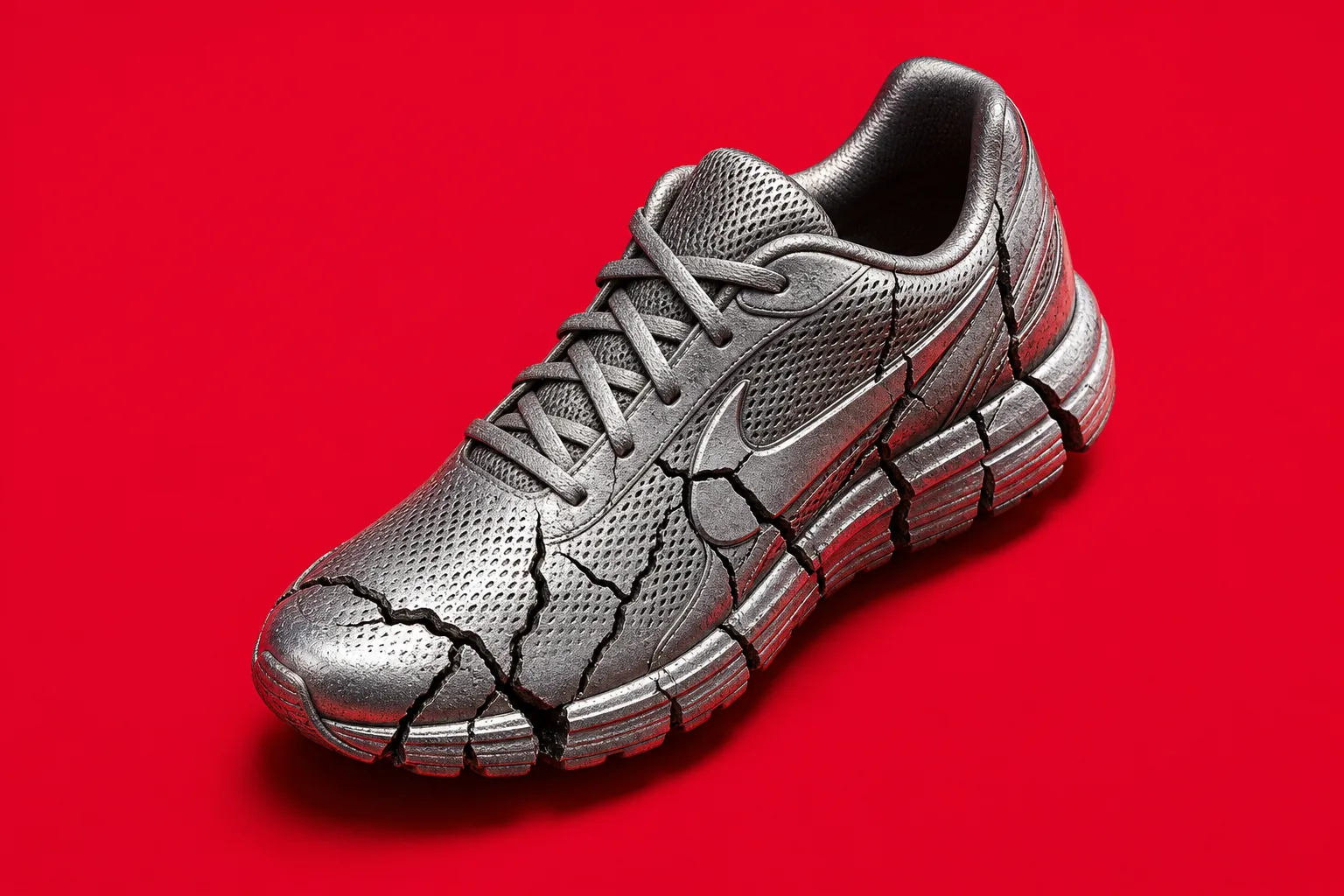
Nike stock came under renewed pressure after the company warned that sales declines over the next two quarters will be worse than previously expected, reinforcing concerns that the athleticwear giant’s turnaround will take longer to materialize.
Shares fell 3% in premarket trading after management signaled that demand conditions remain weak, particularly in sportswear and North America. The update overshadowed better-than-expected fourth-quarter results and pushed investors to focus on the pace of recovery rather than the latest earnings beat.
For a company whose shares are trading near 2014 levels, the central question is no longer whether Nike can improve margins, but whether it can restore sustainable revenue growth without sacrificing long-term brand momentum.
Key Facts
- Nike shares fell 3% in premarket trading after the company lowered its near-term sales outlook.
- The company now expects sales to decline in the low-to-mid single digits, versus an earlier forecast for a low-single-digit decline.
- Management said the softer trend is expected over the next six months, with slower wholesale shipments in North America a major factor.
- Nike’s performance business grew 5% in the fourth quarter, even as broader sportswear demand remained under pressure.
- UBS said the stock still looks expensive at about 27 times its fiscal 2027 EPS estimate.
Nike Stock
Nike’s latest quarter delivered a familiar split for investors: operating execution showed signs of control, but top-line momentum remained elusive. The company posted fourth-quarter sales and profit that were broadly better than feared, yet management’s commentary made clear that the broader business reset is still in progress. Executives described the environment as increasingly challenging as the quarter developed, with North America slowing by mid-April.
The revised outlook matters because it suggests the recovery is not simply being delayed by a single product cycle or temporary inventory issue. Nike is still working through weakness in sportswear, Jordan and streetwear, while also managing inventory and tighter buying patterns in several regions, including China. That creates a more complicated turnaround than a typical rebound driven by one blockbuster franchise or a one-quarter promotional cleanup.
Investors are also weighing a structural question inside the business mix. Analysts have pointed to Nike’s fashion-oriented categories as a persistent weak spot, even though performance categories such as running have been more resilient. If Nike leans harder into performance and trims exposure to slower-moving fashion segments over time, the brand may strengthen strategically, but the transition could weigh on revenue growth for multiple years.
“We are not expecting the environment to improve meaningfully over the next six months.”
Why the recovery is taking longer
One reason sentiment remains cautious is that margin improvement alone may not be enough to re-rate the stock. Nike modestly improved its gross margin outlook and trimmed selling, general and administrative expense expectations, allowing it to preserve broader profit guidance. That discipline is a positive, especially for a company trying to rebuild profitability after a difficult stretch.
But cost control has its own limits. Some analysts worry Nike may be restraining investment too aggressively in order to protect near-term earnings per share. If marketing, innovation, digital development or wholesale support need to increase later to reignite sales, margins could face renewed pressure. In other words, the current balance between earnings defense and growth reinvestment may not hold indefinitely.
There are still areas of progress. The performance business grew 5% in the fourth quarter, and management appears to be applying operational improvements seen in running to categories such as basketball, training, outdoor and tennis. If those efforts gain traction, Nike could produce upside surprises in demand over the next 12 months. For now, however, investors are being asked to wait while the company proves that gains in select categories can outweigh broader weakness.
Implications for Investors
For shareholders, Nike presents a classic turnaround debate: the brand remains globally powerful, but the timing and shape of the recovery remain uncertain. The biggest near-term risk is that the market has not fully discounted a prolonged reset. If revenue pressure extends beyond the next two quarters, valuation could remain vulnerable even if margins improve.
At roughly 27 times a fiscal 2027 earnings estimate cited by UBS, the stock does not appear deeply discounted relative to the operational uncertainty still facing the business. That matters because premium valuations typically require clear evidence of accelerating growth, stronger direct-to-consumer trends, or a faster rebound in wholesale demand. At the moment, Nike is offering only partial visibility on those fronts.
Still, there are reasons investors will keep watching the name closely. Nike is demonstrating tighter cost control, its performance categories are showing resilience, and management is signaling that June trends improved from the slowdown seen in mid-April, helped in part by interest around global football. If that momentum broadens and inventory normalization progresses without heavy discounting, sentiment could stabilize. Key watch-points include North America wholesale shipments, direct-to-consumer demand, China inventory, and whether the company can rebuild sales without eroding brand pricing power.
Nike remains one of the most closely watched consumer discretionary stocks, but the next phase of the story will be defined by revenue credibility rather than cost cutting alone. Until sales trends show a clearer inflection, investors may continue to treat the stock as a recovery candidate rather than a confirmed turnaround.