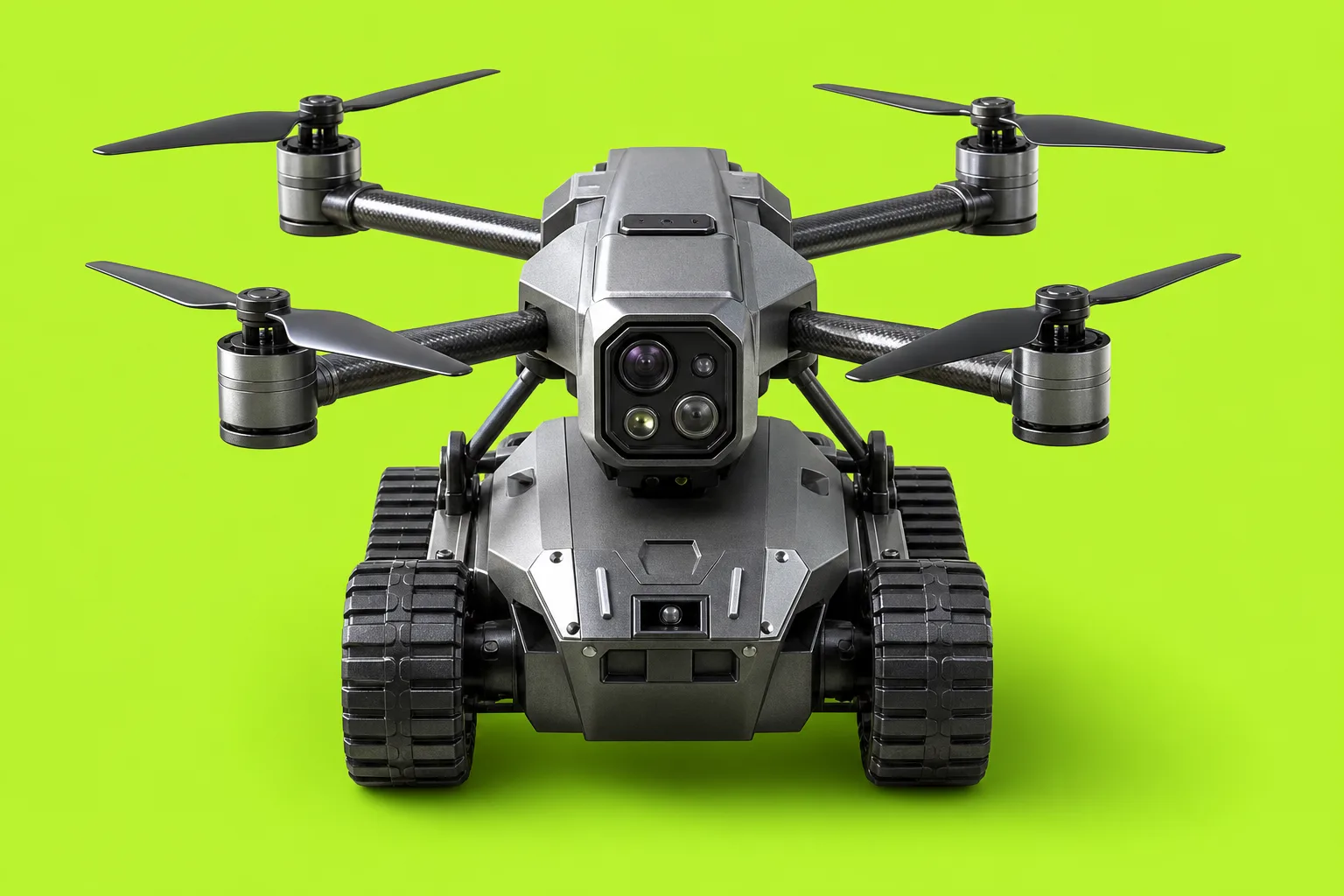
Ondas has moved aggressively to expand in autonomous defense systems, announcing 14 acquisitions since October 2025 and committing roughly $2.1 billion to the strategy. The buying spree has reshaped the company from a smaller drone-focused operator into a broader supplier of air, ground and counter-drone technologies.
The market opportunity is substantial. One analyst estimates the global market for autonomous and AI-driven defense systems exceeds $100 billion, while Ondas is positioned to pursue more than $45 billion of that addressable demand.
For investors, the central question is no longer whether Ondas is expanding, but whether the company can integrate its deals fast enough to convert backlog, program wins and military demand into durable revenue growth.
Key Facts
- Ondas has announced 14 acquisitions since October 2025, deploying about $2.1 billion after raising roughly $1.9 billion from investors.
- The largest transaction was the $875.8 million acquisition of DZYNE Technologies, adding long-endurance aircraft, autonomous strike systems, drone swarms and counter-UAS capabilities.
- Ondas now expects revenue of more than $525 million, up from a prior expectation of $170 million to $180 million entering 2026.
- The company has reported a backlog of $457 million, $1.6 billion in program wins and a two-year opportunity pipeline valued at $4.3 billion.
- Ondas shares closed at $9.31 on August 10, while a cited analyst target of $13 implied about 40% upside and the broader 12-month average target stood at $19.28.
Ondas defense tech expansion
Ondas is trying to position itself at the center of a fast-growing defense technology shift: the move toward low-cost, AI-enabled autonomous systems that can operate across multiple domains. Its recent acquisitions extend the company beyond drones into counter-drone cyber tools, precision-strike platforms, stratospheric surveillance, ground robotics and military engineering applications.
A key part of that strategy is SkyWeaver, an AI platform developed with Palantir Technologies that is designed to connect drones, ground vehicles, sensors and high-altitude surveillance assets into a unified command-and-control network. That matters because defense procurement is increasingly focused not only on individual vehicles, but on integrated systems that can share data, improve battlefield awareness and support faster decisions.
The acquired portfolio also broadens Ondas’ reach beyond combat missions. The company now markets systems relevant to military bases, borders, airports, stadiums and critical infrastructure, giving it exposure to both defense and homeland security spending. If procurement budgets continue to prioritize autonomous systems, Ondas could benefit from a wider set of customers than a pure-play drone manufacturer.
Ondas is making a high-stakes bet that scale, integration and AI-enabled autonomy will matter more to defense buyers than standalone hardware.
What the acquisition spree added
The transactions show a deliberate effort to build a full-stack autonomy platform. DZYNE Technologies strengthened the company across all five Pentagon drone classifications, including larger high-altitude systems. SentryCS added cyber-focused counter-drone tools, while World View contributed stratospheric surveillance platforms. Omnisys brought AI-based battlefield resource optimization software, and Mistral added defense contracting access tied to Army and Special Operations procurement channels.
Additional deals involving Roboteam, 4M Defense and INDO Earth expanded Ondas into ground robotics, military engineering and autonomous demining. Together, these assets give the company a more diversified product lineup, but they also raise the complexity of execution. Integration, manufacturing discipline, customer support and regulatory compliance become more difficult as the portfolio grows.
Implications for Investors
For investors, Ondas offers exposure to one of the most discussed themes in defense: autonomous systems shaped by recent battlefield lessons and rising military budgets. Forecasts cited in the market point to revenue of $520.5 million in 2026, $1 billion in 2027 and $1.23 billion in 2028. If those figures are achieved, the current business would look materially different from the smaller company investors were assessing before the M&A wave.
But the opportunity comes with meaningful risk. Ondas has financed much of its expansion with fresh capital, and investors will want evidence that acquired businesses can be integrated without margin erosion or operational disruption. A backlog of $457 million and program wins of $1.6 billion suggest demand, yet defense contracts can be delayed, resized or shifted by budget cycles and procurement processes.
Trading behavior also deserves attention. Ondas shares have remained roughly between $6 and $14 over the past year, suggesting the market is still debating whether the company deserves a higher valuation multiple. A sustained move above that upper range could indicate growing confidence in execution and order conversion. If revenue synergies disappoint, however, the stock could remain volatile as investors reassess the benefits of the acquisition strategy.
The next phase for Ondas will depend on contract momentum, integration results and proof that its enlarged platform can translate technology breadth into repeatable cash-generating growth. For investors tracking defense tech, the company is becoming a closely watched test case for whether consolidation can create a scaled autonomous systems contender.