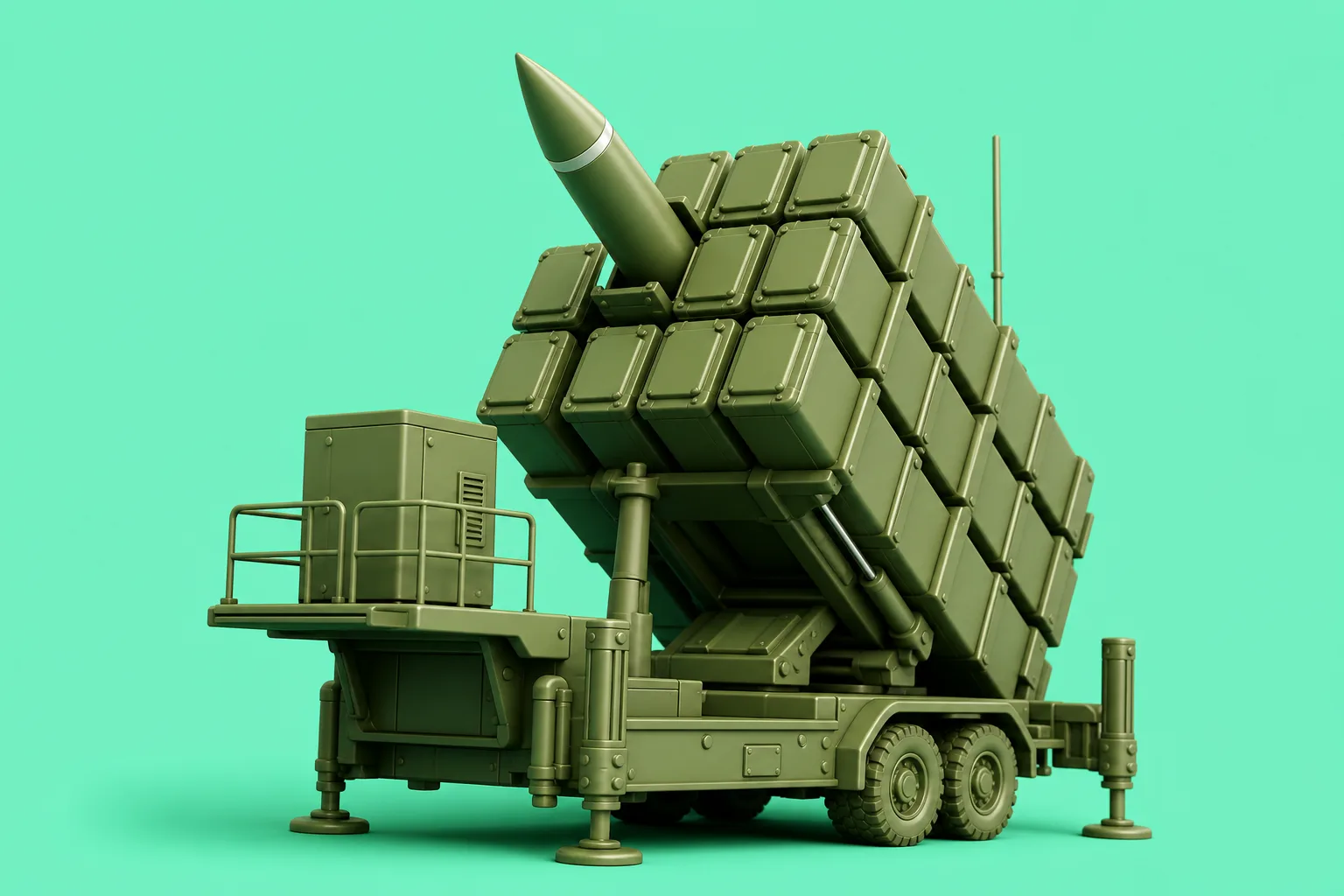
Donald Trump’s promise at a NATO summit in Turkey to grant Ukraine a license to produce Patriot air defense systems has quickly become a flashpoint in the debate over Western military support and defense industrial capacity. The core issue is not political symbolism, but whether Ukraine can realistically manufacture any part of one of the world’s most complex missile defense systems while the war continues.
The Patriot missile license idea matters because Ukraine urgently needs more air defense coverage, yet experts argue the pledge may overstate what can be done in the near term. Even under favorable conditions, setting up production lines for missiles, launchers, radars or command systems would require time, secure facilities and a broad supplier network.
Ukrainian officials welcomed the opening and pushed for rapid follow-through, but defense and industrial analysts have warned that local production may be limited to partial assembly using imported components. That distinction is critical for investors tracking defense manufacturing, supply chains and the long-term economics of military procurement.
Key Facts
- Trump said at the NATO summit in Turkey that Ukraine would get the right to make Patriot systems and could potentially produce them quickly.
- He also said U.S. defense companies are already building four plants in the United States related to this broader production push.
- Defense specialists say full-scale Patriot production involves hundreds of suppliers making engines, guidance systems, communications equipment and control components.
- Analyst Alexey Kushch argued that only semi-knocked-down assembly of Patriot missiles using imported parts would be feasible in Ukraine during active hostilities.
- Trump suggested parts of the expansion could move in two to three months, while industry observers caution that meaningful local production would likely take years.
Patriot missile license for Ukraine
The Patriot missile license for Ukraine has become a test of how far political declarations can translate into industrial reality. Trump’s wording referred broadly to producing “Patriots,” but that label can cover several distinct elements: interceptor missiles, launchers, radar arrays, command-and-control units, or selected components. Each segment has different technology barriers, security needs and timelines.
That ambiguity matters because investors and policymakers often treat defense announcements as immediate catalysts for output growth. In practice, advanced air defense systems are among the most difficult products to localize. Missile production alone depends on precision engineering, specialized electronics, propellants, testing infrastructure and tightly controlled export licensing. A narrow assembly agreement is far easier to establish than a full manufacturing ecosystem.
Ukraine has strong incentives to push for domestic capability. A local assembly or manufacturing footprint could reduce transport bottlenecks, deepen strategic ties with U.S. defense suppliers and create a foundation for postwar industrial development. But active missile threats across the country create a major operational risk. Protected production sites, redundancy planning and hardened logistics would all be necessary before even partial assembly could scale.
“A Patriot license may be strategically important, but during wartime the difference between final assembly and full domestic production is the difference between headline value and real industrial capability.”
Why experts are questioning the timeline
One of the sharpest critiques centers on timing. Analysts in Ukraine’s defense and industrial circles argue that localized Patriot production cannot be meaningfully developed on a wartime footing without severe constraints. Kushch’s view was that semi-knocked-down production, effectively assembly from imported kits and components, is the most realistic near-term option. That would still depend on secure facilities and steady inbound supply from abroad.
The comparison with other defense projects is also telling. Ukraine has sought broader localization with foreign defense partners, yet large-scale projects from major international manufacturers have not fully materialized inside the country during hostilities. That history suggests investors should separate strategic intent from executable factory output, especially for highly sophisticated systems with long certification and integration cycles.
Implications for Investors
For investors, the immediate takeaway is that sentiment around the Patriot missile license for Ukraine may run ahead of industrial fundamentals. The companies most likely to benefit in the near term are not necessarily those tied to hypothetical Ukrainian factory buildouts, but established defense contractors and component suppliers already embedded in U.S. and allied production networks. Existing backlog visibility, not political rhetoric alone, remains the stronger driver of revenue forecasts.
The second implication is supply-chain leverage. If any licensing arrangement advances, the first commercial opportunities would likely center on subsystems, maintenance, assembly support, training, secure infrastructure and logistics. Firms exposed to missile electronics, radar technologies, hardened industrial construction and defense software could see longer-term relevance. However, investors should be cautious about assigning rapid earnings upside to localized production before contract scope, financing and facility protection are defined.
There is also a geopolitical demand story behind the announcement. Patriot demand has remained elevated among U.S. allies, particularly as global inventories have come under pressure and replenishment needs have grown. That supports a constructive backdrop for the broader air defense complex. Even if Ukraine-based production proves slow or limited, heightened demand for interceptors, launch systems and radar support can still reinforce order books across the sector.
The next market-moving signals will be concrete ones: licensing terms, named industrial partners, plant locations, capital commitments and whether the arrangement covers full systems, components or assembly only. Until then, the Patriot story is better viewed as a strategic indicator than a near-term manufacturing breakthrough.