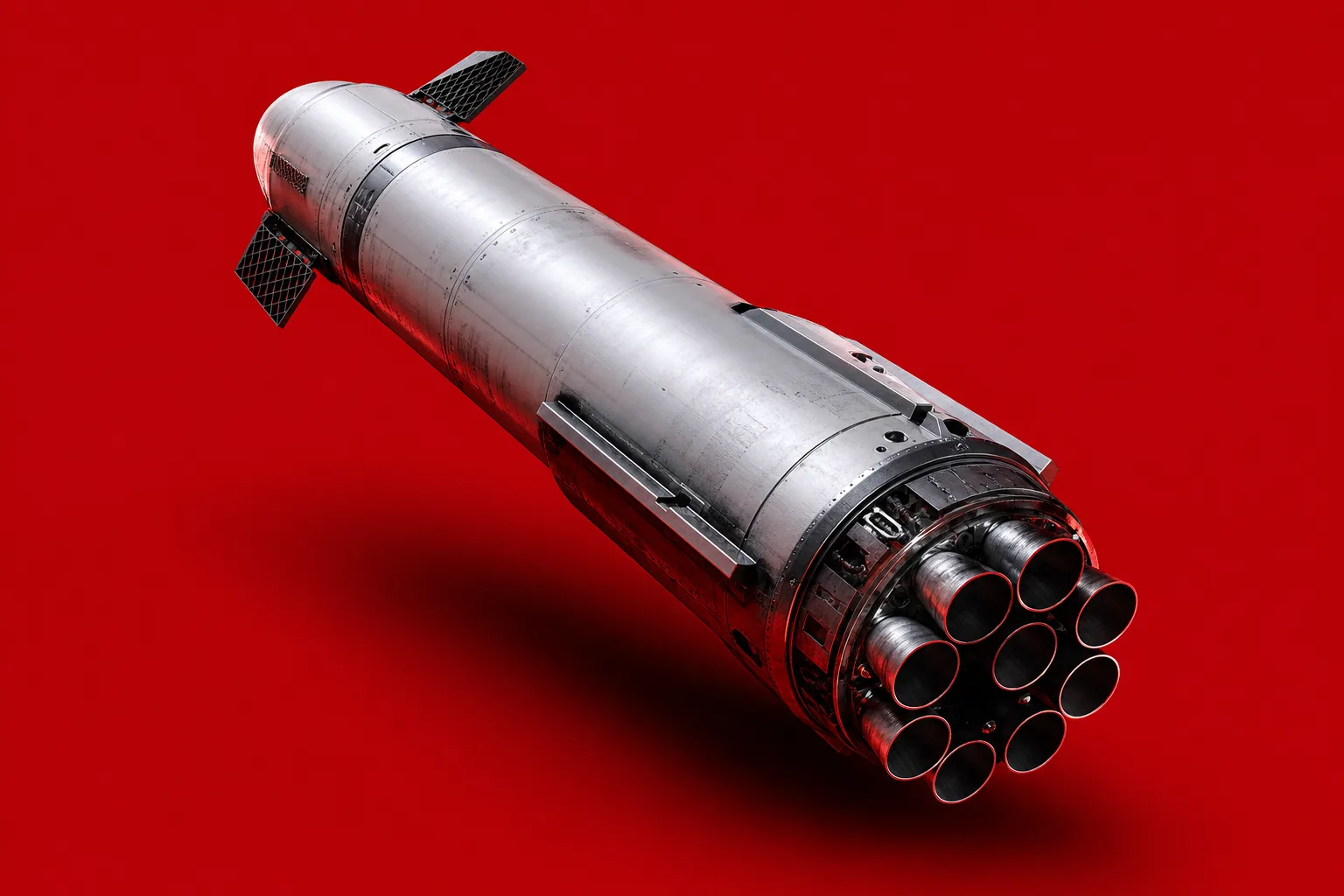
A spent SpaceX Falcon 9 upper stage is forecast to collide with the Moon on Aug. 5 at 06:34 UTC, in a rare deep-space debris event that could be visible from Earth. Researchers estimate the roughly 3,900-kilogram rocket stage will hit near Einstein Crater at about 2.43 kilometers per second.
The expected impact is drawing attention far beyond astronomy circles because it combines a measurable physical event with a growing policy issue: what happens to discarded spacecraft hardware as lunar activity accelerates. With governments and private companies expanding Moon ambitions, even an unplanned collision has implications for long-term space operations.
If the modeling is accurate, the impact could generate the first debris plume on the Moon’s sunlit side observed from Earth, turning an otherwise accidental crash into a useful test case for lunar science and space-debris management.
Key Facts
- A Falcon 9 upper stage with an estimated mass of about 3,900 kilograms is projected to hit the lunar surface on Aug. 5 at 06:34 UTC.
- The stage is expected to strike at roughly 2.43 km/s, equivalent to about 8,750 km/h or 5,437 mph.
- Researchers project an ejecta curtain rising about 15 to 20 kilometers and a central ejecta spike reaching 75 to 100 kilometers.
- The debris field could extend about 183 kilometers laterally from the impact point near the Moon’s sunlit limb.
- Early estimates suggest the collision may excavate a crater of roughly 100 feet across.
SpaceX Falcon 9 Moon Impact
The event centers on a Falcon 9 upper stage left in orbit after a mission in January 2025. Instead of remaining in a stable trajectory, the hardware is now on course to strike the Moon, creating a high-speed impact that researchers have modeled using high-resolution physics simulations. Their work suggests the resulting plume may briefly stand out against the dark-sky background by several orders of magnitude, especially in the first minutes after impact.
That matters because direct observations of impact plumes can reveal how lunar surface material behaves under stress, how dust travels in low gravity, and how crater formation unfolds in real conditions rather than laboratory models. A visible plume on the sunlit side of the Moon would offer a valuable calibration point for future remote-sensing studies and mission planning, particularly for operators considering landing zones, habitats, or surface equipment.
The incident also underscores a more practical issue: cislunar space is getting busier. The United States, China, and commercial launch providers are all positioning for a stronger presence around the Moon. As traffic increases, abandoned upper stages, mission leftovers, and navigation errors could become operational hazards. For investors watching the space economy, this is a reminder that infrastructure growth in orbit and beyond Earth will require not just launch capacity, but also better tracking, disposal protocols, and standards for responsible mission design.
An accidental Moon collision is becoming an unplanned stress test for both lunar science and the emerging rules of the cislunar economy.
Why the plume could matter
The modeling points to a debris cloud large enough to attract telescopic observation from Earth if lighting and timing cooperate. Researchers estimate brightness levels shortly after impact could exceed background conditions by a wide margin, with a particularly intense signal in the earliest resolved moments. If confirmed by observation, that would provide a rare data set linking impact velocity, mass, ejecta height, and surface response.
There is also a strategic dimension. Future lunar bases, communications relays, and logistics networks will depend on accurate forecasting of impact risk, dust movement, and surface disturbance. Even a single unplanned event can improve assumptions used by aerospace contractors, insurers, and mission planners building the business case for sustained lunar operations.
Implications for Investors
For public-market investors, the immediate financial effect on SpaceX is limited because the company is privately held and the incident does not appear tied to an active crewed or commercial service failure. But the broader read-through for aerospace and defense names is more meaningful. The event reinforces demand for space situational awareness, debris tracking, mission-planning software, precision navigation, and in-space sustainability technologies.
Companies with exposure to lunar logistics, satellite servicing, optical observation, and defense-oriented space monitoring could benefit as regulators and customers place greater emphasis on asset accountability beyond Earth orbit. As cislunar missions scale up, procurement priorities are likely to shift toward systems that reduce collision risk and improve end-of-life disposal. That could create opportunity across launch-adjacent manufacturing, tracking networks, propulsion subsystems, and specialized sensors.
The main watch-points are policy and contracts. Investors should monitor whether space agencies and national regulators respond with stricter debris-mitigation standards for lunar missions, and whether that leads to new funding for tracking infrastructure or cleanup-related capabilities. The long-term winners may not be the firms generating headlines with launches, but the ones building the systems that make repeatable lunar operations safer and more insurable.
The Aug. 5 impact is a singular event, but its significance reaches into the next phase of the space economy. If the plume is observed as projected, it may sharpen both scientific understanding and commercial urgency around how humanity manages traffic on the road back to the Moon.