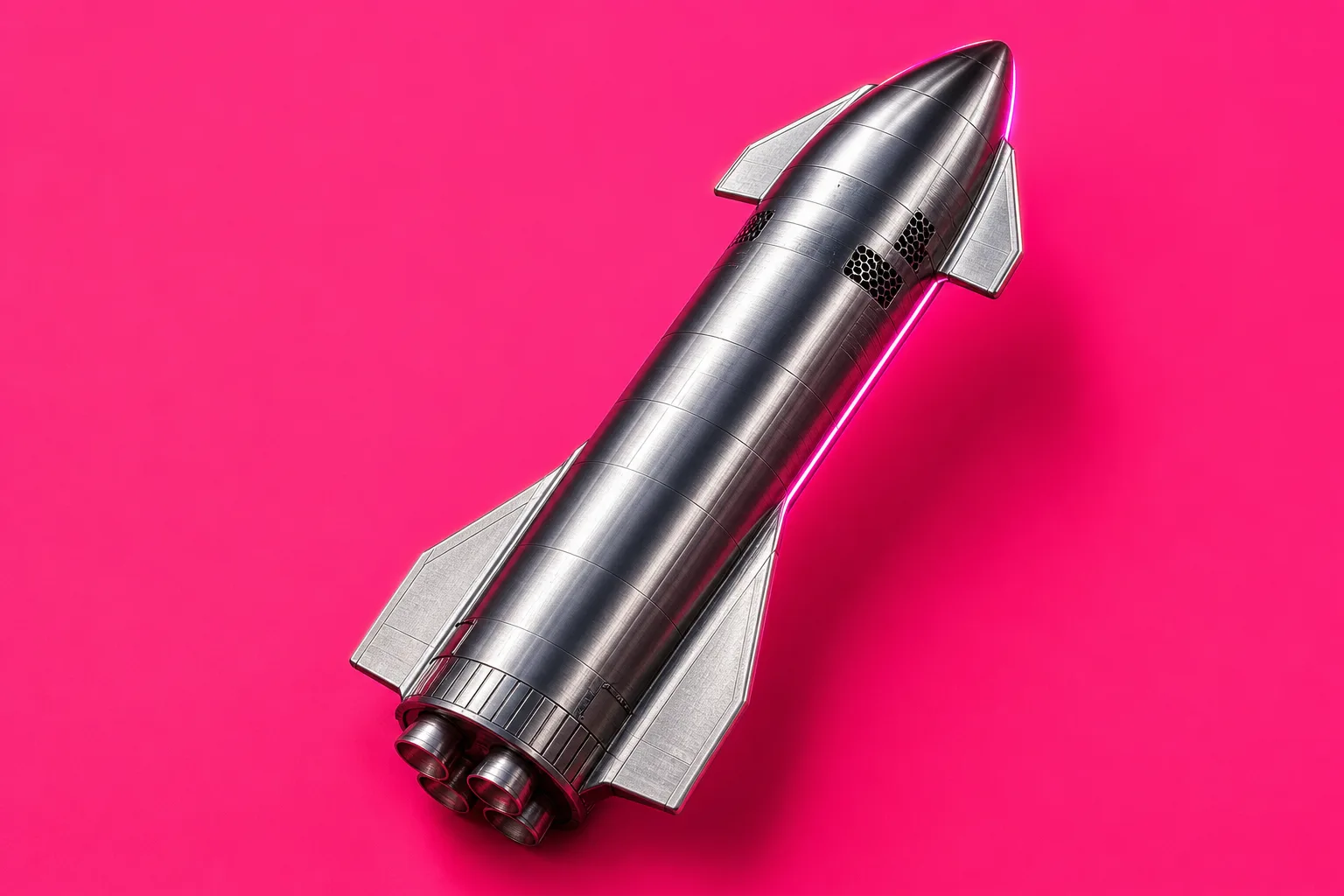
SpaceX Starship Flight 13 delivered a mixed but meaningful result for investors: the company successfully deployed 20 next-generation Starlink V3 satellites and completed the upper stage’s primary objectives, even as the Super Heavy booster again failed to execute a fully successful landing burn.
The mission matters because Starship is central to SpaceX’s long-term economics. Full or near-full reusability would lower launch costs, expand Starlink deployment capacity, and strengthen the company’s position in commercial launch and satellite broadband.
Shares were trading near $113 in premarket action after the test, down about 50% from post-IPO highs and roughly 15% below the $135 offering price, underscoring how closely public-market sentiment is now tracking technical milestones.
Key Facts
- Starship Flight 13 successfully deployed 20 functional Starlink V3 satellites on July 24, 2026.
- The first launch attempt on July 16, 2026 was aborted after 4 of 33 Super Heavy Raptor engines failed to ignite.
- The launch commit criteria allow a maximum of 2 engines out at liftoff, triggering an automatic abort.
- SpaceX replaced 6 Raptor engines after identifying off-nominal liquid oxygen turbopump spin behavior linked to residual moisture and freezing.
- About 911.5 million shares are set to become eligible for sale at the Aug. 6, 2026 lockup expiration, two days after the scheduled quarterly earnings report.
SpaceX Starship Flight 13
Flight 13 showed that SpaceX is still making measurable progress on the most important parts of the Starship development roadmap. The upper stage, referred to as Ship, completed its primary test objectives, including in-space engine relight, reentry, and a controlled splashdown in the Indian Ocean. Just as important commercially, the mission marked the first deployment of functional, rather than simulated, Starlink V3 satellites aboard the upgraded Starship system.
The main setback came on the booster side. Super Heavy performed well through ascent, stage separation, and the high-thrust portion of the boostback burn, but only a subset of engines appeared to relight for the landing burn. That led to a harder-than-planned splashdown instead of a soft controlled impact. The same broad issue was observed on Flight 12, suggesting booster landing reliability remains the program’s clearest unresolved technical bottleneck.
For investors, that split result is important. Starship does not need perfection on every test to create value, but repeated trouble in booster recovery could slow the timetable for fully reusable operations. Since reusability is the core driver behind lower cost per launch and higher launch cadence, any delay in solving engine relight and recovery mechanics can affect long-term revenue assumptions tied to Starlink, government contracts, and deep-space missions.
Flight 13 suggests Starship is advancing where it matters most commercially, but booster recovery remains the key gate between impressive testing and repeatable economics.
Why the aborted attempt and rerun matter
The first attempt on July 16 reached T-0 before the automated system halted liftoff. Four of the booster’s 33 Raptor engines did not ignite, exceeding the allowable threshold. SpaceX traced the issue to abnormal liquid oxygen turbopump spin response in 6 engines, likely caused by residual moisture that froze during cryogenic propellant loading. The company then removed and replaced 6 engines and ran verification checks before trying again.
A later delay on July 23 was tied to weather conditions and the desire to preserve visual monitoring of heat shield tiles during ascent. That detail is more than operational trivia. Heat shield durability remains one of the less mature elements of Starship, and recovering high-quality imagery from reentry is critical to reducing risk before more ambitious recovery attempts, including a possible tower catch of the upper stage on Flight 14.
Several elements of Flight 13 were technically significant beyond the headline satellite deployment. Hot-staging was clean, all 33 booster engines and all 6 Ship engines performed through their powered phases, and the upper stage completed a single-engine in-space relight for the longest duration yet demonstrated. The vehicle also returned high-quality telemetry and imagery from reentry, offering rare insight into how the heat shield held up under higher dynamic pressure.
Implications for Investors
The biggest near-term takeaway is that Starship is becoming more commercially relevant even before full reusability is achieved. The successful deployment of 20 Starlink V3 satellites indicates the platform can already support constellation expansion in a meaningful way. If SpaceX can continue launching V3 payloads with partial reusability, investors may begin valuing Starship less as a distant engineering project and more as an operational asset tied directly to broadband growth.
At the same time, the stock setup remains sensitive. Shares have fallen sharply from post-IPO highs, and the Aug. 6 lockup expiration could introduce a substantial supply overhang with 911.5 million shares becoming eligible for sale. That event arrives just after the scheduled earnings report, creating a compressed window in which operating metrics, commentary on Starlink monetization, and management’s tone on Flight 14 could all influence sentiment.
Investors should also watch for the next major catalyst: a possible attempt to catch the Ship with the launch tower arms on Flight 14, potentially in late August or September if post-flight data review does not reveal major issues. A successful upper-stage catch would mark a major step toward true reusability and could materially strengthen confidence in SpaceX’s long-term margin profile. A failed attempt, however, could reinforce concerns that technical progress is real but still slower and costlier than bullish forecasts assume.
For now, the investment case rests on whether SpaceX can turn engineering progress into repeatable operations. Flight 13 moved that story forward, but the next few weeks will test whether technical gains, earnings scrutiny, and lockup dynamics can coexist without adding fresh pressure to the shares.