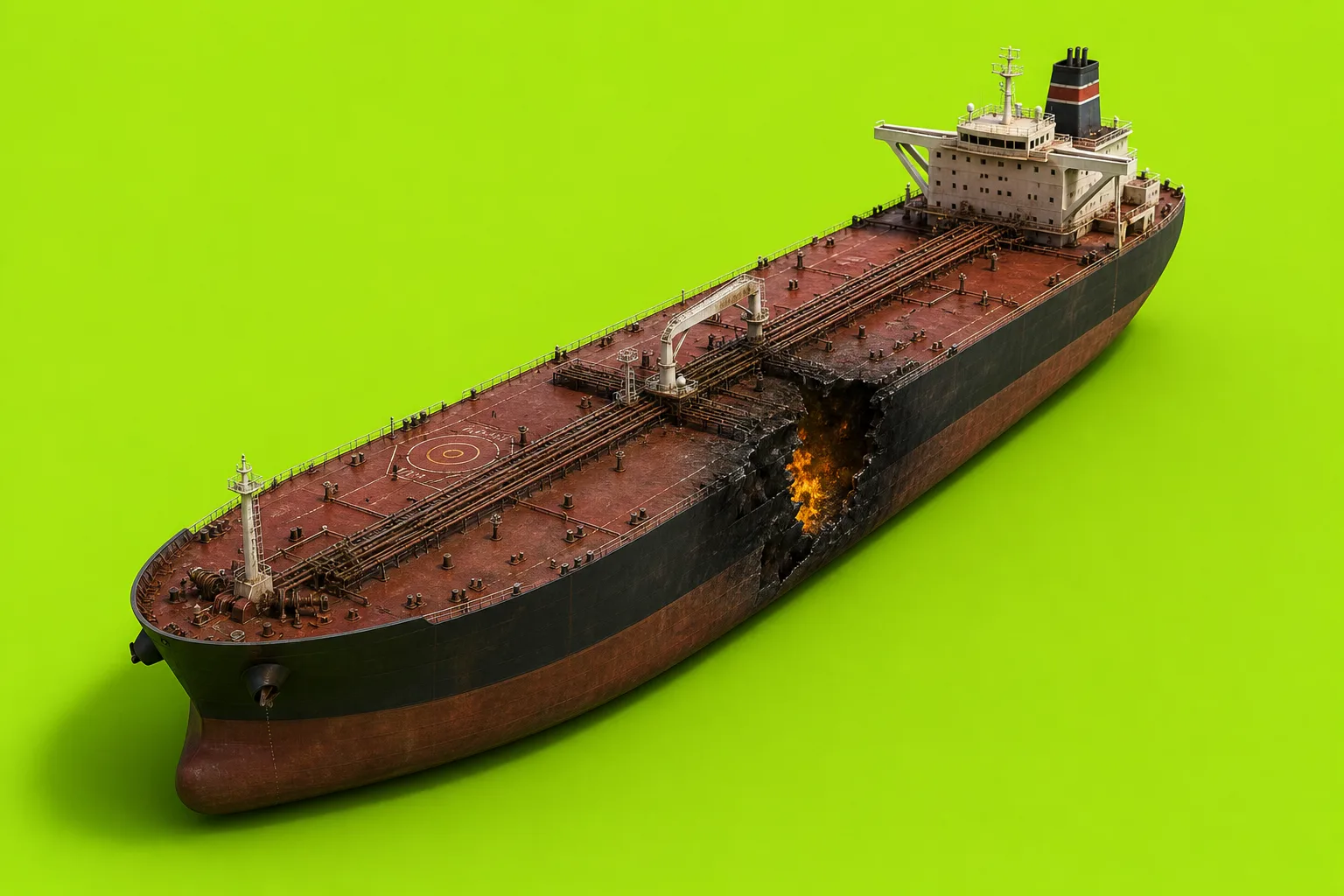
Strait of Hormuz tensions moved back to the center of global market risk after Iran’s Islamic Revolutionary Guard Corps claimed a supertanker caught fire when it was struck by two naval mines in the waterway. The allegation, tied to an attempted passage through the southern channel, immediately raised concerns over the safety of one of the world’s most important crude shipping routes.
The market relevance is straightforward: even a limited threat to tanker traffic in the Strait of Hormuz can ripple across oil, insurance, freight and equity markets. With regional tensions already elevated for roughly six months, the latest incident reinforces the risk that energy supply chains could face renewed disruption.
For investors, the issue is not only whether one vessel was damaged, but whether the episode marks a broader effort to signal control over passage through the strait. That possibility matters because Hormuz remains a narrow but essential corridor for global oil and refined product exports.
Key Facts
- The IRGC claimed a supertanker caught fire after being hit by two naval mines in the Strait of Hormuz.
- The vessel was described as attempting to pass through the strait through the southern passage “illegally.”
- The latest escalation comes after roughly six months of sustained tensions involving Iran and the United States.
- The Strait of Hormuz is a critical transit route for global crude flows, making even isolated incidents market-sensitive.
Strait of Hormuz tensions
The immediate significance of Strait of Hormuz tensions lies in the waterway’s outsized role in global energy logistics. A meaningful share of internationally traded crude and petroleum products moves through the strait, linking Gulf producers to customers in Asia, Europe and beyond. When security risks rise there, markets tend to react quickly because rerouting options are limited and shipping schedules can be disrupted with little warning.
The latest claim also fits a familiar geopolitical pattern: pressure is exerted not necessarily through a full closure of the waterway, but through enough uncertainty to raise costs and complicate transit. Even if shipping continues, insurers may demand higher war-risk premiums, shipowners may alter routes or delay departures, and refiners may move to secure alternative cargoes. Those second-order effects can matter almost as much as an outright supply interruption.
Who is affected extends far beyond the immediate parties. Oil producers in the Gulf depend on secure passage, tanker operators face operational and insurance decisions, and importing nations must prepare for possible price volatility. Equity investors also need to consider knock-on effects for airlines, chemicals groups, transport firms and energy-intensive manufacturers if crude and fuel prices push higher.
Any credible threat in the Strait of Hormuz can move markets because the waterway is less a regional flashpoint than a global pricing lever for energy, freight and risk sentiment.
Why this chokepoint matters so much
The Strait of Hormuz has long been one of the most strategically sensitive maritime corridors in the world. Its narrow shipping lanes leave little room for operational error, while the volume of crude passing through means that even small incidents can force a reassessment of supply security. Markets often price geopolitical events there not on confirmed physical losses alone, but on the probability of escalation.
That is why single-vessel incidents, mine reports or military warnings can have an outsized market effect. The mechanics are simple: traders reprice oil benchmarks, freight markets adjust expected voyage costs, and safe-haven assets can attract inflows if the event appears likely to broaden. In this sense, the strait functions as both a physical chokepoint and a psychological one for global investors.
Implications for Investors
For portfolios, the first watch-point is oil. If Strait of Hormuz tensions persist or worsen, crude benchmarks could build a larger geopolitical premium even without a formal supply outage. That tends to support upstream energy producers and, in some cases, oil services names, while creating margin pressure for fuel-sensitive industries such as airlines, shipping users and some consumer-facing sectors.
The second issue is cross-asset volatility. Heightened security risks in the Gulf can influence inflation expectations if energy costs rise, potentially affecting bond yields, central bank assumptions and broader equity valuations. Investors with exposure to emerging markets that are large net energy importers may want to monitor currency pressure and trade-balance sensitivity if oil prices stay elevated for an extended period.
Finally, investors should focus on confirmation and follow-through rather than headlines alone. The critical variables are whether commercial shipping continues normally, whether insurers raise premiums, whether naval escorts or security advisories expand, and whether any major producers signal loading or export delays. If the episode remains isolated, market reactions may fade. If incidents multiply, the repricing could broaden from oil into global risk assets.
The next phase will depend on whether tanker traffic through the Strait of Hormuz remains steady and whether regional rhetoric turns into repeated operational disruption. For now, investors should treat the event as a reminder that geopolitical chokepoints can rapidly reshape energy pricing and market sentiment.