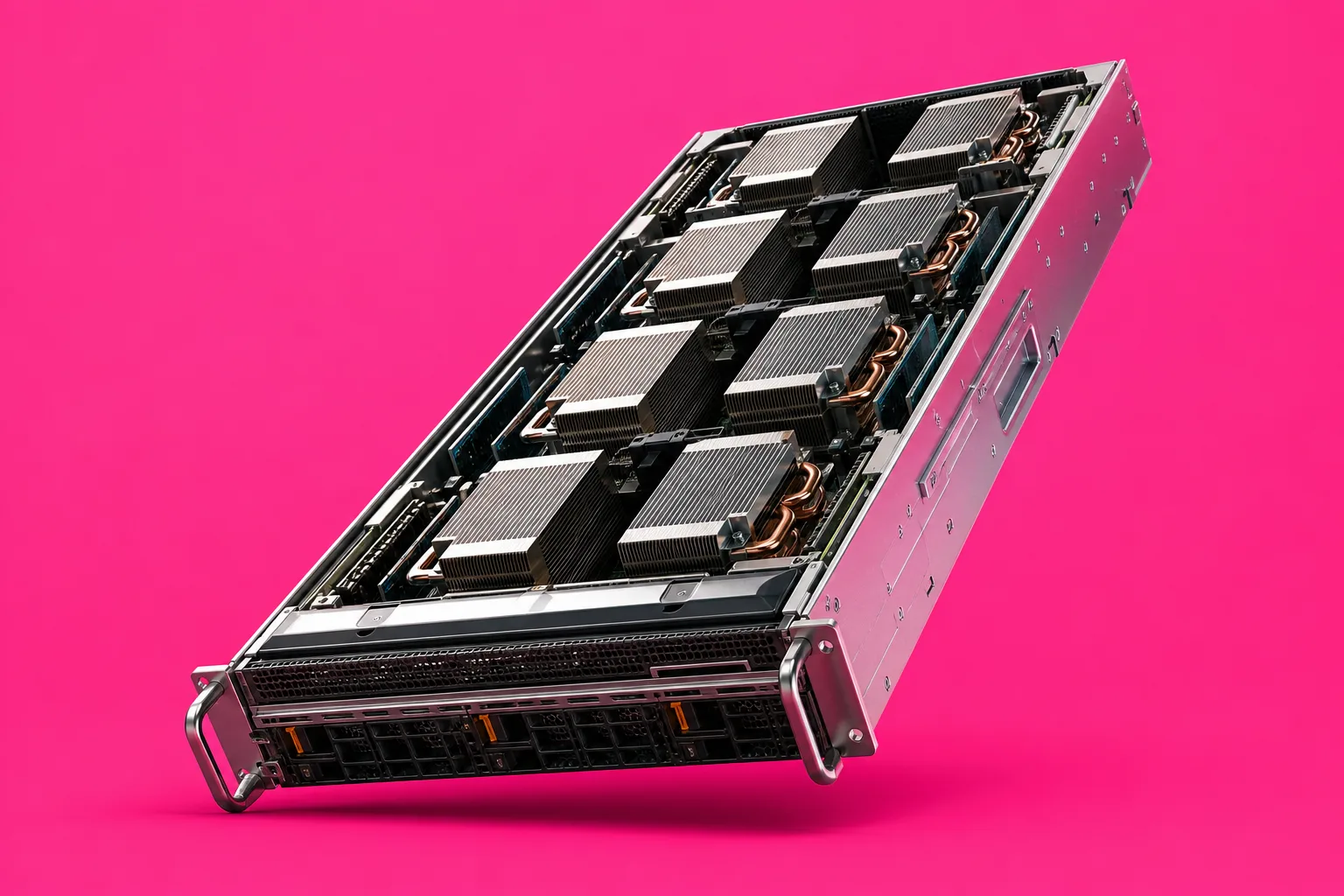
Super Micro Computer delivered one of the largest quarters in the AI hardware sector, reporting fiscal first-quarter revenue of $19.95 billion, up 298% from a year earlier. The scale of the beat was hard to ignore: revenue topped consensus by $3.64 billion, while non-GAAP diluted EPS of $1.81 came in far ahead of expectations.
Yet SMCI stock struggled to hold its gains. After rising in extended trading and climbing above $34 in premarket action, the shares reversed sharply during the regular session, reflecting investor concern about negative operating cash flow, lower sequential margins, and unusually high customer concentration.
That disconnect matters because Super Micro Computer is now guiding to as much as $82 billion in fiscal 2027 revenue, but the market is still valuing the company like a low-margin assembler rather than a premium AI platform.
Key Facts
- Super Micro Computer reported fiscal first-quarter revenue of $19.95 billion, up 298% year over year from $5.02 billion.
- Non-GAAP diluted EPS reached $1.81, above the $1.23 consensus estimate and well above the company’s prior guidance range.
- The company raised fiscal 2027 revenue guidance to $72 billion to $82 billion, up from $65 billion to $72 billion previously.
- Operating cash flow was negative $434 million in the quarter, despite GAAP net income of $1.594 billion.
- One customer represented 44% of first-quarter sales, highlighting a major concentration risk for SMCI.
Super Micro Computer
What happened is straightforward: Super Micro Computer produced exceptional growth, but the quality of that growth is under heavier scrutiny. The company said about $2.3 billion of first-quarter revenue came from deployments originally scheduled for earlier periods. Even adjusting for that catch-up effect, normalized revenue would still have been roughly $17.6 billion, comfortably above expectations.
The bigger issue is profitability and cash generation. Non-GAAP gross margin came in at 12.8%, above guidance and higher than a year ago, but materially below the prior quarter’s 17.6%. Management’s outlook points to second-quarter gross margin of 12% to 12.5%, with full-year fiscal 2027 gross margin expected at 11.8% to 12.2%. For investors, that suggests Super Micro is scaling quickly, but at thinner economics than many AI bulls would prefer.
The company is also highly exposed to the pace of AI data-center expansion. Management expects AI-related products to account for 70% to 80% of fiscal 2027 revenue. That gives SMCI direct leverage to continued AI infrastructure spending, but it also ties the stock closely to any slowdown in hyperscaler orders, data-center permitting, or spending discipline among large cloud and model-training customers.
Super Micro’s quarter proved that AI server demand is real, but the market is waiting for evidence that record revenue can turn into durable cash flow.
Why the Stock Reaction Turned Negative
Negative operating cash flow remains the clearest reason for the post-earnings volatility. Super Micro used $434 million of cash in operations during the quarter, and free cash flow was negative $481 million after capital spending and investments. The imbalance came largely from working capital, including a $3.6 billion increase in accounts receivable and inventory growth to $15.1 billion from $12.9 billion.
Customer prepayments provided some offset, with deferred revenue increasing by $3.1 billion. That suggests demand remains strong, but it does not fully eliminate concerns. When a company reports record earnings while still consuming cash and carrying large inventory balances financed in part by debt, investors tend to assign a lower valuation multiple until conversion improves.
Implications for Investors
For investors, SMCI presents a classic high-growth, high-risk valuation case. Based on the second-quarter non-GAAP EPS midpoint of $1.78, annualized earnings power would be about $7.12 per share. At around $29.98, that implies a multiple of roughly 4.2 times run-rate earnings, a level usually associated with earnings contraction rather than a business guiding to nearly double annual revenue.
The opportunity is obvious if execution holds. A modest re-rating to five or six times run-rate earnings would imply a materially higher share price, especially if Super Micro can deliver positive operating cash flow in the current quarter and stabilize margins near the low-12% range. The company’s raised revenue outlook, strong AI demand exposure, and still-low valuation relative to peers make it one of the more debated names in the sector.
The risks are equally clear. A single customer accounted for 44% of first-quarter sales, inventory reached $15.1 billion, and total debt stood at $8.6 billion against $6.9 billion in cash. Governance overhangs also remain in focus, including an ongoing board review and the fact that preliminary first-quarter figures released on October 20 were unaudited at that stage. Investors should watch three data points closely: operating cash flow, gross margin trends, and any change in customer concentration.
If Super Micro can convert AI demand into stronger cash generation, the stock’s valuation gap could narrow quickly. If not, SMCI may continue to trade like a volatile, low-margin infrastructure supplier despite its record scale.