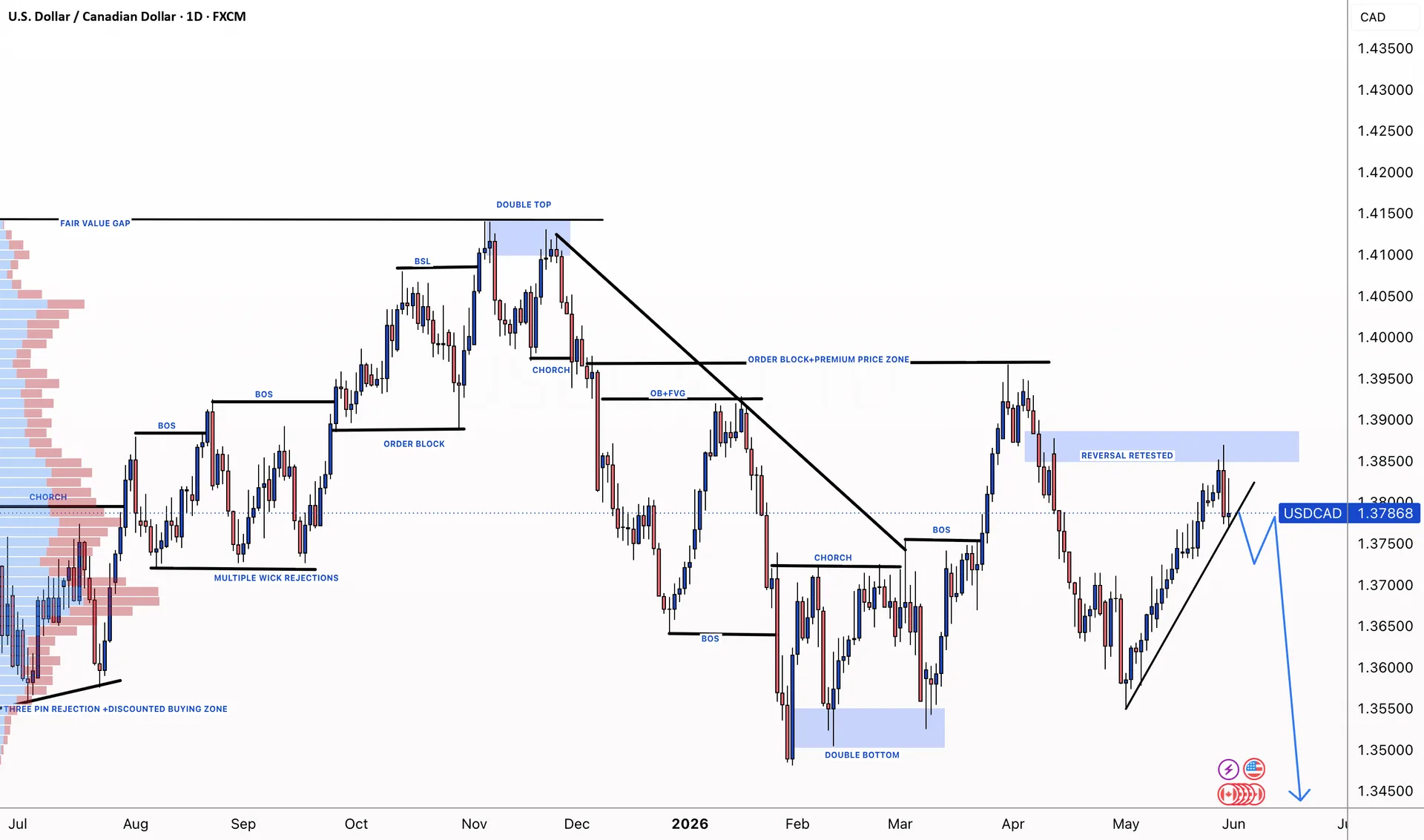
USDCAD is leaning bearish as the pair transitions from an earlier upside phase into a weaker technical structure. The central pattern in focus is a retest setup around a broken bearish trendline, which could define the next move.
For market participants tracking USDCAD, the key question is whether this retest confirms renewed selling pressure or turns into a failed breakdown. That reaction may set the tone for the pair over the near term.
Market Snapshot
USDCAD, a major forex pair, is being viewed through a technical lens that favors downside continuation. While the original setup does not specify a precise chart interval, the structure suggests a swing-oriented view in which price has shifted away from bullish momentum and into a more cautious, corrective phase.
In plain English, the market appears to be testing whether the prior upward move has run out of strength. The prevailing bias is bearish, with attention centered on a retest pattern that often emerges after a change in trend character. If sellers defend the retest zone, the pair could resume lower and reinforce the developing downtrend.
Key Levels
- Support: Recent reaction lows and the next lower demand area beneath the retest zone, which would act as the first downside objective if selling accelerates.
- Resistance: The broken trendline retest area and the most recent lower high, where sellers may attempt to reassert control.
These levels matter because retest zones often become decision points after a structural shift. If price stalls near former support-turned-resistance or around trendline confluence, that can strengthen the bearish case. A clean move through nearby support, on the other hand, would suggest that downside momentum is broadening.
Bullish Scenario
Although the broader bias is negative, a bullish alternative remains possible if USDCAD reclaims the retest area and holds above it. The initial trigger for that outcome would be a sustained push back over the trendline zone, especially if price begins printing higher lows rather than rolling over beneath resistance.
Under that scenario, the pair could work back toward the latest swing high or a nearby overhead supply zone. Such a move would not automatically erase the bearish structure, but it would weaken the immediate downside narrative and imply that the market needs more time before choosing a clearer direction.
Bearish Scenario
The bearish path remains the primary setup. The idea is that price falls from the retest area, confirms seller control, and then extends lower through nearby support. In this framework, the retest acts as the trigger zone: if rallies continue to fail there, the probability of another leg down increases.
Invalidation of the immediate bearish setup would come from a decisive move above the retest resistance and above the recent lower-high structure. If that invalidation does not occur, a realistic downside objective would be a revisit of prior lows followed by an extension into the next support zone below, where buyers may attempt to slow the decline.
What to Watch
Macro catalysts can be especially important for USDCAD because the pair is sensitive to both US dollar drivers and Canada-specific data. Traders will likely monitor major inflation releases, labor-market numbers, central bank commentary, and broader rate expectations that can shift relative currency strength.
Energy markets also deserve attention. Because the Canadian dollar often shows a relationship with crude oil, a strong move in oil prices can influence sentiment around USDCAD. Rising oil can support the Canadian dollar and align with downside pressure in the pair, while weaker oil may reduce that effect.
Session timing and dollar sentiment across correlated markets may provide additional clues. North American trading hours often bring the most relevant volatility for this pair, particularly when economic releases are scheduled. Watching how USDCAD reacts alongside the US Dollar Index and broader risk sentiment can help clarify whether the retest develops into a confirmed bearish continuation or a failed breakdown.
For now, USDCAD remains at a technically important inflection point. The way price behaves around the retest zone should offer a clearer read on whether the bearish bias remains intact in the sessions ahead.