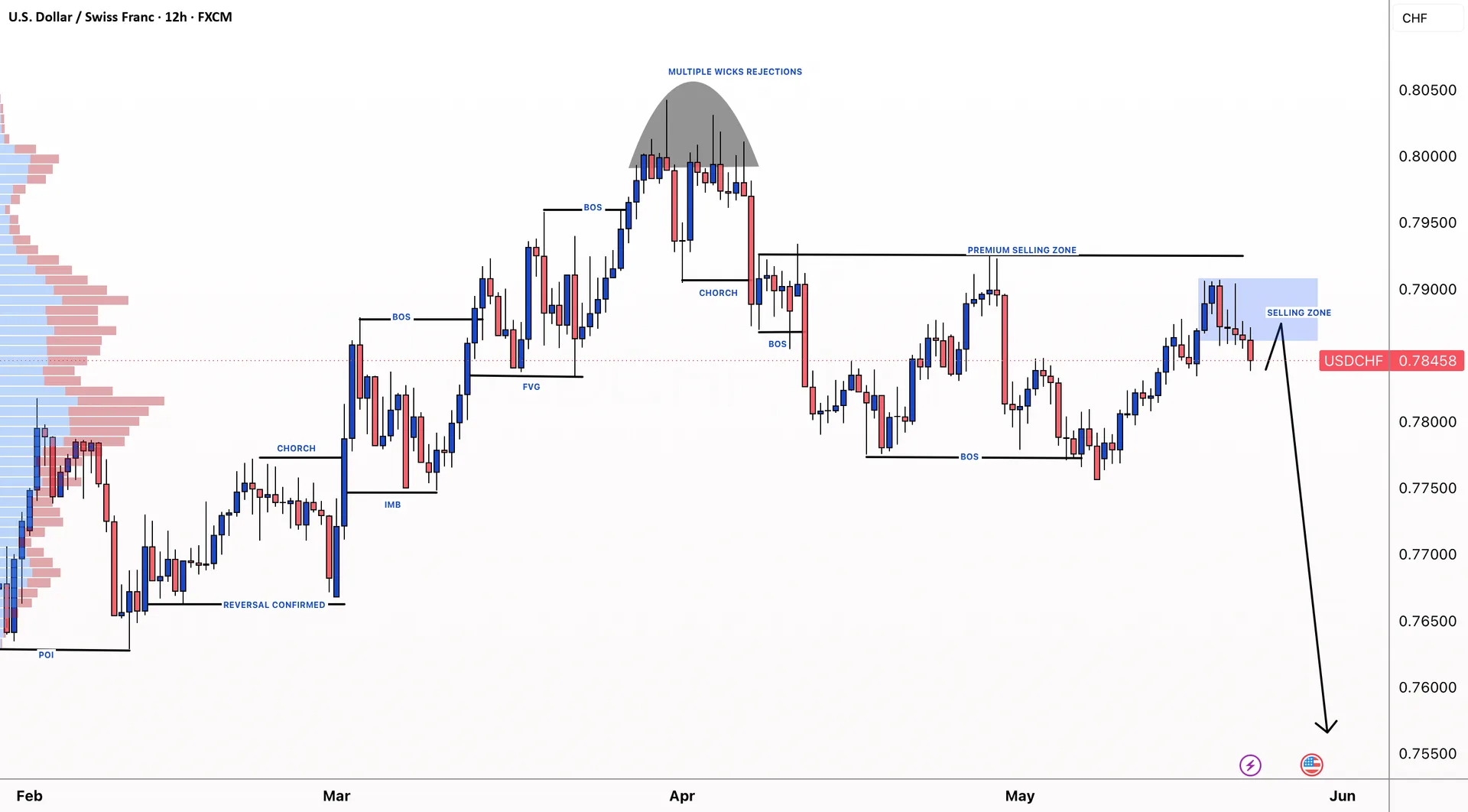
USDCHF is holding a bearish bias after a rejection at resistance, with 0.75 standing out as the most important downside level in the current setup. The pair continues to trade with a soft tone, and that support zone is now central to the near-term outlook.
For market participants tracking USDCHF, the key question is whether selling pressure can extend cleanly toward 0.75 or whether a firmer US dollar backdrop slows the move. The recent price structure suggests sellers still have the upper hand unless the pair can stabilize above the area that triggered the latest rejection.
Market Snapshot
USDCHF is a major forex pair, and the current technical picture points to a bearish structure on the intraday horizon. Price action has turned lower after failing to hold near resistance, creating a pattern consistent with a rejection rather than a breakout continuation.
In plain English, the market is struggling to build upward momentum. Instead, sellers appear to be defending higher levels, leaving the pair vulnerable to another leg lower. As long as that structure remains intact, the prevailing bias stays tilted to the downside with 0.75 acting as the primary reference point.
Key Levels
- Support: 0.75
- Resistance: —
The 0.75 level matters because it is the clearest downside objective highlighted by the current structure. When a pair rejects higher prices and begins to rotate lower, traders often focus on the nearest major support as the next test of conviction. If momentum builds into that zone, it could become a major decision area for the next directional move.
Bullish Scenario
The bullish alternative depends on USDCHF avoiding a sustained breakdown and reclaiming short-term control after the recent rejection. A recovery would likely require the pair to hold above the latest swing lows and push back through the area where sellers stepped in, signaling that bearish momentum is fading rather than accelerating.
If that stabilization occurs, the pair could shift into a corrective rebound rather than a continuation selloff. In that case, the realistic upside path would be a move back toward the recent rejection zone, where resistance is likely to be retested. A stronger US dollar environment, especially if the US Dollar Index remains firm, would support this recovery scenario and reduce immediate pressure on 0.75.
Bearish Scenario
The bearish case remains the base scenario as long as USDCHF stays capped beneath the recent rejection area. Failure to reclaim that lost ground would keep the market in a weak technical posture and preserve the expectation of another move lower. In this structure, the inability to recover is effectively the confirmation that sellers remain in control.
The main downside target is the 0.75 support zone. A steady slide toward that level would fit the current pattern, while a decisive move below it would suggest a deeper extension in bearish momentum. For this scenario, invalidation would come from a meaningful recovery back above the area of resistance rejection, as that would undermine the immediate bearish structure and open the door to a broader rebound.
What to Watch
The US dollar backdrop remains an important catalyst for USDCHF. If broad dollar sentiment strengthens, especially through moves in the US Dollar Index, the pair may find support and delay a drop toward 0.75. If the dollar weakens more broadly, the bearish setup in USDCHF would likely gain traction and make that support test more probable.
Macro releases also matter because USDCHF often reacts to shifts in rate expectations and safe-haven demand. US inflation data, labor market releases, central bank commentary, and Swiss franc risk sentiment can all affect short-term momentum. Markets tend to become more directional around those events, which can either validate the prevailing bearish bias or trigger a fast squeeze against it.
Session timing is another factor worth monitoring. Liquidity and volatility often increase during the London and US trading windows, and that is typically when rejection patterns either confirm into trend continuation or fail through a reversal. Watching how USDCHF behaves during those higher-volume periods can offer a clearer read on whether sellers are still pressing the market toward 0.75.
USDCHF remains technically vulnerable while price stays below the recent rejection area, with 0.75 still the level to watch on the downside. The next phase will depend on whether bearish momentum follows through or broader dollar strength begins to stabilize the pair.