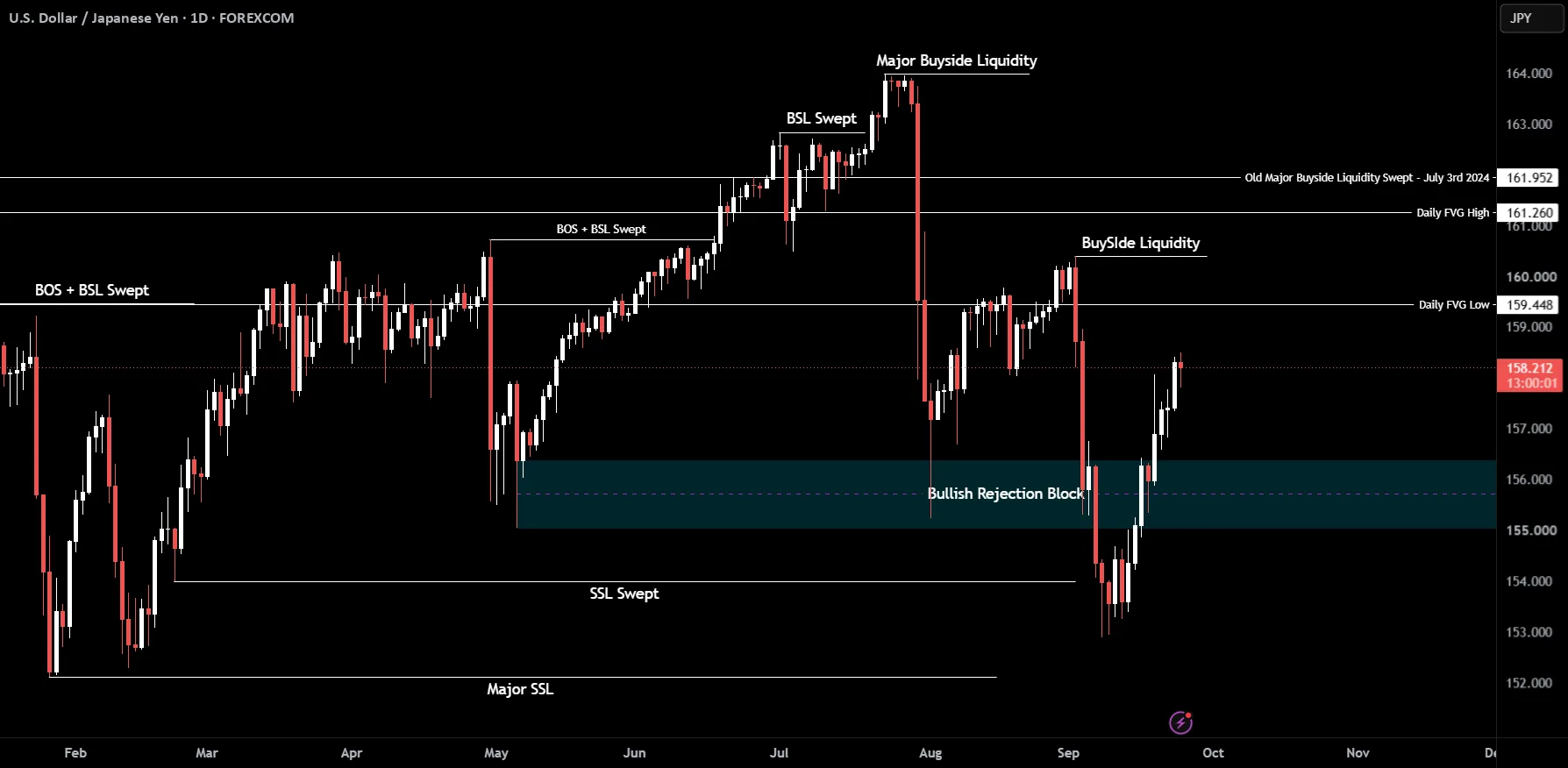
USDJPY is holding a bullish bias, with price action centered on a liquidity-sweep structure and the key 159.44 resistance area. That level stands out as the main technical trigger, as a confirmed move through it would strengthen the case for a continuation higher.
The setup is notable because momentum has started to build around recent highs, while nearby support remains close enough to define the market structure clearly. As long as buyers keep pressure on resistance, the pair stays in focus for a possible extension toward the next upside objective.
Market Snapshot
USDJPY is a major forex pair, and the current technical view is based on a higher-timeframe structure that highlights a bullish market bias. Price is trading within an area shaped by a recent liquidity sweep, suggesting that the market may have cleared weaker positioning before attempting another move higher.
In plain English, the pair is pressing against an important ceiling while still respecting nearby support. That leaves the broader structure constructive, with bulls watching for a clean break above resistance to confirm continuation.
Key Levels
- Support: 153.99, 159.35
- Resistance: 159.44, 160.39
These levels matter because they define the immediate battleground between continuation and rejection. The 159.35-159.44 area is especially important due to its proximity to the daily fair value gap and recent reaction points, while 160.39 marks the next realistic upside reference if momentum expands.
Bullish Scenario
The bullish path remains straightforward: USDJPY would need to retest and then break decisively above 159.44. If that breakout is supported by firm price acceptance above the level rather than a brief spike, it would suggest that buyers are regaining control after the liquidity sweep and are ready to challenge higher resistance.
In that scenario, the next target zone comes in around 160.39. A move into that region would fit the current structure, especially if the pair continues to print higher lows and attract momentum during active trading sessions. The bullish view stays strongest while price remains stable above 159.35 and continues to pressure the upper boundary.
Bearish Scenario
The bearish case is less developed in the source setup, but the main risk to the bullish outlook would be a failure to hold above 159.35 after repeated tests of 159.44. If USDJPY cannot sustain upward pressure and slips back below nearby support, that would indicate the breakout attempt lacks follow-through and that the market may need more time to consolidate.
For the bullish structure, a deeper move toward 153.99 would represent a broader invalidation zone and a clear sign that the current upside thesis has weakened materially. Short of that, any retreat that remains above major support may still be interpreted as a pause rather than a full reversal, but a rejection from resistance would put the pair under closer scrutiny.
What to Watch
Macro catalysts remain important for USDJPY because the pair is highly sensitive to interest-rate expectations, central-bank communication, and shifts in global bond yields. U.S. data releases tied to inflation, labor conditions, or Federal Reserve policy can quickly influence the dollar side of the equation, while any change in tone around Japanese monetary policy can affect yen demand just as sharply.
Session timing also matters. USDJPY often sees notable movement during the Tokyo, London, and New York overlaps, especially when price is sitting directly under a major resistance level like 159.44. A breakout during high-liquidity hours generally carries more technical weight than a move that occurs in thinner trading conditions.
Traders may also want to monitor correlated assets and broader sentiment. U.S. Treasury yields, the dollar index, and risk appetite across equity markets can all shape the pair’s direction. If yields remain firm and the dollar stays supported, that backdrop would align more closely with the bullish technical picture now forming on the chart.
For now, USDJPY remains centered on whether resistance at 159.44 can give way on sustained momentum. The next phase will likely depend on how price behaves around that trigger level and whether buyers can maintain control into the 160.39 area.