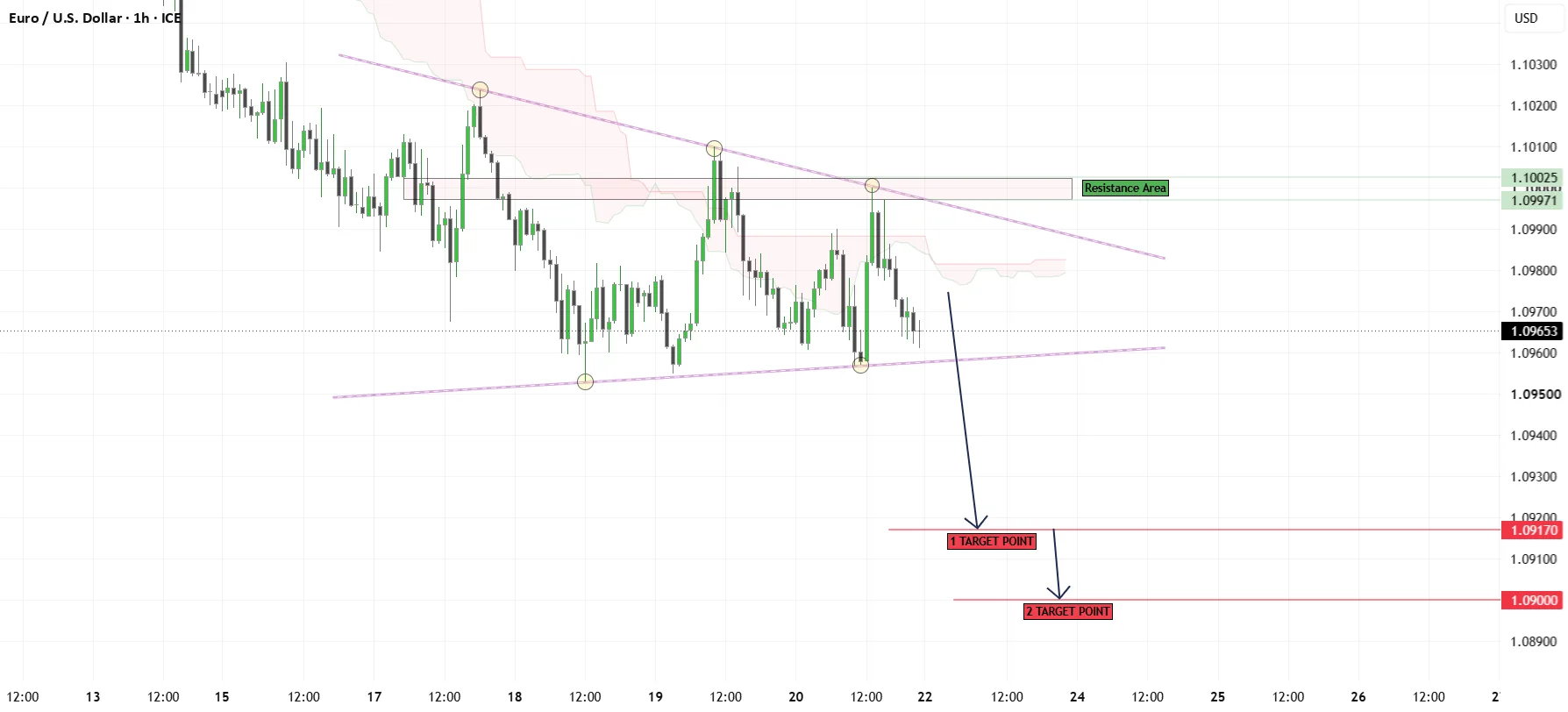
EURUSD retains a bearish near-term bias as price action compresses around a lower support structure, keeping breakout risk firmly in focus. The most important technical feature is the descending trendline, which continues to cap recovery attempts.
As long as EURUSD trades beneath that falling resistance, the broader setup favors downside continuation over a sustained rebound. The next directional move may depend on whether sellers can force a clean break below support or whether buyers can reclaim control with a trendline breakout.
Market Snapshot
EURUSD is a major forex pair currently tracking a bearish technical structure on the chart, with price confined within a weakening formation after earlier downside pressure. The setup points to a breakout environment, where compression near support often precedes an expansion in volatility.
In plain terms, the market remains tilted to the downside unless the pair can recover higher ground and push above descending resistance. Until that happens, rallies may be viewed as corrective rather than a confirmed change in trend.
Key Levels
- Support: The lower support structure currently containing price, which serves as the main trigger zone for any bearish continuation breakout.
- Resistance: The descending trendline and nearby higher recovery area, which must be reclaimed to weaken the current bearish bias.
These levels matter because they define the market’s short-term decision points. Support marks the area where buyers have so far prevented a deeper slide, while the descending trendline reflects repeated seller control and trend confluence.
Bullish Scenario
A bullish development would require EURUSD to stabilize above the current support base and then reclaim higher levels with enough momentum to break above the descending trendline. That sequence would suggest that recent selling pressure is fading and that the pair may be shifting from a continuation pattern into a recovery phase.
If that trigger is confirmed, the upside path would open toward the next nearby reaction zone above trendline resistance, where prior selling interest could re-emerge. Even in that case, the rebound would need follow-through to challenge the broader bearish structure in a meaningful way.
Bearish Scenario
The bearish case remains the primary technical view while EURUSD trades below falling resistance. A downside breakout through the lower support structure would likely confirm continuation, signaling that sellers have regained control after a period of consolidation.
In that scenario, the invalidation point for immediate bearish momentum would be a recovery back above the broken support area and, more importantly, above the descending trendline. If price fails to reclaim those levels after a breakdown, the pair could extend toward the next lower demand zone as selling pressure accelerates.
What to Watch
Traders will want to monitor macroeconomic catalysts that typically move major currency pairs, especially eurozone and U.S. data tied to inflation, growth, labor-market conditions, and central bank expectations. Shifts in rate outlooks often act as the main driver behind EURUSD breakouts and failed breakdowns.
Session timing also matters. Volatility in EURUSD often increases during the London session and into the London-New York overlap, when liquidity is deepest and technical levels are more likely to be tested decisively. A breakout outside active market hours may require additional confirmation.
Beyond the pair itself, correlated moves in the U.S. dollar index, European bond yields, and broader risk sentiment could help confirm direction. If the dollar strengthens while risk appetite weakens, the bearish EURUSD structure may gain traction. If dollar momentum softens, buyers may get another chance to test descending resistance.
For now, EURUSD remains at an important technical junction, with support and trendline resistance defining the next move. Whether the pair breaks lower or stages a recovery, price behavior around those boundaries should offer the clearest signal on near-term direction.