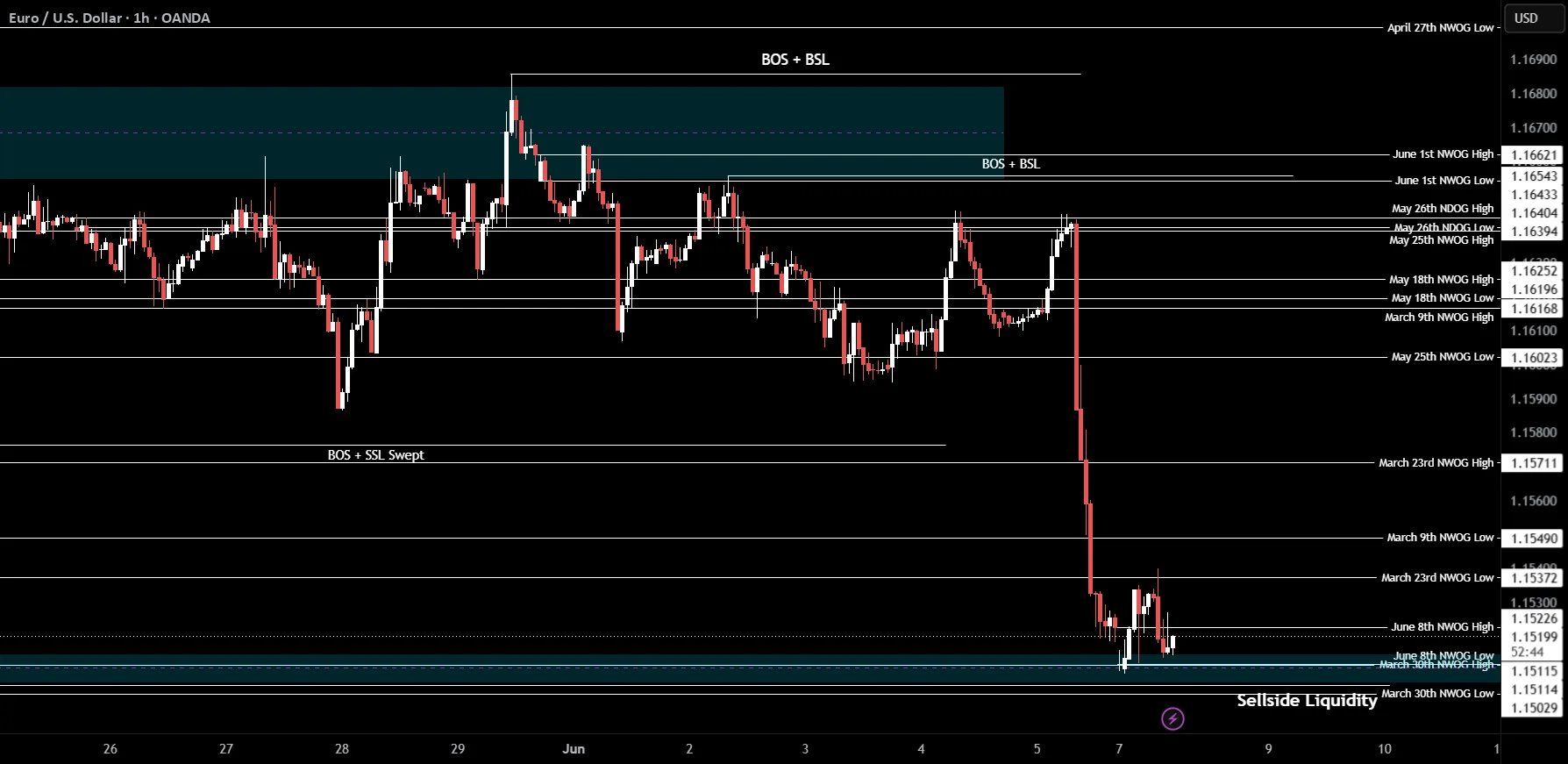
EURUSD is trading with a bearish bias, and the clearest technical feature is a retest structure developing between resistance at 1.1642 and support at 1.1508. That setup keeps downside risk in focus unless buyers can reclaim higher ground.
For now, the pair appears to be balancing between a fragile recovery attempt and broader selling pressure. The most important level remains 1.1508, as a confirmed break below that support would strengthen the case for another leg lower.
Market Snapshot
EURUSD is a major forex pair, and the current setup points to a market that is testing prior reaction zones rather than establishing a clean reversal. On the available technical view, price is moving within a retest pattern, where rebounds into former supply can attract renewed selling interest.
In plain English, the prevailing bias remains bearish. While short-term upside movement is still possible from a demand zone, the broader structure suggests that rallies may be corrective unless the pair can push through resistance and hold above it with follow-through.
Key Levels
- Support: 1.1508
- Resistance: 1.1642
These levels matter because they define the current technical battlefield. Support at 1.1508 marks the area where buyers may attempt to stabilize price, while 1.1642 represents the zone sellers would likely want to defend to preserve the bearish structure. A sustained move beyond either boundary could shape the next directional phase.
Bullish Scenario
A bullish scenario would begin with EURUSD holding above the 1.1508 support area and building a stronger rebound from demand. In that case, the first constructive signal would be a push back toward 1.1642, where the market would need to prove that buying pressure is more than just a temporary bounce.
If bulls manage to break and sustain trade above 1.1642, the pair could extend into a modest recovery zone above recent congestion. Even then, the upside path would still need confirmation through stronger momentum, because the broader structure currently favors the view that rebounds are retests rather than a decisive trend change.
Bearish Scenario
The bearish path remains the base case as long as EURUSD fails to establish acceptance above 1.1642. Rejection from that resistance zone, especially after a short-lived recovery, would reinforce the idea that sellers are using strength to re-enter in line with the prevailing trend.
The key downside trigger is a break below 1.1508. If that level gives way, the retest structure would look increasingly complete, opening the door to a move into a lower target zone beneath recent price action. In this setup, a sustained move above 1.1642 would weaken the bearish case and act as the practical invalidation level for near-term downside expectations.
What to Watch
Macro catalysts remain especially important for EURUSD because the pair is highly sensitive to shifts in interest-rate expectations and relative growth outlooks between the euro area and the United States. Traders will likely focus on inflation readings, central bank commentary, labor-market data, and any surprise changes in rate-path expectations that can alter demand for the euro or the US dollar.
Session timing also matters. EURUSD often sees its most active price discovery during the overlap between the European and US trading sessions, when liquidity deepens and reactions to economic releases become clearer. A failed bounce during that window can carry more technical significance than a similar move in quieter conditions.
Correlated assets and broader sentiment should also stay on the radar. Moves in the US Dollar Index, sovereign bond yields, and general risk appetite can influence whether EURUSD follows through on its bearish bias or stabilizes into a broader consolidation. If dollar strength accelerates alongside rising yields, pressure on the pair could intensify; if those themes soften, the short-term recovery case may gain traction.
EURUSD remains at an important technical juncture between 1.1508 support and 1.1642 resistance. Price behavior around those levels should offer a clearer read on whether the pair extends its bearish structure or transitions into a deeper corrective rebound.