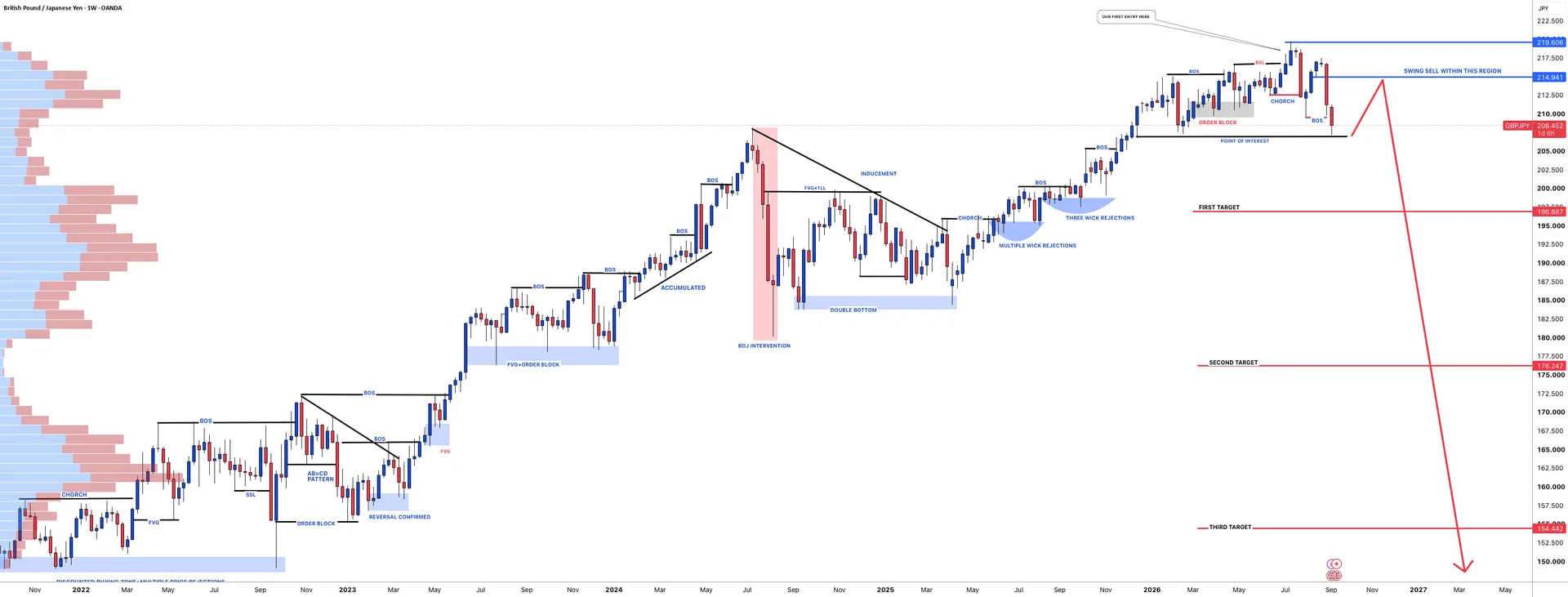
GBPJPY is holding a bearish bias as price action continues to reflect a weaker structure after a liquidity sweep and subsequent downside shift. The 214.941 level is the main reference point, as any retest there could shape the next directional move.
For traders tracking medium-term forex trends, this setup is notable because it combines a failed push higher with bearish structure signals. If sellers defend the retest zone, GBPJPY could remain under pressure toward lower support areas.
Market Snapshot
On the weekly timeframe, GBPJPY is showing a bearish technical structure following a liquidity sweep that was followed by a change of character and a break of structure to the downside. In plain English, that means the pair attempted to run higher, failed to hold those gains, and then began forming a weaker trend profile.
The prevailing bias remains bearish while price stays capped below key resistance. GBPJPY is now at a stage where market participants may focus on whether rallies into overhead supply attract fresh selling interest or whether the pair can reclaim higher levels and neutralize the downside setup.
Key Levels
- Support: No major support level was specified in the current setup, so traders may instead monitor prior swing lows and reaction zones beneath the current range.
- Resistance: 214.941, 219.606
These resistance levels matter because they align with the recent bearish structure narrative. The 214.941 area is especially important as a potential retest zone after the break lower, while 219.606 marks a higher barrier that could invalidate the immediate bearish sequence if price climbs back above it with strength.
Bullish Scenario
Although the dominant bias is bearish, a bullish alternative remains possible if GBPJPY reclaims 214.941 and starts holding above that level on a sustained basis. Such a move would suggest that sellers are losing control of the retest area and that the pair may be transitioning from a corrective bounce into a broader recovery.
In that case, the next realistic upside target zone would be the 219.606 resistance area. A push into that region would test whether the rebound is merely a short-covering rally or the beginning of a more meaningful reversal in weekly structure.
Bearish Scenario
The bearish case remains centered on a retest of 214.941 that fails to break higher. If GBPJPY rallies into that zone and encounters renewed selling pressure, it would reinforce the idea that the recent change of character and break of structure are still in effect.
For the bearish outlook, 214.941 acts as the practical invalidation line for immediate downside continuation. As long as price is rejected from that area and remains below 219.606, the pair may continue rotating lower toward unlisted prior swing lows and deeper demand zones on the weekly chart.
What to Watch
Macro catalysts will remain important for GBPJPY because the pair is sensitive to both UK and Japanese policy expectations. Traders may want to track central bank communication, inflation data, labor market releases, and bond yield movements, as these factors often influence rate-sensitive currency pairs.
Session timing can also matter. GBPJPY often sees stronger activity during the overlap between European and early global macro flows, while volatility can also build around major Japanese and UK economic releases. A retest of resistance during a high-liquidity session may carry more technical significance than a move occurring during thinner market conditions.
Correlated assets and broader sentiment should also stay on the radar. Yen pairs can respond to shifts in global risk appetite, equity market tone, and sovereign yield spreads. If risk sentiment deteriorates and the yen strengthens broadly, that backdrop could support the bearish GBPJPY case. On the other hand, a rebound in risk assets combined with sterling resilience could challenge the downside bias.
For now, GBPJPY remains a structure-driven chart with 214.941 as the pivotal level. The next reaction around that zone should offer a clearer signal on whether the bearish trend extends or begins to stabilize.