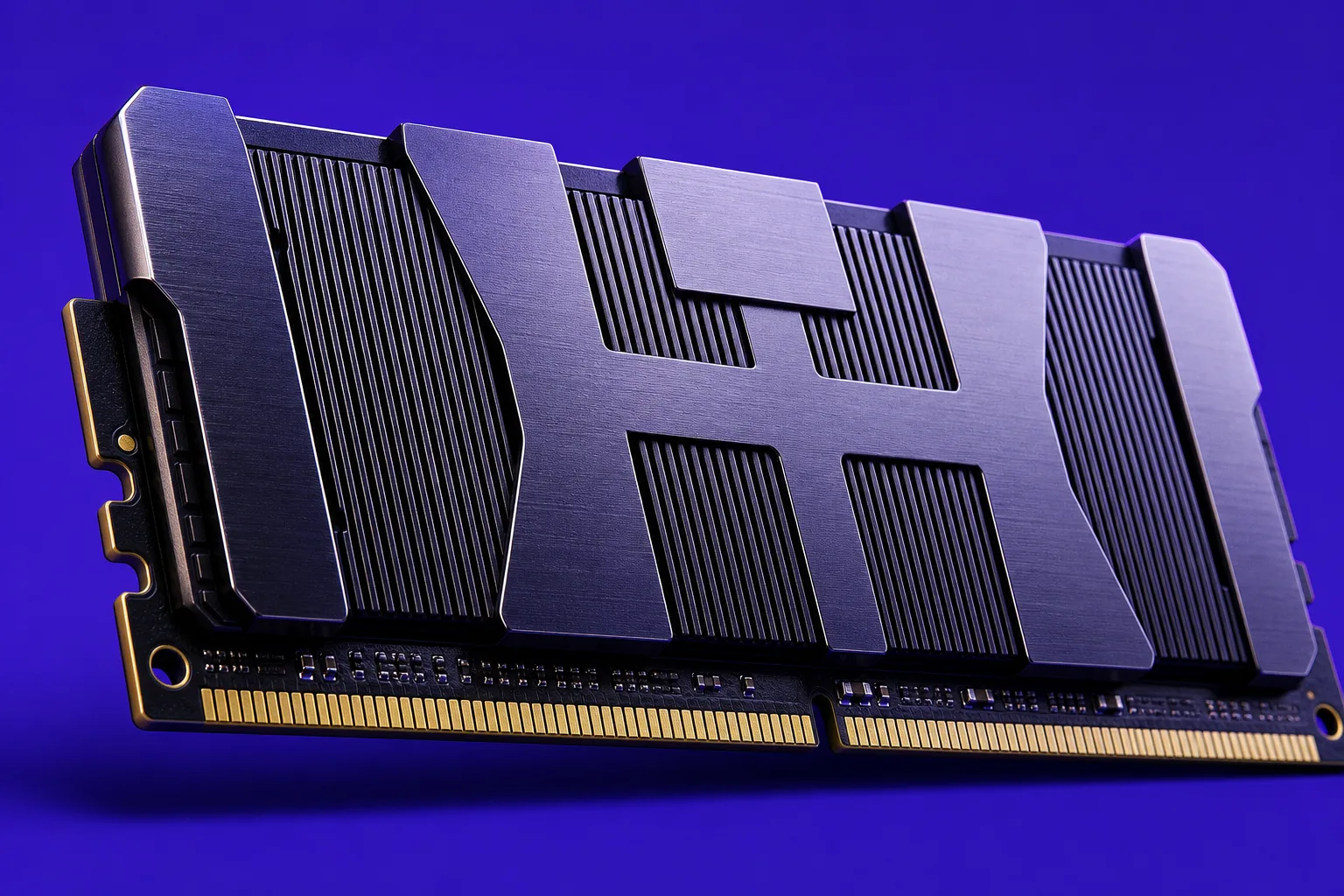
Micron delivered one of the strongest semiconductor earnings reports of 2026, posting fiscal third-quarter revenue of $41.5 billion and adjusted earnings of $25.11 a share. The results reinforced the company’s transformation into a key supplier of AI memory, particularly High-Bandwidth Memory, or HBM.
Yet the market’s response was far from straightforward. After rallying as much as 15% to 17% following the report and touching about $1,213, Micron shares retreated toward $1,132 as the broader memory and chip sector sold off.
The sharp reversal has turned Micron into a test case for the HBM supercycle: whether AI-driven demand and contracted supply can support unusually high margins for longer than past memory booms.
Key Facts
- Micron reported fiscal Q3 revenue of $41.5 billion, up 346% from the prior-year quarter.
- Adjusted earnings reached $25.11 per share, well above the $20.78 market expectation cited in the raw data.
- Net income climbed to $28.2 billion, while profit margin expanded to 68% from 20% a year earlier.
- The company guided for roughly $50 billion in fiscal Q4 revenue and gross margins near 81%.
- Micron shares surged to about $1,213 after earnings before falling back near $1,132, with the $1,050 area emerging as a key support zone.
Micron HBM Supercycle
Micron’s latest quarter matters because it strengthens the argument that the company is no longer trading like a traditional commodity-memory producer. For years, memory stocks were judged mainly on pricing cycles in DRAM and NAND, where oversupply could quickly erode margins. The current AI buildout has changed that equation by making HBM one of the most valuable components in data-center infrastructure.
HBM is essential for advanced AI systems because the most powerful accelerators require very fast, energy-efficient memory close to the processor. That has pushed demand sharply higher and tightened supply across the market. Micron, as one of the few global producers capable of supplying advanced memory at scale, has benefited from both higher volumes and stronger pricing. The result is a business showing margin levels that would have been hard to imagine in prior memory cycles.
The stock’s pullback after earnings does not negate the strength of the quarter. Instead, it highlights investor unease over durability. Bulls see a structurally improved company with sold-out HBM capacity, long-term customer commitments, and expanding participation in AI infrastructure. Bears focus on the memory industry’s history: periods of exceptional profitability often attract aggressive capital spending, which can eventually lead to oversupply and lower returns.
Micron’s record quarter proved the AI memory boom is real, but the market is still deciding how long supercycle economics can last.
Why the stock sold off after a blowout quarter
The share-price reversal was driven less by Micron’s own numbers than by the sector backdrop. Memory and storage stocks declined together as investors reduced exposure across the semiconductor complex, with the main chip benchmarks nearing correction territory after a weak week. In that environment, even companies posting record results were vulnerable to profit-taking.
There is also a valuation and cycle debate embedded in the move. On current earnings estimates, Micron can look inexpensive relative to its growth profile. But memory companies have often appeared cheap near peak earnings, only to see profits normalize later. That tension helps explain why investors rewarded the earnings beat initially, then quickly shifted focus to capex, supply additions, and how much of the current margin profile is sustainable through 2027 and beyond.
Implications for Investors
For investors, Micron now sits at the center of one of the market’s most important semiconductor questions: whether AI infrastructure spending can extend memory profitability far beyond a normal cycle. The company’s guidance suggests momentum remains powerful. A move from $41.5 billion in fiscal Q3 revenue to roughly $50 billion in fiscal Q4 points to continued demand strength, while gross margin guidance near 81% signals pricing power is still intact.
The opportunity is clear. If HBM demand remains constrained and customer contracts continue to support pricing, Micron could justify further earnings upgrades and maintain its premium positioning within the AI supply chain. The company’s role in advanced memory for next-generation computing platforms gives it exposure to data-center spending that many older semiconductor names do not have.
The risks are just as important. Micron raised fiscal 2026 investment plans to more than $25 billion, and the broader industry is also expanding capacity. If those additions arrive into a cooler demand environment after 2027, investors could begin discounting lower future margins well before the income statement weakens. In the near term, traders are also watching technical levels closely: the post-earnings high near $1,213 marks resistance, while the $1,000 to $1,050 range appears to be a critical support base.
Micron’s next phase will depend on whether AI memory demand continues to outpace new supply. If that imbalance holds, the company may keep redefining what investors expect from a memory manufacturer; if not, the stock could once again trade on the industry’s old cyclical playbook.