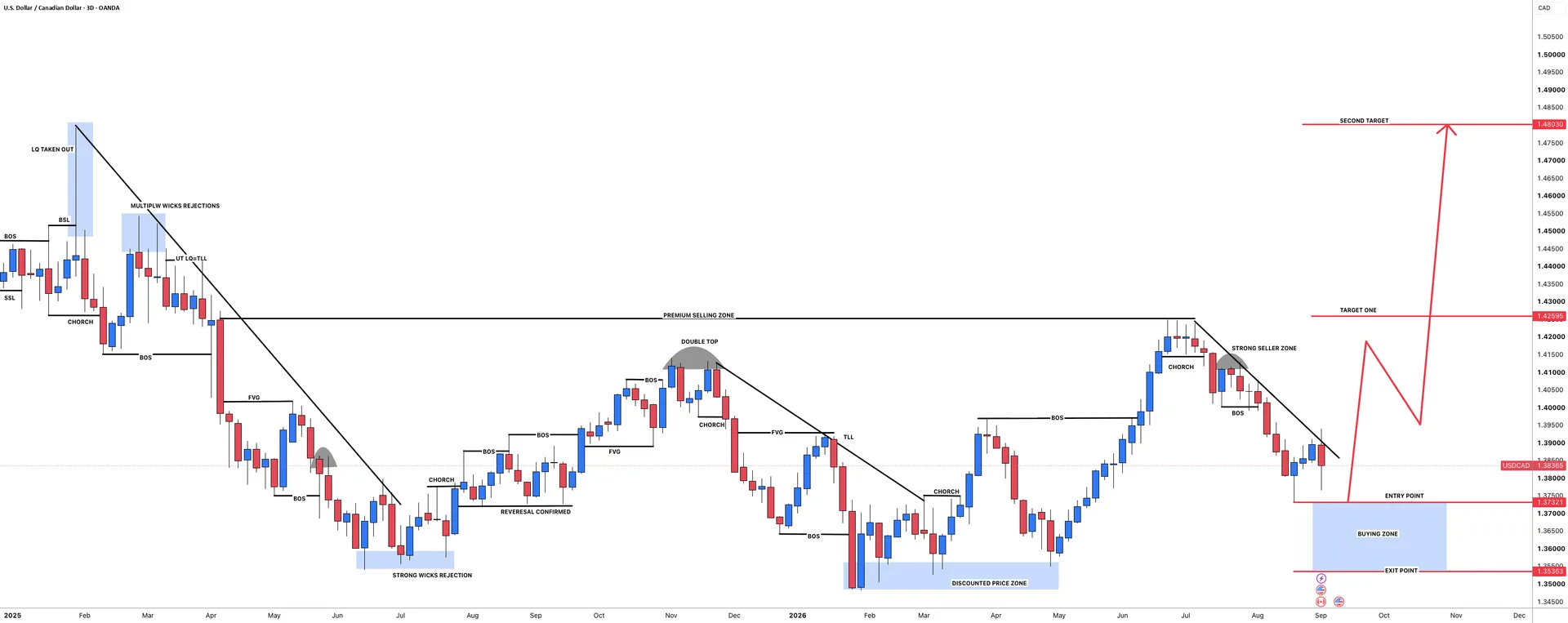
USDCAD is holding a bullish bias, with the market focused on the 1.35363-1.37321 demand zone as the most important technical area on the chart. The current pullback appears corrective rather than structural, keeping attention on the possibility of another leg higher.
For traders tracking trend continuation setups, this support band is the key reference point. If buyers defend it, USDCAD could attempt to rebuild upside momentum toward the next major resistance near 1.42595.
Market Snapshot
USDCAD is a forex pair being assessed through the lens of a corrective retracement within a broader bullish structure. The underlying view remains constructive as long as price action continues to respect higher-value support and avoids a deeper breakdown below the lower edge of the demand zone.
In plain English, the pair has paused after advancing and is now testing whether buyers are still willing to step in on weakness. That makes the current phase especially important: a stable reaction from support would reinforce the prevailing bullish bias, while a sustained failure there would weaken the outlook.
Key Levels
- Support: 1.37321, 1.35363
- Resistance: 1.42595
These levels matter because they define the active battlefield between dip buyers and sellers. The 1.37321-1.35363 region stands out as a demand zone where a prior retracement could find support, while 1.42595 marks the main upside barrier and the clearest reference for any continuation move.
Bullish Scenario
The bullish case depends on USDCAD stabilizing inside or just above the 1.35363-1.37321 support area and producing a convincing bounce. If that reaction develops, it would suggest the current decline is only a corrective retracement within a larger uptrend rather than the start of a broader reversal.
In that scenario, the first trigger would be clear evidence that buyers are reclaiming short-term control after defending support. From there, the pair could work back into prior swing territory and eventually target the 1.42595 resistance zone. A move toward that level would be a realistic objective if momentum strengthens and the recovery is backed by firm trend structure.
Bearish Scenario
The bearish risk emerges if price fails to hold the demand zone and starts closing decisively below 1.35363. That would invalidate the current bullish continuation idea and indicate that the retracement is becoming deeper and more structurally important than initially expected.
If support breaks, the market could shift into a broader corrective phase, with downside pressure likely extending below the recent base area before buyers attempt to re-enter. In that case, 1.35363 becomes the key invalidation level for the bullish thesis, and any recovery attempts would need to reclaim that area before the upside case could regain credibility.
What to Watch
The next catalyst for USDCAD may come from macroeconomic releases affecting the US dollar or the Canadian dollar, especially inflation data, labor-market prints, and central-bank communication. Interest-rate expectations remain a major driver for the pair, so any shift in the policy outlook could amplify the reaction around the noted support band.
Session timing also matters. Liquidity and volatility tend to build during the North American trading window, when both USD and CAD flows are most active. If price reaches the support zone during a high-volume session, the resulting reaction may offer a clearer read on whether institutional buyers are defending the area.
Traders should also monitor correlated markets, particularly crude oil, which can influence the Canadian dollar, as well as broad US dollar sentiment across major FX pairs. If the dollar remains broadly firm while oil softens, that combination could support the bullish USDCAD narrative. By contrast, stronger risk sentiment and a rebound in CAD-linked assets could make upside follow-through more difficult.
For now, USDCAD remains in a technically constructive position while the demand zone holds. The next move will likely depend on whether the pair can convert this corrective retracement into a fresh push toward resistance.